It’s Not Your Child!

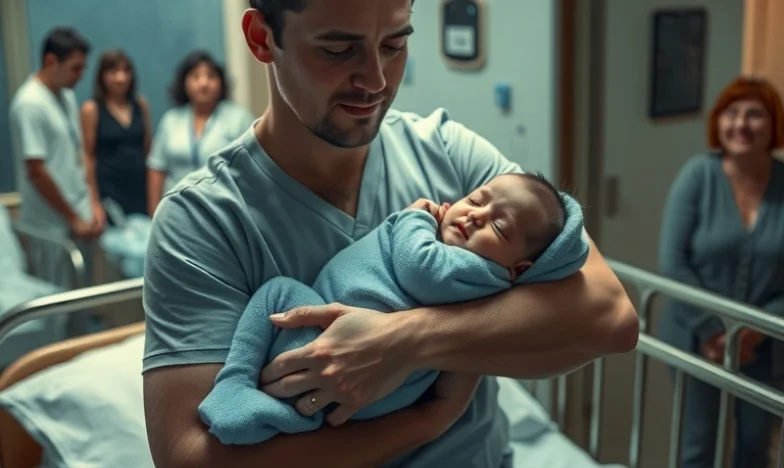
“That’s not your child, Tom! That’s not your child!” Mum’s voice sliced through the hospital corridor, sharp as a winter wind off the Thames. I stood there, clutching the tiny blue blanket, my son—my son—sleeping soundly in my arms, oblivious to the chaos erupting around him. Emily, pale and exhausted, looked at me with pleading eyes, her lips trembling as she tried to muster a smile for the crowd of relatives and friends who’d gathered to welcome our little miracle. The midwife, caught between duty and discomfort, hovered by the door, her congratulations dying on her lips.
I’d waited years for this moment. After three miscarriages and endless rounds of IVF, Emily and I had almost given up hope. But here he was—Samuel Thomas Bennett, born at 3:17am on a rainy Tuesday in March, with a shock of dark hair and lungs that could wake the dead. I’d never felt so proud, so complete. Until Mum’s words echoed again, louder this time, drawing stares from the other families in the ward.
“Don’t be ridiculous, Mum,” I hissed, trying to keep my voice low. “Of course he’s mine.”
She shook her head, her face twisted with something I couldn’t name—fear, maybe, or anger. “He doesn’t look like you, Tom. Or anyone in our family. I know what I’m saying.”
Emily’s sister, Claire, stepped in, her voice brittle. “For God’s sake, Margaret, let them have their moment. You’re being cruel.”
But the seed was planted. Even as I tried to brush it off, to focus on the weight of Samuel in my arms, I felt it burrowing deep, curling around my heart. That night, as Emily slept, I sat by the window of our tiny flat in Hackney, watching the city lights flicker through the drizzle. Samuel’s tiny fingers curled around mine, and I wondered—just for a moment—if Mum could be right.
The days that followed were a blur of visitors, nappies, and sleepless nights. Emily was radiant, even through the exhaustion, and I tried to match her joy, but I kept catching myself staring at Samuel’s face, searching for traces of myself. His eyes were blue, like Emily’s, but his nose—was it too small? His chin—too pointed? I hated myself for thinking it, but the doubt gnawed at me.
Mum didn’t let up. She called every day, her voice tight. “You need to talk to Emily, Tom. You need to know the truth.”
I snapped at her, told her to leave us alone, but she wouldn’t. “You’re my son. I’m just trying to protect you.”
Emily noticed the change in me. One night, as we sat in the dim light of the living room, Samuel finally asleep, she reached for my hand. “What’s wrong, love? You’ve been miles away.”
I wanted to tell her, to confess the ugly thoughts swirling in my head, but I couldn’t. Instead, I shook my head and kissed her forehead. “Just tired, Em. That’s all.”
But the distance grew. I started working late, volunteering for extra shifts at the office, anything to avoid coming home to the questions I couldn’t answer. Emily grew quieter, her smiles forced. I caught her crying in the kitchen one afternoon, wiping her eyes as I walked in. “It’s nothing,” she said, but I knew it wasn’t.
Then, one evening, I came home to find Mum sitting at our kitchen table, a mug of tea untouched in front of her. Emily stood by the sink, her arms folded, her face set.
“We need to talk,” Mum said, her voice cold.
Emily glared at her. “This is my home, Margaret. You can’t just—”
“I’m not leaving until Tom hears the truth.”
I felt my stomach drop. “What truth?”
Mum looked at Emily, then back at me. “Ask her. Ask her where she was last June, when you were away in Manchester for that conference.”
Emily’s face went white. “You can’t seriously believe—”
“Just answer the question!” Mum snapped.
Emily’s hands shook. “I was here. I was at work. You know that.”
Mum turned to me. “Did you ever see proof? Did you ever check?”
I stared at Emily, searching her face for a sign—a flicker of guilt, a lie. She met my gaze, tears brimming in her eyes. “Tom, please. You know I’d never—”
But I didn’t know. Not anymore.
The next day, I bought a paternity test. I told myself it was just to prove Mum wrong, to put the doubts to rest. Emily found the kit in my bag that night. She didn’t say a word, just handed it to me, her hands trembling.
“If this is what you need, then do it,” she whispered. “But know this, Tom—I’ve never lied to you. Not about this. Not about anything.”
I took the test, my hands shaking so badly I nearly dropped the swab. Samuel gurgled in his cot, blissfully unaware of the storm raging around him.
The days waiting for the results were agony. Emily barely spoke to me, moving around the flat like a ghost. Mum called every day, asking if I’d heard. I snapped at her, told her to leave us alone, but she wouldn’t. “You’re my son. I’m just trying to protect you.”
When the envelope finally arrived, I sat at the kitchen table, staring at it for what felt like hours. Emily stood in the doorway, her arms folded, her face pale.
“Well?” she said, her voice barely above a whisper.
I tore open the envelope, my heart pounding. The words blurred before my eyes, but I found the line I needed: ‘Probability of paternity: 99.99%.’
I looked up at Emily, relief flooding through me, but she didn’t smile. She just shook her head, tears streaming down her face.
“I can’t believe you doubted me,” she whispered. “After everything we’ve been through.”
I tried to reach for her, but she pulled away. “You let her get inside your head. You let her ruin this for us.”
Mum called that night, but I didn’t answer. I sat in Samuel’s room, watching him sleep, his tiny chest rising and falling. I thought about everything I’d risked—my marriage, my family, my own sanity—because of a single seed of doubt.
Emily moved out two weeks later, taking Samuel with her. She said she needed space, time to heal. I begged her to stay, promised I’d make it right, but she just shook her head. “Trust is everything, Tom. Without it, what do we have?”
Now, I sit alone in our empty flat, the silence pressing in on me. I see Samuel on weekends, but it’s not the same. Emily is polite, distant. I don’t know if she’ll ever forgive me.
Sometimes, late at night, I replay those moments in my head—the accusations, the doubt, the test. I wonder if I could have done things differently, if I could have trusted her more, loved her better.
Was it really my fault? Or was it just the world we live in—where doubt is easier than trust, and fear can destroy even the strongest love?
Would you have done the same? Or would you have believed in the person you loved, no matter what?