The Past Returns: Thirty Years Later, I Discovered I Had a Son

“Arthur, there’s a letter for you. Looks important.”
My wife’s voice echoed from the hallway, slicing through the quiet of our North London home. I was halfway through my morning coffee, the day’s schedule already mapped out in my mind—meetings at the council, a lunch with the mayor, and a charity gala in the evening. My life, as always, was meticulously planned, every minute accounted for. That’s how I liked it. That’s how I kept the chaos at bay.
But as I took the envelope from Margaret’s hand, I felt a strange chill. The handwriting was unfamiliar, the address scrawled with a nervous energy. I hesitated, my thumb tracing the edge. Thirty years in politics had taught me to expect the unexpected, but nothing could have prepared me for what was inside.
“Dear Arthur Collins,
You don’t know me, but I know you. My name is Daniel. I believe you are my father.”
The words blurred as I read them again and again. My heart hammered in my chest, a cold sweat prickling my skin. Margaret was watching me, concern etched on her face. I forced a smile, folding the letter and slipping it into my jacket pocket. “Just some council business,” I lied, my voice barely steady.
But as I left for work, the words echoed in my mind, relentless. Daniel. My son? It couldn’t be. Could it?
The past I’d buried so carefully began to claw its way back. Thirty years ago, I was a different man—reckless, hungry for life, desperate to escape the shadow of my father’s failures. I’d met Emily at university in Manchester, a whirlwind romance that burned bright and fast. But when she told me she was pregnant, I panicked. I told myself I wasn’t ready, that I had a future to build. I left her, convincing myself it was for the best. I never looked back.
Until now.
The next few days passed in a haze. I went through the motions—smiling at constituents, shaking hands, making speeches—but inside, I was unravelling. I reread Daniel’s letter a hundred times, searching for clues, for any sign that it was a mistake or a cruel joke. But the details were too precise: Emily’s name, the year, the way he described the scar on my chin from a drunken fall in ’89. There was no denying it.
I waited until Margaret was asleep before I called the number Daniel had left. My hands trembled as I dialled, my breath shallow. The phone rang twice before a young man’s voice answered, cautious but hopeful.
“Hello?”
“Daniel? This is… this is Arthur.”
There was a pause, heavy with years of longing and uncertainty. “Thank you for calling. I wasn’t sure you would.”
I swallowed hard. “I’m sorry. I… I didn’t know.”
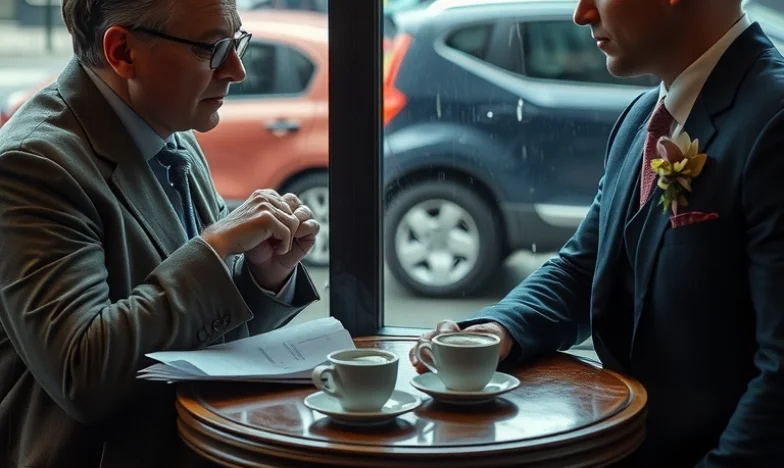
We agreed to meet at a café in Camden, neutral ground. I barely slept the night before, my mind racing with questions and regrets. When I arrived, Daniel was already there, nervously stirring his tea. He looked so much like me at that age—tall, dark-haired, the same stubborn jaw. But his eyes were Emily’s, soft and searching.
He stood as I approached, uncertainty flickering across his face. “Arthur?”
I nodded, my throat tight. “Yes. Daniel.”
We sat in awkward silence for a moment, the noise of the café a distant hum. Finally, he spoke. “I’m not here to ruin your life. I just… I wanted to know where I came from.”
I looked at him, guilt and shame warring inside me. “You have every right. I should have been there. For you. For your mother.”
He shrugged, a bitter smile on his lips. “Mum never spoke badly of you. She said you had dreams. That you were scared.”
I felt tears prick my eyes. “I was a coward. There’s no excuse.”
We talked for hours, piecing together the years we’d lost. He told me about his childhood in Manchester, his mother’s kindness, her battle with cancer that she lost two years ago. He’d grown up without a father, always wondering, always hoping. He was a teacher now, working with kids who reminded him of himself—lost, searching for answers.
As we parted, he hesitated. “I don’t expect anything from you. I just wanted to know.”
I reached for his hand, desperate to bridge the gap. “I want to try. If you’ll let me.”
He nodded, a flicker of hope in his eyes. “We’ll see.”
Telling Margaret was the hardest thing I’ve ever done. We sat in the kitchen, the winter sun casting long shadows across the table. I told her everything—about Emily, about Daniel, about my shame. She listened in silence, her face unreadable.
When I finished, she stood and walked to the window, her back to me. “You lied to me, Arthur. For thirty years.”
“I lied to myself,” I whispered. “I was afraid.”
She turned, tears streaming down her cheeks. “What about our children? What about me?”
I reached for her, but she pulled away. “I need time,” she said, her voice breaking. “I don’t know if I can forgive you.”
The days that followed were a blur of tension and whispered arguments. Our children—Sophie and James—were confused, hurt by the revelation of a half-brother they’d never known. James was angry, accusing me of betrayal. Sophie was quieter, her disappointment cutting deeper than any words.
I tried to reach out to Daniel, inviting him to dinner, to family gatherings. The first time he met Sophie and James was excruciating—polite smiles, awkward silences, the weight of unspoken questions hanging in the air. But slowly, cracks began to appear in the walls we’d built. Daniel and James bonded over football, arguing about Arsenal and United. Sophie, ever the peacemaker, found common ground in their shared love of literature.
Margaret remained distant, her trust shattered. I tried to make amends, to show her that I was still the man she married, but the past hung between us like a shadow. One night, as we lay in bed, she turned to me, her voice barely a whisper. “Why didn’t you tell me?”
I stared at the ceiling, searching for answers. “I was ashamed. I thought if I buried it deep enough, it would disappear.”
She sighed, the sound heavy with sorrow. “The past always finds us, Arthur. No matter how far we run.”
Christmas came, and with it, a fragile sense of hope. Daniel joined us for dinner, his presence both a balm and a reminder of all I’d lost. We laughed, we argued, we remembered Emily—her warmth, her laughter, the way she’d believed in second chances.
As the evening drew to a close, Daniel pulled me aside. “I’m glad I found you. Even if it took thirty years.”
I gripped his shoulder, emotion choking me. “I’m glad too. I want to make up for lost time, if you’ll let me.”
He smiled, a real smile this time. “We’ll get there. One day at a time.”
Now, as I sit in the quiet of my study, I think about the choices that define us—the moments of fear, of weakness, of regret. I wonder if I can ever truly make amends, if the wounds I’ve caused can ever heal. But I know this: the past may haunt us, but it also gives us a chance to change, to be better, to love more fiercely.
Do we ever really escape the shadows of our mistakes? Or do we simply learn to live with them, hoping that forgiveness—ours and others’—will one day set us free?