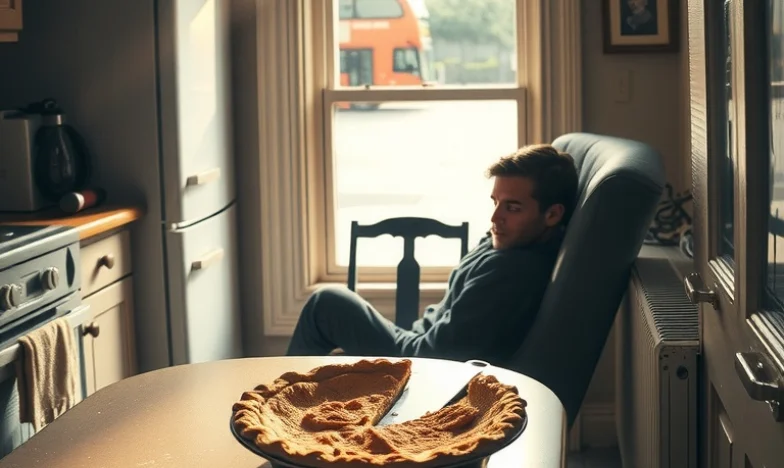
Shadows in the Kitchen

The third time I found a slice of apple pie on the kitchen table, I didn’t feel fear. Not even surprise. Just that bone-deep exhaustion, the kind that seeps into your marrow and makes every movement feel like wading through treacle. The pie sat there, golden and fragrant, dusted with cinnamon, as if someone had just set it down and stepped out for a moment. But I lived alone. Had done for nearly two years, since Anna left with her suitcase and her silence, and the flat had been nothing but echoes and the hum of the fridge ever since.
I stared at the pie, then at the empty hallway, and finally at my own hands, as if I might find crumbs clinging to my fingers. I hadn’t bought it. I hadn’t baked it. I hadn’t even thought about apple pie since Mum died last spring, and yet here it was, as real as the bills piling up on the counter and the condensation on the window.
I slumped into a chair, the cold from the kitchen tiles creeping up my legs. Outside, the city was waking up, buses rumbling past, people hurrying to jobs they hated, faces turned away from each other. I used to be one of them, before the world shrank to the size of this flat and the endless grind of work-from-home days and sleepless nights. I was so tired of it all—the empty conversations at work, the forced laughter at the pub, the way everyone seemed to be performing a version of themselves for an audience that had long since stopped watching.
My phone buzzed. A message from Dad: “You coming round Sunday? Your sister’s bringing the twins.” I stared at it, thumb hovering over the screen. I hadn’t seen Dad in months, not since the funeral. We’d argued, of course. We always did. He wanted me to move on, to stop moping about, to “get back out there.” As if grief was a coat you could shrug off and hang in the cupboard.
I ignored the message and turned back to the pie. I should have thrown it away. Instead, I ate it, each bite thick with guilt and nostalgia. It tasted just like Mum’s—tart apples, buttery pastry, a hint of lemon. I could almost hear her voice, soft and tired, telling me to eat up, that things would look better in the morning.
That night, I dreamt of shadows moving through the flat. Not ghosts, exactly, but memories—Anna’s laughter echoing down the hallway, Mum’s hands kneading dough, Dad’s voice raised in anger. I woke up tangled in the sheets, heart pounding, the taste of apples still on my tongue.
The next morning, I found another slice of pie. This time, I called my sister. “Have you been round here?” I asked, trying to keep my voice steady.
She laughed. “Don’t be daft, Chris. I’ve got enough on with the twins. Why?”
“Nothing. Just… weird dreams, that’s all.”
She paused. “You alright? You sound off.”
“I’m fine,” I lied. “Just tired.”
After we hung up, I sat in the kitchen, staring at the pie. I thought about setting up a camera, but the idea made me feel ridiculous, like some paranoid old man. Instead, I went to work, the office colder and emptier than ever. My boss, Mr. Hargreaves, cornered me by the printer.
“You look like death warmed up, lad. Everything alright at home?”
I shrugged. “Just not sleeping well.”
He nodded, but his eyes slid away, already bored. “Well, try to get some rest. We need you sharp for the Henderson pitch.”
I nodded, but I knew I wouldn’t sleep. Not with the shadows in the kitchen.
That evening, I called Anna. I don’t know why. Maybe I wanted to hear her voice, to remind myself that I hadn’t imagined the years we’d spent together. The phone rang and rang, then went to voicemail. I hung up without leaving a message.
The next morning, the pie was gone. In its place was a note, written in Mum’s looping script: “Eat. Rest. Remember.”
My hands shook as I read it. I pressed the paper to my face, breathing in the faint scent of her perfume. I wanted to believe it was a trick of the mind, that I’d written it myself in some fugue state. But the handwriting was hers. I’d know it anywhere.
I called Dad. “Did you come round?”
He sounded tired. “No, Chris. I haven’t left the house in days. Why?”
I hesitated. “Nothing. Just… missing Mum, I suppose.”
He was silent for a moment. “Me too, son. Me too.”
After we hung up, I sat in the kitchen, the note clutched in my hand. I thought about all the things I’d never said to Mum, all the arguments and silences, the way I’d pulled away from her in those last months. I thought about Anna, about the way we’d drifted apart, about the things I’d left unsaid.
That night, I dreamt of the kitchen filled with light, Mum at the table, Anna laughing, Dad humming under his breath. I woke up crying, the ache in my chest sharper than ever.
The next morning, there was no pie. Just an empty plate, and the realisation that I couldn’t keep living like this—haunted by shadows, paralysed by regret. I called my sister. “Can I come round?”
She sounded surprised, but pleased. “Of course. The twins will be thrilled.”
I went, and for the first time in months, I felt something shift inside me. The twins clambered over me, sticky-fingered and loud, and my sister made tea, and we talked about Mum, about the good times and the bad. Dad came round later, and we sat in the garden, the sun warm on our faces, and for a moment, the shadows receded.
That night, I went home and baked an apple pie. The kitchen filled with the scent of cinnamon and butter, and I felt Mum’s presence, not as a ghost, but as a memory—warm and bittersweet.
I set a slice on the table, just in case.
Sometimes I wonder—are the shadows in the kitchen just memories, or something more? And if they are, is it really so bad to let them in, just for a while?