“Are You Planning to Be a Parasite Forever?” — How My Mother-in-Law Drove Me to Tears

“So, are you planning to be a parasite forever, or will you finally do something with your life?”
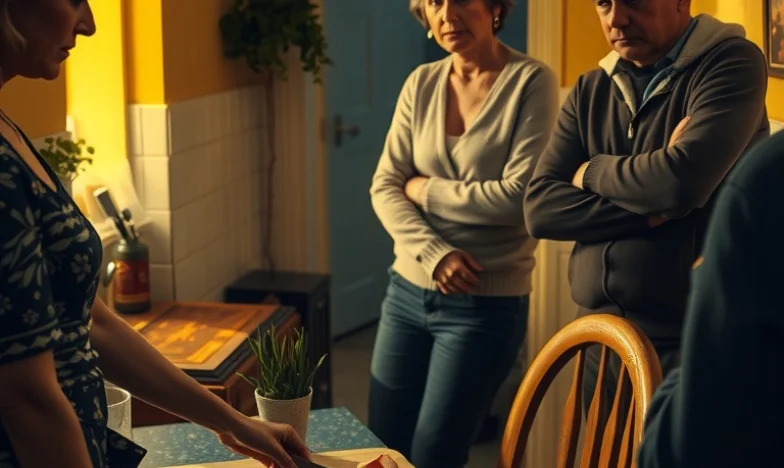
Her words sliced through the kitchen air, sharper than the knife I was using to chop onions for Sunday roast. I froze, my hand trembling, the blade clattering onto the wooden board. My mother-in-law, Margaret, stood by the doorway, arms folded, her lips pursed in that familiar, disapproving line. My husband, Tom, sat at the table, his eyes darting between us, the tension in the room thick enough to choke on.
I wanted to scream, to throw the knife across the room, to tell her she had no idea what I’d been through. But all I could do was stare at the onions, blinking back tears that stung more than their fumes ever could. “I’m not a parasite,” I whispered, my voice barely audible.
Margaret scoffed, shaking her head. “You quit your job, Emily. You sit at home all day, and Tom works his fingers to the bone. What exactly do you contribute?”
Tom shifted uncomfortably. “Mum, that’s enough—”
“No, Tom, it’s not enough,” she snapped. “I didn’t raise you to marry someone who’d drag you down.”
I felt the walls closing in, the kitchen suddenly too small, too suffocating. I wanted to run, to hide, but I stood my ground, clutching the edge of the counter until my knuckles turned white. I could feel my heart pounding in my chest, each beat echoing Margaret’s accusation.
It hadn’t always been like this. When Tom and I first moved into the little terraced house in Reading, I was working as a teaching assistant at the local primary school. It wasn’t glamorous, but I loved the children, the sense of purpose. But the headteacher changed, the atmosphere grew toxic, and every day became a battle. I’d come home exhausted, crying in the shower so Tom wouldn’t see. Eventually, I broke. I handed in my notice, thinking I’d take a few months to recover, maybe retrain, maybe finally write that children’s book I’d always dreamed of.
But Margaret saw things differently. She’d grown up in a different world, one where women soldiered on, no matter how unhappy. She’d worked in a factory for thirty years, never missed a day, never complained. To her, my breakdown was weakness, my unemployment a disgrace.
The first few weeks were bearable. Tom was supportive, telling me to take my time, that we’d manage. But then Margaret started visiting more often, bringing casseroles and criticism in equal measure. She’d glance around the house, tutting at the dust on the skirting boards, the pile of laundry waiting to be folded. “When I was your age, I had two children and a job,” she’d say, her voice dripping with disappointment.
I tried to ignore her, to focus on small victories: a freshly baked loaf of bread, a chapter written, a walk in the park. But her words burrowed under my skin, festering. I started to doubt myself, to wonder if I really was useless, a burden. I stopped writing, stopped baking, stopped leaving the house. I spent hours scrolling through job sites, my stomach twisting with anxiety at every rejection.
Tom noticed the change. “You’re not yourself, Em,” he said one evening, reaching for my hand. “Don’t let her get to you.”
But how could I not? Every time Margaret visited, she found a new way to remind me of my failures. “Maybe you should try cleaning more, if you’re not working,” she’d suggest, eyeing the crumbs on the counter. Or, “I saw a job at the supermarket. It’s not glamorous, but at least it’s something.”
One afternoon, I overheard her talking to Tom in the garden. “She’s dragging you down, love. You deserve better.”
I pressed my back against the wall, tears streaming down my face. I wanted to scream, to tell her I was trying, that I was more than my job title. But the words stuck in my throat, suffocated by shame.
The final straw came on a rainy Thursday. I’d spent the morning cleaning, determined to prove Margaret wrong. I scrubbed the floors, polished the windows, even ironed Tom’s shirts. When Margaret arrived, she barely glanced at my efforts. Instead, she handed me a leaflet for a cleaning agency. “They’re hiring. You might as well get paid for what you’re doing.”
Something inside me snapped. “Why do you hate me so much?” I blurted, my voice shaking. “What have I ever done to you?”
She looked startled, then angry. “I don’t hate you, Emily. I just want what’s best for my son.”
“And what about what’s best for me?” I demanded. “Don’t I matter?”
She stared at me, her eyes cold. “Not if you’re going to ruin his life.”
Tom stormed in, his face red with fury. “Mum, that’s enough! You can’t talk to her like that. If you can’t be supportive, don’t come here.”
Margaret left in a huff, slamming the door behind her. I collapsed onto the sofa, sobbing. Tom held me, whispering that he loved me, that we’d get through this. But the damage was done. I felt broken, worthless, a parasite in my own home.
Days passed in a blur. I stopped answering the phone, stopped seeing friends. I couldn’t face the world, not when I felt so small. Tom tried to help, but I pushed him away, convinced he’d be better off without me.
One evening, as I sat staring at the rain streaking down the window, Tom knelt beside me. “Em, please. Talk to me.”
I shook my head. “I can’t. I’m nothing. Your mum’s right.”
He took my hands in his. “She’s wrong. You’re not a parasite. You’re my wife, my best friend. I love you. But I can’t help you if you shut me out.”
His words broke through the fog. I realised I’d let Margaret’s voice drown out my own, let her define my worth. I didn’t want to live like that anymore.
The next day, I called my GP. I started therapy, slowly rebuilding my confidence. I applied for a part-time job at the library, something gentle, manageable. I started writing again, pouring my pain onto the page.
Margaret still visits, but I don’t let her words hurt me anymore. I set boundaries, stand up for myself. Tom and I are stronger, closer. I’m not the same woman I was before, but maybe that’s a good thing.
Sometimes, late at night, I lie awake and wonder: Why do we let other people’s opinions shape our lives? Why do we measure our worth by what we do, instead of who we are? Maybe it’s time we started asking ourselves what really matters.