The Widow’s Bargain: A House Full of Serpents

“Ten quid for a house? You must be mad, Mum.”
My son Jamie’s words echoed in my ears as I stood at the rusted gate, the wind biting through my coat. The estate agent had barely looked me in the eye when he handed over the yellowed deed. “It’s all yours, Mrs. Carter. Needs a bit of work, mind.”
A bit of work. That was an understatement. The cottage crouched at the edge of the moor, its stone walls mottled with moss, windows clouded with grime. But it was mine. After Alan died, the world shrank to a single, suffocating room in my sister’s flat in Leeds. I’d scraped together every penny from his insurance, desperate for a place to call my own. When I saw the listing—‘Detached cottage, urgent sale, £10’—I thought it was a joke. But the solicitor confirmed it. Ten pounds. The price of a takeaway. The price of hope.
I pushed open the gate, its hinges shrieking in protest, and trudged up the overgrown path. My boots squelched in the mud. I could almost hear Alan’s voice: “You always did like a challenge, love.”
The front door stuck, swollen with damp. I shoved it with my shoulder, heart thudding. The air inside was thick, stale, tinged with something sharp. I flicked on my torch and stepped into the gloom.
The sitting room was a time capsule: threadbare armchair, faded rug, a cracked photo of a family I didn’t know on the mantel. I ran my fingers over the peeling wallpaper, imagining laughter, arguments, Sunday roasts. My own family had splintered since Alan’s death. Jamie barely called. My daughter, Sophie, hadn’t spoken to me since the funeral row. I’d hoped this place might bring us back together.
A noise stopped me cold—a soft, slithering sound from the kitchen. I froze, torch beam trembling. “Hello?” My voice sounded small, ridiculous.
No answer. Just that sound, like silk dragged over stone. I edged forward, every instinct screaming to run. The kitchen was empty, save for a battered table and a sink full of dead leaves. I let out a shaky breath. Probably a rat, I told myself. Or the wind.
I spent the day scrubbing, sweeping, trying to banish the ghosts. By dusk, exhaustion dragged at my bones. I made a bed on the sofa, wrapped in Alan’s old jumper, and drifted into uneasy sleep.
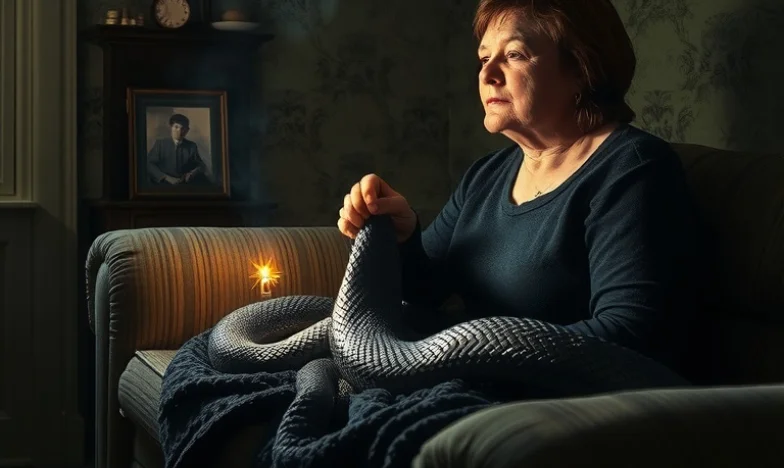
I woke to a cold weight on my chest. My eyes snapped open. In the torchlight, I saw it—a snake, thick and glistening, coiled across my blanket. I screamed, flinging myself to the floor. The snake vanished beneath the sofa. My heart hammered so hard I thought it would burst.
I scrambled outside, gulping the icy air. My hands shook as I dialled Jamie. He answered on the third ring, voice thick with sleep. “Mum? What’s wrong?”
“There’s a snake in the house,” I gasped. “I can’t—Jamie, I can’t stay here.”
He sighed. “It’s the countryside, Mum. Probably just a grass snake. They’re harmless.”
“Jamie, please. There’s something wrong with this place.”
He promised to come the next day. I spent the night in the car, engine running for warmth, eyes fixed on the dark windows.
Morning brought no comfort. Jamie arrived, grumbling, but when he lifted the sofa, his face went white. “Bloody hell.”
There were more snakes—dozens, tangled in the shadows, slipping through cracks in the floorboards. Jamie swore, backing away. “We need to get out. Now.”
We drove to the village, hands still shaking. The pub landlord, Mr. Hargreaves, listened to our story, his face unreadable. “That cottage’s been empty for years,” he said. “Last folk who lived there left in a hurry. Never said why.”
“Why would someone sell it for ten pounds?” Jamie demanded.
Hargreaves shrugged. “Some say it’s cursed. Others say it’s just bad luck. Either way, no one stays long.”
I stared into my tea, the warmth doing nothing to thaw the chill inside me. Jamie wanted to go back to Leeds. “Sell it, Mum. Cut your losses.”
But I couldn’t. I’d poured everything into that house. I needed it to work. I needed to prove—to myself, to my children—that I could start again.
That night, I returned alone. I sealed the gaps with towels, sprinkled salt along the skirting boards—an old wives’ tale, but I was desperate. I sat in the armchair, torch in hand, waiting.
The snakes came anyway. They slid from the fireplace, from behind the cooker, silent and relentless. I sobbed, clutching Alan’s jumper, begging for help. In the morning, I found their shed skins coiled around my boots.
Word spread in the village. Some folk avoided me, crossing the street when I passed. Others whispered about the widow in the snake house. I felt the weight of their pity, their suspicion. Was I mad? Had grief twisted my mind?
Sophie called at last, her voice brittle. “Mum, what are you doing to yourself?”
“I just wanted a home,” I whispered. “For us. For you and Jamie.”
She was silent for a long time. “We’re not coming, Mum. Not to that place.”
I hung up, tears burning my cheeks. I was alone, more alone than ever.
One night, as a storm battered the windows, I heard a knock at the door. It was Mrs. Wilkins, the vicar’s wife, holding a thermos of soup. She sat with me, listening as I poured out my fears.
“Sometimes,” she said gently, “we cling to things because we’re afraid to let go. But not every house is meant to be a home.”
Her words haunted me. I spent days wandering the moor, searching for answers. I found an old man tending sheep, who told me the land had once been a snake pit, filled in after the war. “Some things don’t stay buried,” he said, eyes sad.
I realised then that I’d been trying to fill the hole Alan left with bricks and mortar, with stubbornness and hope. But the past can’t be exorcised by force. Some wounds never heal.
In the end, I left the cottage, locking the door behind me. I gave the keys to the council, walked away with nothing but a battered suitcase and Alan’s jumper.
Now, I live in a small flat above the bakery in the village. It’s not much, but it’s warm, and the neighbours smile when they see me. I still dream of snakes, sometimes, coiling in the shadows. But I’m learning to let go.
Was it foolish to believe I could start again with so little? Or is hope itself the bravest thing we have?