When My Brother Moved In: A London Flat, Family Ties, and the Cost of Kindness

“You’re not serious, are you, Jamie?” I asked, my voice echoing off the bare walls of my tiny kitchen. The kettle was hissing, the only sound in the flat apart from my brother’s nervous laughter. He stood by the window, hands shoved deep in his pockets, eyes darting everywhere but at me. “I wouldn’t ask if we had anywhere else to go, Tom,” he said, his voice barely above a whisper. “It’s just… the rent’s gone up again, and with Anna’s hours cut, we’re barely scraping by.”
I stared at him, mug halfway to my lips. I’d always been the responsible one, the older brother who sorted things out. When we’d first moved to London for uni, our parents had paid the rent, sent us care packages from Sheffield—jars of Mum’s jam, Dad’s pickled onions, the odd tin of beans. But now, three years on, I was working nights at the warehouse, juggling shifts and coursework, finally managing to pay for the flat myself. Jamie was still at uni, but he’d married Anna last summer, a whirlwind romance that left our parents both proud and quietly worried.
“Just for a few months,” Jamie pleaded. “Until we get back on our feet.”
I wanted to say no. The flat was barely big enough for me, let alone three adults. But Jamie was my brother. I remembered the way he’d looked up to me as kids, the way he’d always tried to keep up, even when he couldn’t. I sighed, feeling the weight of responsibility settle on my shoulders. “Alright,” I said. “But we’ll have to set some ground rules.”
The first week was awkward but manageable. Anna was polite, always offering to cook or clean, and Jamie tried to keep out of my way. But the flat felt smaller with them there, every sound magnified, every movement a negotiation. I’d come home from a twelve-hour shift to find Anna’s shoes in the hallway, Jamie’s textbooks spread across the sofa, the telly blaring some reality show I couldn’t stand.
One evening, as I collapsed onto my bed, I heard raised voices from the kitchen. “You said you’d look for jobs today,” Anna snapped. “I did!” Jamie shot back. “But no one’s hiring, not with my schedule.”
I pressed my pillow over my ears, but their argument seeped through the walls. I missed the quiet, the solitude I’d fought so hard to build. The next morning, Anna cornered me as I made tea. “I’m sorry about last night,” she said, eyes red-rimmed. “It’s just… hard, you know?”
I nodded, not trusting myself to speak. I knew what she meant. London was brutal—expensive, relentless, always demanding more. I’d seen friends forced out of their flats, relationships strained to breaking point by money and stress. I’d thought Jamie and Anna would be different.
As the weeks dragged on, tensions simmered. Jamie started borrowing my things without asking—my razor, my headphones, even my favourite mug. Anna rearranged the kitchen, moving my spices, throwing out food she thought had gone off. I tried to bite my tongue, but resentment grew like mould in the corners of the flat.
One Friday night, I came home to find Jamie and Anna hosting friends in the living room. Laughter and music spilled into the hallway, the smell of takeaway curries hanging in the air. My heart sank. I’d been looking forward to a quiet night, a chance to catch up on sleep. Instead, I was greeted by strangers sprawled on my sofa, drinks in hand, shoes on the carpet.
“Tom! Come join us!” Jamie called, oblivious to my exhaustion. I forced a smile, but inside I was seething. I retreated to my room, slamming the door behind me. The laughter outside felt like a personal affront.
The next morning, I found the kitchen a mess—empty bottles, curry stains, crumbs everywhere. I snapped. “This isn’t a bloody student house!” I shouted, startling Jamie and Anna. “I work all week to keep this place running, and you treat it like a doss house!”
Jamie’s face crumpled. “We’re sorry, Tom. We just wanted to have a bit of fun. It won’t happen again.”
But it did. The boundaries blurred, my patience wore thin. I started staying late at work, volunteering for extra shifts just to avoid going home. I missed the days when Jamie and I were just brothers, not flatmates, not adversaries.
One night, after another argument about bills—Anna insisting they couldn’t pay more, me insisting I couldn’t pay less—I found myself walking the empty streets of Hackney, rain soaking through my jacket. I thought about calling Mum, but what could I say? That I’d failed as a brother? That kindness had become a burden?
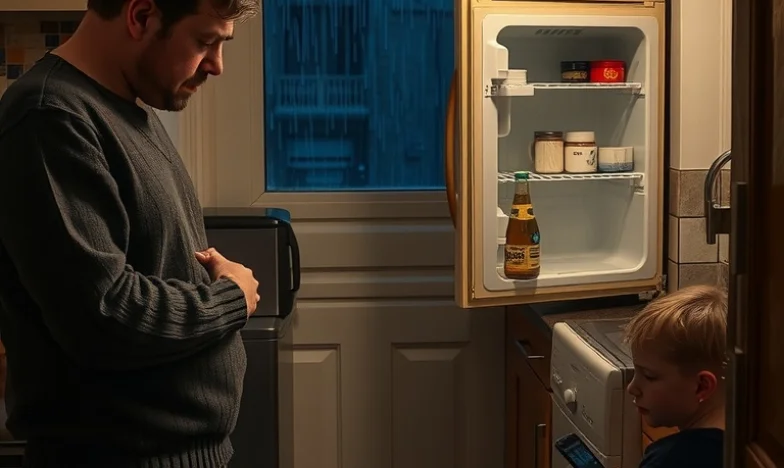
The breaking point came one Sunday afternoon. I’d planned to cook a roast, a rare treat, but when I opened the fridge, half the ingredients were gone. Anna was in the kitchen, scrolling through her phone. “Did you use the chicken?” I asked, trying to keep my voice steady.
“Oh, sorry, Tom. Jamie fancied a sandwich earlier. I thought you wouldn’t mind.”
Something inside me snapped. “You thought I wouldn’t mind? This is my home! I pay the rent, I buy the food, and you just take whatever you want!”
Anna stared at me, stunned. Jamie rushed in, eyes wide. “What’s going on?”
“I can’t do this anymore,” I said, voice shaking. “I can’t be responsible for everyone. I need my life back.”
There was a long, painful silence. Jamie looked at Anna, then at me. “We’ll go,” he said quietly. “We’ll figure something out.”
They moved out a week later, finding a bedsit in a rough part of town. We barely spoke for months. The flat felt empty, but the silence was a relief. I missed my brother, but I didn’t miss the chaos.
Mum called, worried. “You boys need each other,” she said. “Don’t let London come between you.”
I wanted to believe her, but I knew things had changed. The city had hardened us, forced us to draw lines we never thought we’d need.
Months passed. Jamie and I met for a pint, awkward at first, then easier. We talked about home, about Mum’s jam and Dad’s onions, about how hard it was to make it here. We laughed, remembering the old days, the stupid things we’d done as kids.
“I’m sorry, Tom,” Jamie said, eyes shining. “I never meant to take advantage.”
“I know,” I replied. “We were both just trying to survive.”
Now, as I sit in my quiet flat, I wonder—was I wrong to put myself first? Or is there a limit to how much we owe our family, even when we love them? What would you have done in my place?