The Unwanted Son and the Reluctant Carer: A British Family Reckoning

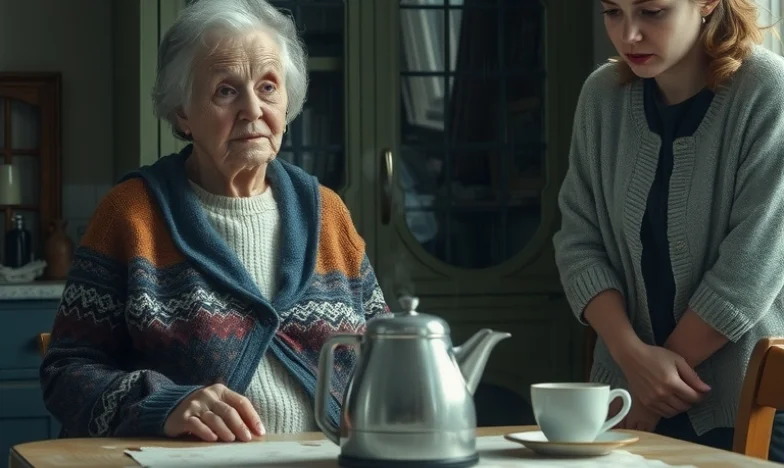
“You’ve never liked me, have you, Margaret?” I blurted, my voice trembling as I stood in the cramped kitchen, the kettle whistling shrilly behind me. My mother-in-law, perched stiffly at the table, looked up with those cold, appraising eyes. She didn’t answer, just pursed her lips and turned her gaze back to the window, as if the grey drizzle outside was more interesting than the woman now responsible for her daily care.
I never wanted this. Not really. But here I am, forty-six years old, married to Marek for nearly two decades, and now, after all these years, it’s me who’s left to look after Margaret. Not Agata, not Kasia – her precious daughters, who she always called her “angels.” No, they’re too busy, too far away, too wrapped up in their own lives in London and Manchester. It’s me, the daughter-in-law, the outsider, the one she never quite trusted, who’s left to wipe her chin and fetch her pills.
I remember the first time I met Margaret. It was Christmas Eve, 2004. Marek and I had just got engaged, and he insisted we drive up to Sheffield to meet his family. The house was warm and full of laughter – but not for me. Margaret barely looked at me, fussing over Agata’s new job in the city and Kasia’s latest boyfriend. Marek, her youngest, hovered awkwardly at the edge of every conversation, and I felt his pain as keenly as my own. I tried to help in the kitchen, but Margaret shooed me away. “Let the girls do it, love,” she said, as if I was a stranger who’d wandered in off the street.
Years passed, and nothing changed. When Marek and I had our son, Jamie, Margaret sent a card – no phone call, no visit. But when Agata’s daughter was born, Margaret moved in for a month to help. I watched Marek’s face as he read his mother’s text: “So happy for Agata! Can’t wait to meet little Sophie.” He didn’t say anything, but I saw the way his hands shook.
Now, Margaret is eighty-one, frail and forgetful, and the daughters she adored are nowhere to be found. It was Agata who called me, her voice brisk and businesslike. “Mum’s not coping. You’re the only one nearby. Can you sort something out?”
I wanted to say no. I wanted to scream, “Why should I?” But I didn’t. Marek just looked at me, silent, his eyes pleading. So we moved Margaret into our spare room, cleared out Jamie’s old toys, and tried to make her comfortable.
It’s been six months. Six months of endless cups of tea, of Margaret’s sharp tongue and sharper silences. She complains about the food, about the noise, about the way I fold her cardigans. She never asks about Jamie, who’s away at university, or about Marek, who works late most nights just to avoid coming home. Sometimes, when I tuck her in, I see a flicker of something – regret, maybe, or just exhaustion. But mostly, she’s as hard as ever.
One night, after another argument about her medication, I found Marek sitting in the dark, head in his hands. “Why does she hate me?” he whispered. “What did I ever do?”
I didn’t know what to say. I wanted to comfort him, to tell him it wasn’t his fault, but the truth is, I didn’t understand it either. I’d watched Margaret pour all her love into her daughters, leaving Marek to fend for himself. He was the afterthought, the spare. And now, when she needs help, it’s him – and me – who are left to pick up the pieces.
The tension in the house is suffocating. Every day feels like a test I’m destined to fail. Margaret’s health is declining, and the carers from the council only come twice a week. The rest is up to me. I bathe her, feed her, listen to her endless complaints. Sometimes, late at night, I hear her crying softly. I want to feel sorry for her, but mostly I just feel tired.
Agata and Kasia call occasionally, their voices bright and distant. “How’s Mum?” they ask, as if she’s a pet we’re minding for the weekend. They promise to visit, but something always comes up – a work trip, a sick child, train strikes. Marek tries to hide his disappointment, but I see it in the way he slumps after every call.
One Sunday, Agata finally arrives, breezing in with expensive perfume and a bag of Marks & Spencer treats. She hugs Margaret, who lights up for the first time in weeks. They sit together, laughing and reminiscing, while I make tea in the kitchen. When I bring in the tray, Agata barely glances at me. “You’re a saint for doing all this,” she says, her tone patronising. “I don’t know how you manage.”
I want to scream. I want to throw the tea in her face. Instead, I smile tightly and retreat to the garden, where Marek is smoking a cigarette, something he only does when he’s truly stressed. “She’ll be gone soon,” he mutters. “Back to her real life.”
After Agata leaves, Margaret is inconsolable. She refuses to eat, refuses to speak. I sit with her, holding her hand, feeling the weight of all the years she spent ignoring us. “Why did you never love him?” I ask quietly. She doesn’t answer, just squeezes my hand and turns away.
The weeks drag on. Margaret’s health worsens. The doctor says it won’t be long now. I find myself crying in the bathroom, overwhelmed by guilt and anger and exhaustion. Marek is distant, lost in his own pain. Jamie calls from university, worried about us both. “You’re doing your best, Mum,” he says. “She’s lucky to have you.”
But I don’t feel lucky. I feel trapped. Trapped by duty, by resentment, by a family that never really wanted me. I wonder what will happen when Margaret is gone. Will the sisters swoop in, claim the house, the money, the memories? Will Marek finally be free, or will the scars of his childhood haunt him forever?
One night, as I sit by Margaret’s bed, she opens her eyes and looks at me. “I’m sorry,” she whispers. “For everything.”
I don’t know if she means it. I don’t know if it’s enough. But I squeeze her hand and nod, tears streaming down my face.
After she’s gone, the house feels empty. Agata and Kasia come for the funeral, all crocodile tears and whispered arguments about the will. Marek stands apart, silent and broken. I watch them, these sisters who were always so loved, and I wonder if they’ll ever understand what they left behind.
Sometimes, late at night, I lie awake and ask myself: Was it worth it? Did I do the right thing? Or was I just another afterthought, another spare, in a family that never really saw me at all?
Would you have done the same? Or would you have walked away?