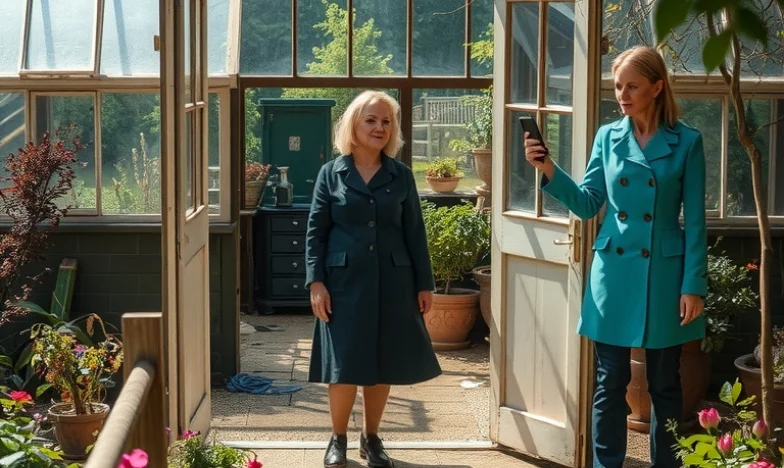
A Greenhouse of Secrets: How One Deceit Nearly Tore Us Apart

“It’s all gone, Kate! Everything’s ruined!” Agatha’s voice cracked as she stumbled into my kitchen, her muddy boots leaving smears on the linoleum. I’d barely set the kettle on when she grabbed my arm, her grip desperate, eyes wide with panic. “The greenhouse—someone’s smashed it to bits. All my tomatoes, the cucumbers, even the bloody runner beans!”
I stared at her, heart thumping. Agatha wasn’t one for dramatics. She was the sort who’d chase a fox off with a broom and laugh about it later. But now, she looked broken, her hands shaking so badly she could hardly hold the mug I pressed into them.
“Who would do such a thing?” I asked, my own voice trembling. The village of Little Wrenford was hardly a hotbed of crime. We had our spats—over hedges, over dogs, over whose turn it was to host the WI meeting—but nothing like this.
Agatha shook her head, tears spilling down her cheeks. “I don’t know. But I’ll tell you this, Kate—someone wanted to hurt me. And I think I know who.”
She didn’t have to say it. I could see the suspicion in her eyes, the way she glanced towards the window, as if expecting to see someone lurking in the garden. My stomach twisted. There’d been tension between Agatha and the Harrisons next door for months now, ever since that business with the boundary fence. But this—this was something else.
I tried to comfort her, but she was inconsolable. “It’s not just the plants, Kate. It’s our livelihood. You know how much we rely on the market stall. Without those vegetables, we’re sunk.”
I nodded, feeling helpless. My own husband, David, was away on a job in Bristol, and I’d been looking after our two boys on my own for the week. The last thing I needed was to get dragged into a neighbourly feud. But Agatha was my friend. I couldn’t turn her away.
That afternoon, the village was buzzing. Word spread faster than wildfire. By teatime, everyone knew about the greenhouse. Some blamed the Harrisons, others muttered about teenagers from the estate up the road. But when I saw the look on Mrs Harrison’s face at the shop, I knew she was just as shocked as the rest of us.
“Kate, you don’t think we’d do something like that, do you?” she whispered, her voice trembling. “We’ve had our differences, but… we’re not monsters.”
I wanted to believe her. But Agatha was adamant. “They’ve always resented us. Ever since we bought that extra bit of land. This is their way of getting back at us.”
The days that followed were a blur of whispered conversations and suspicious glances. The police came, took statements, but found nothing. No footprints, no fingerprints, just a mess of broken glass and trampled plants. Agatha grew more withdrawn, barely leaving her house. Her husband, Mark, was furious, threatening to take matters into his own hands.
One evening, as I was putting the boys to bed, I heard shouting from next door. Mark’s voice, loud and angry, carrying across the gardens. I crept to the window, heart pounding, and saw him standing at the Harrisons’ gate, fists clenched.
“You think you can get away with this?” he yelled. “You’ve always been jealous, but this—this is criminal!”
Mr Harrison came out, red-faced and shaking. “We had nothing to do with it, Mark! You’re barking up the wrong tree!”
The argument escalated, neighbours gathering at their windows, some even stepping outside to watch. I felt sick. This wasn’t the village I knew. We were supposed to look out for each other, not tear each other apart.
The next morning, Agatha came to me again, her face pale. “Kate, I need your help. I can’t prove it was them, but I know it in my bones. Will you come with me to talk to them? Maybe if we confront them together, they’ll confess.”
I hesitated. “Agatha, what if you’re wrong? What if it wasn’t them?”
She looked at me, eyes pleading. “Please, Kate. I can’t do this alone.”
So I went with her, heart in my mouth. We knocked on the Harrisons’ door, and Mrs Harrison answered, looking wary.
“Agatha, Kate. What can I do for you?”
Agatha didn’t waste time. “We know what you did. Just admit it, and we can put this behind us.”
Mrs Harrison’s face crumpled. “I swear to you, we had nothing to do with it. Why would we? We’ve got our own greenhouse, our own problems.”
The conversation went nowhere. Agatha grew more frustrated, Mrs Harrison more defensive. I tried to mediate, but it was like talking to a brick wall. We left, both feeling worse than before.
That night, I couldn’t sleep. I kept thinking about the look in Mrs Harrison’s eyes—hurt, betrayed. And about Agatha, so sure she was right, so desperate for someone to blame.
A week passed. The village was divided. Some sided with Agatha, others with the Harrisons. The children stopped playing together. People crossed the street to avoid each other. I felt trapped in the middle, torn between loyalty and doubt.
Then, one evening, as I was locking up the shed, I saw something glinting in the grass by the fence. I bent down and picked it up—a small, silver key. It looked familiar. My heart skipped a beat. It was the key to Agatha’s greenhouse.
I stared at it, confused. How had it ended up here, on my side of the fence? I remembered Agatha coming over that morning, frantic, searching for something. She’d said she’d lost her keys. But why would the key be here?
A horrible thought crept into my mind. What if… what if it hadn’t been the Harrisons? What if someone else had done it—someone closer to home?
I confronted Agatha the next day. “I found your greenhouse key in my garden. How did it get there?”
She went pale. “I—I must have dropped it when I came over. I was so upset, I wasn’t thinking straight.”
But something in her voice didn’t ring true. I pressed her. “Agatha, are you sure? Is there something you’re not telling me?”
She burst into tears. “Oh, Kate, I’m so sorry. I didn’t mean for any of this to happen.”
The truth came tumbling out. It hadn’t been the Harrisons. It hadn’t even been vandals. It was Agatha’s own son, Jamie. He’d been angry—angry at his parents for grounding him, angry at the world. He’d snuck out in the night, smashed up the greenhouse in a fit of rage, then panicked and ran home. Agatha had found out the next morning, but she couldn’t bear to admit the truth. So she’d let everyone believe it was the Harrisons.
I was stunned. “Why didn’t you tell anyone?”
She sobbed. “I was scared. Scared of what people would think. Scared of losing my friends. I thought… I thought if I could just blame someone else, it would all go away.”
But it hadn’t gone away. It had festered, poisoning the village, turning neighbour against neighbour.
I convinced Agatha to come clean. Together, we went to the Harrisons, told them everything. There were tears, angry words, but in the end, forgiveness. The village slowly healed, but things were never quite the same.
Sometimes, when I walk past the empty patch where Agatha’s greenhouse once stood, I wonder how close we came to losing everything—friendships, trust, our sense of community—all because of one desperate lie.
Would you have done the same in Agatha’s place? Or would you have found the courage to tell the truth, no matter the cost?