Uncle Stephen: The Stranger in My Living Room

“Don’t touch me!” I shrieked, my voice echoing off the hallway walls as Mum tried to coax me out from behind the sofa. My heart hammered in my chest, and my fists clenched so tightly my nails dug into my palms. I was six, and I hated men. Their voices were too loud, their laughter too sharp, their hands too big. Even the postman’s cheery wave made me shrink back into myself. But today, there was a new man in our house—a stranger with a suitcase and a lopsided grin, standing awkwardly in the doorway as Mum fussed over him.
“Stephen, this is Kacper,” Mum said, her voice too bright, too hopeful. “He’s just a bit shy, that’s all.”
Uncle Stephen—though I’d never met him before, and the word ‘uncle’ felt foreign and sticky in my mouth—gave me a small wave. He was short and round, with curly hair that stuck out at odd angles and glasses perched on his nose. His eyes were blue, clear as boiled sweets, and his smile was so wide it made his cheeks bunch up like dough. He looked more like a teddy bear than a man, but I still pressed myself further into the corner, wishing I could disappear.
“Alright, mate,” he said, his voice soft and uncertain. “No need to be scared. I’m just here for a bit, that’s all.”
Mum shot him a grateful look, but I could see the worry in her eyes. Ever since Dad left, she’d been different—quieter, more tired, as if she was always waiting for something to go wrong. Stephen was her younger brother, the one who’d always been ‘a bit odd’, according to Gran. He’d lost his job in Manchester and needed somewhere to stay. Mum said it was only temporary, but I could feel the tension in the air, thick as fog rolling in from the Thames.
The first week was the hardest. Stephen tried to make himself invisible, tiptoeing around the house and whispering apologies whenever he bumped into something—which was often. He was clumsy, always knocking over mugs or tripping on the rug, and his laugh was a high, nervous giggle that made me flinch. But he never raised his voice, never tried to touch me. Instead, he spent hours at the kitchen table, fiddling with crossword puzzles and humming old Beatles tunes under his breath.
One afternoon, I found him in the garden, kneeling in the mud with his trousers rolled up and a trowel in his hand. He was talking to the daffodils, telling them stories about a cat he’d once had called Marmalade. I watched from the window, fascinated despite myself. He looked so silly, so harmless, that I almost forgot to be afraid.
Mum noticed the change, too. She started inviting Stephen to dinner, setting an extra place at the table and nudging me to say thank you when he passed the peas. At first, I refused to speak, staring at my plate until the silence grew unbearable. But Stephen never pushed. He just smiled that goofy smile and told stories about his childhood—about the time he got stuck up a tree, or the day he accidentally dyed Gran’s hair blue with his chemistry set.
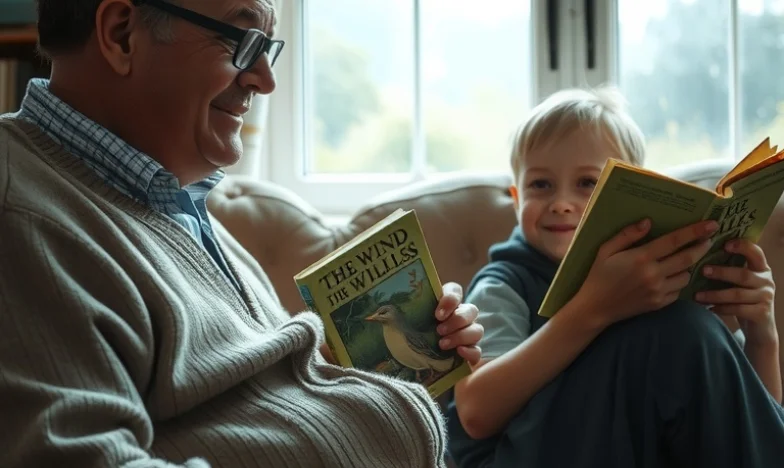
Slowly, I began to thaw. One evening, as rain lashed against the windows and thunder rattled the panes, I crept downstairs to find Stephen curled up on the sofa, reading a battered copy of The Wind in the Willows. He looked up, surprised, and patted the cushion beside him.
“Want to hear about Toad’s latest adventure?” he asked, his voice barely above a whisper.
I hesitated, then nodded. He read aloud, his voice gentle and warm, and for the first time in months, I felt safe.
But not everyone was happy about Stephen’s presence. Gran came round one Sunday, her lips pursed and her eyes sharp as she surveyed the mess in the living room—Stephen’s crossword books, his muddy boots, the half-finished jigsaw on the coffee table.
“Honestly, Mary,” she huffed, glaring at Mum. “You can’t keep looking after him forever. He’s a grown man, not a child.”
Mum’s jaw tightened. “He’s family, Mum. He needs us.”
Gran sniffed. “He’s always needed someone. When’s he going to stand on his own two feet?”
Stephen shrank into himself, his cheeks flushing red. I wanted to say something, to tell Gran she was wrong, but the words stuck in my throat. Instead, I watched as Mum squeezed Stephen’s hand under the table, her eyes fierce with love and defiance.
The arguments grew more frequent as the weeks passed. Mum and Gran would shout in the kitchen, their voices muffled by the closed door. I’d sit on the stairs, hugging my knees, listening to the words I didn’t understand—‘responsibility’, ‘burden’, ‘future’. Stephen would retreat to the garden, talking to the flowers or scribbling in his notebook, pretending not to hear.
One night, after another blazing row, Mum sat on the edge of my bed, her face pale and drawn.
“I know it’s hard, love,” she whispered, brushing my hair from my forehead. “But Stephen’s family. We look after each other, even when it’s not easy.”
I nodded, though I wasn’t sure I understood. All I knew was that Stephen made the house feel less empty, less sad. He made Mum laugh again, even if it was just for a moment.
But the tension couldn’t last forever. One morning, I woke to find Stephen gone. His suitcase was missing, and the house felt colder, quieter than ever. Mum sat at the kitchen table, her hands wrapped around a mug of tea, staring out the window with red-rimmed eyes.
“He’s gone to stay with Auntie Jean for a bit,” she said, her voice trembling. “He thought it would be easier for everyone.”
I felt a strange ache in my chest, a hollow space where Stephen’s laughter used to be. I missed his silly stories, his clumsy hugs, the way he made the world seem a little less scary.
Days turned into weeks, and life settled into a new routine. Mum went back to work, Gran visited less often, and I spent my afternoons alone in the garden, talking to the daffodils like Stephen had taught me. But the house never felt quite right. There was always something missing, a gap that no amount of noise or light could fill.
Then, one rainy afternoon, the doorbell rang. I opened the door to find Stephen standing on the step, his hair plastered to his forehead and his glasses fogged up. He looked smaller than I remembered, more fragile, but his smile was just as wide.
“Alright, mate,” he said, holding out a packet of boiled sweets. “Thought you might fancy a treat.”
I threw my arms around him, burying my face in his jumper. For the first time, I wasn’t afraid.
Mum came running, tears streaming down her face as she hugged us both. Gran arrived later, grumbling about the mess but bringing a tin of biscuits all the same. We sat around the table, sharing stories and laughter, and for a moment, everything felt whole again.
Looking back, I realise now that Stephen wasn’t just a guest in our home—he was the glue that held us together, the gentle presence that taught me how to trust again. He wasn’t perfect, but he was ours, and that was enough.
Sometimes I wonder—what does it really mean to be family? Is it blood, or is it the people who stay when things get hard? Maybe it’s both. Or maybe, just maybe, it’s something we build together, one clumsy hug at a time.
What do you think—can someone truly become family, even if they don’t fit the mould? Would you have let Stephen stay?