Instead of My Wife and Twins, I Found Only a Note

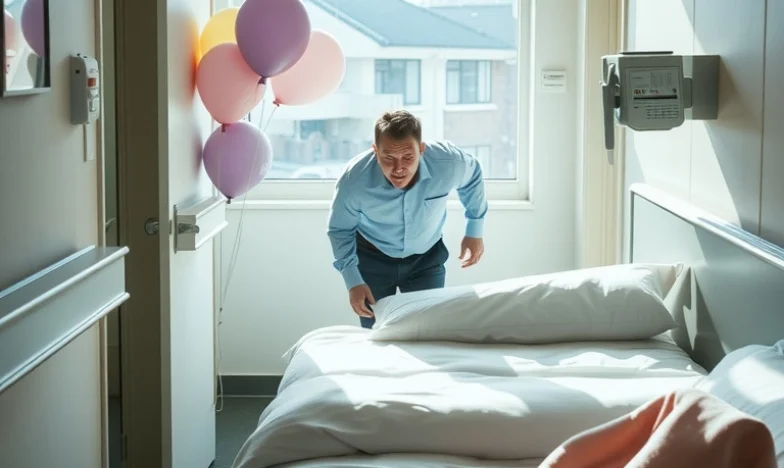
The balloons squeaked against the hospital corridor walls as I hurried along, my grip so tight on the ribbons that my knuckles had turned white. ‘Jan, slow down, mate, you’ll pop them,’ the porter called after me, but I barely heard him. My mind was racing, heart thumping in my chest like a jackhammer. I’d waited for this moment for months—no, years. Today, I was taking my wife, Emily, and our newborn twin girls home. The soft pink blanket lay folded on the back seat of the car, ready to wrap them up against the biting Manchester wind. I could already picture Emily’s tired but radiant smile, the girls’ tiny fists curling around my finger.
But as I pushed open the door to Room 12, the world seemed to tilt. The bed was stripped, the cot empty. No Emily. No babies. Just a single sheet of paper on the pillow, fluttering in the draft from the open window. My breath caught in my throat. I dropped the balloons, letting them bob against the ceiling, and snatched up the note. My hands shook so badly I could barely read the words.
‘Jan, I’m sorry. I had to go. Please don’t look for us. I’ll explain everything when I can. Love, Em.’
For a moment, I just stood there, the words blurring as tears stung my eyes. My knees buckled and I sat heavily on the edge of the bed, the note crumpling in my fist. What did she mean, she had to go? Where could she possibly have gone with two newborns? Why would she leave without a word, without me?
The nurse bustled in, her face falling when she saw me alone. ‘Mr. Taylor? Where’s Emily?’ she asked, glancing around as if my wife might be hiding behind the curtain. I handed her the note, unable to speak. She read it, her lips pursed, and then hurried out, muttering something about security.
The next hours blurred into a nightmare. The police arrived, asking questions I couldn’t answer. Had Emily seemed upset? Had she mentioned anyone who might want to harm her? Did we have problems at home? I shook my head, numb. We’d had our share of rows, sure—who doesn’t? Money was tight, and Emily’s mum had been ill for months, but we were happy. Weren’t we?
I called Emily’s mobile again and again, each time praying she’d pick up, each time hearing her voicemail. I left messages, my voice cracking: ‘Em, please, just tell me you’re safe. Please.’
Her mum, Margaret, arrived at the hospital, pale and trembling. ‘She wouldn’t just leave, Jan,’ she insisted, clutching my arm. ‘Not with the babies. She’s not well, you know that. She’s been so tired, so anxious.’
I remembered the nights Emily had lain awake, staring at the ceiling, her hand resting on her swollen belly. ‘What if I’m not a good mum?’ she’d whispered. I’d held her, promised her we’d be fine. But had I missed something? Had she been crying out for help and I’d been too wrapped up in my own excitement to notice?
The police searched the hospital CCTV. They found footage of Emily, pale and drawn, pushing the twins in their tiny pram out of the side entrance at dawn. She looked over her shoulder, as if afraid of being seen. My heart broke watching it. Why didn’t she tell me?
Days passed. The press got wind of the story—’Mother and Newborn Twins Missing from Manchester Hospital’—and soon our faces were everywhere. I couldn’t leave the house without someone stopping me, asking if there was news. My phone buzzed with messages from friends, neighbours, even strangers. Some offered help. Others hinted at blame. ‘Was she depressed?’ ‘Did you argue?’ ‘Are you sure the babies are yours?’
That last question stung. I’d never doubted Emily, but now, in the silence of our empty flat, I replayed every conversation, every argument. She’d been distant lately, distracted. She’d started locking her phone, jumping when it buzzed. I’d asked her about it, but she’d brushed me off. ‘It’s just Mum, Jan. She’s not well.’
Margaret moved in with me, unable to face her own empty house. We sat up late, drinking tea that went cold, talking in circles. ‘She loved you, Jan,’ Margaret said one night, her voice trembling. ‘But she was scared. She said she couldn’t breathe sometimes, that everything was closing in.’
I thought about the pressure we’d been under. The rent arrears, the endless hospital appointments, the way Emily’s friends had drifted away after the babies were born. I’d tried to be strong, to hold it all together, but maybe I’d failed her.
A week after Emily disappeared, I found another note, slipped under the door. The handwriting was shaky, but it was hers.
‘Jan, I’m safe. The girls are safe. I just need time. Please don’t hate me. I love you.’
No address, no clue where she was. The police traced the postmark to Liverpool, but that was all. I drove there, wandering the streets, showing her photo to anyone who’d listen. No one had seen her. I started to lose hope.
Then, one night, my phone rang. A withheld number. I answered, heart in my mouth.
‘Jan?’ Her voice was barely more than a whisper.
‘Em! Where are you? Are you alright? Please, just come home.’
‘I can’t. Not yet. I’m sorry. I just… I need to sort things out. I need to be better for the girls. For you.’
‘Emily, please, let me help. We can get through this together.’
She was silent for a long moment. I heard a baby crying in the background. My heart twisted.
‘I love you, Jan. Tell Mum I’m sorry.’
The line went dead.
I slumped to the floor, sobbing. Margaret found me there, curled up like a child. She stroked my hair, her own tears falling onto my cheek. ‘She’ll come back,’ she whispered. ‘She just needs time.’
But time dragged on. Weeks turned into months. The police scaled back their search. The press lost interest. Friends stopped calling. I went back to work at the garage, moving through the days like a ghost. Every time the phone rang, my heart leapt, but it was never Emily.
I started seeing a counsellor, at Margaret’s urging. At first, I hated it—sitting in a stuffy room, talking about my feelings. But slowly, I began to understand. Emily hadn’t left because she didn’t love me. She’d left because she was drowning, and she didn’t know how to ask for help.
One evening, nearly a year after she disappeared, there was a knock at the door. I opened it to find Emily standing there, the twins in her arms. She looked thin, exhausted, but her eyes were clear. The girls stared at me, wide-eyed, identical curls framing their faces.
‘Jan,’ she said, her voice trembling. ‘I’m sorry. I want to come home.’
I pulled her into my arms, the girls squirming between us. We stood there, crying, laughing, holding each other as if we’d never let go.
It wasn’t easy. Emily needed help—real help. She was diagnosed with postnatal depression and started therapy. We went to family counselling, learned to talk, to listen. Some days were harder than others. There were setbacks, arguments, tears. But we faced them together.
Now, when I tuck the girls into bed, I think about that empty hospital room, the note on the pillow. I wonder how many other families are torn apart by silence, by fear, by the weight of expectations. I wish I’d seen the signs sooner, that I’d listened more, judged less.
Do we ever really know what someone else is going through? Or do we just see what we want to see, until it’s too late? If you were in my shoes, what would you have done differently?