Invisible Chains: The Awakening of a British Father

“You always take her side, Dad! Why can’t you ever see things from my point of view?”
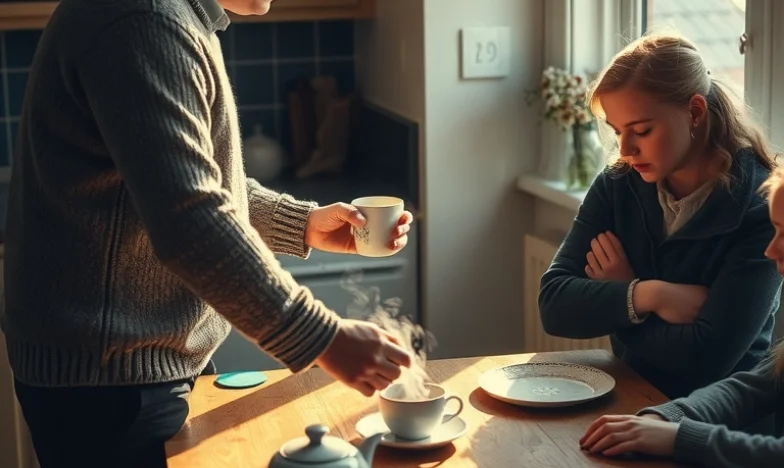
The words echoed through the kitchen, sharp as broken glass. I stood by the sink, hands trembling, the mug of tea I’d made for myself untouched and cooling. My youngest, Sophie, glared at me from across the table, her cheeks flushed with anger. Her older sister, Emily, sat rigid beside her, arms folded, lips pressed into a thin line. The air between them crackled with resentment.
I never imagined it would come to this. I’d always prided myself on being a fair father, the sort who listened, who tried to do right by his children. But somewhere along the way, I’d lost sight of what mattered. I’d let my own fears and insecurities twist my intentions, and now, my family was paying the price.
It started, I suppose, with the divorce. Helen and I had tried to keep things civil, for the girls’ sake. We’d split the house in Surrey, agreed on joint custody, and promised to put the girls first. But promises are easy to make and hard to keep. The girls were teenagers then, already grappling with exams, friendships, and the thousand tiny heartbreaks of growing up. I thought I could shield them from the worst of it. I was wrong.
Emily, the eldest, was always the responsible one. She took on too much, tried to fill the gaps Helen and I had left. Sophie, two years younger, rebelled. She skipped school, dyed her hair blue, brought home friends I didn’t trust. I tried to help, to guide them, but every word I said seemed to drive them further apart.
One evening, after another shouting match, Emily stormed out. I found her in the garden, sitting on the damp grass, knees drawn to her chest. “Why does she get away with everything?” she whispered, not looking at me. “You never punish her. You just let her do whatever she wants.”
I knelt beside her, unsure what to say. “She’s struggling, Em. She needs support.”
“And I don’t?” Her voice cracked. “I’m struggling too, Dad. But you never notice.”
I reached for her hand, but she pulled away. That was the first time I realised how deep the rift had grown. I’d been so focused on Sophie’s troubles that I’d neglected Emily’s pain. Guilt gnawed at me, but I didn’t know how to fix it.
Things only got worse when Sophie failed her A-levels. She blamed everyone but herself, but mostly Emily. “You think you’re so perfect,” she spat one night, slamming her bedroom door. “Dad always listens to you. He never listens to me.”
Emily retreated further into herself, spending hours at the library, volunteering for every after-school club she could find. She barely spoke to Sophie, and when she did, it was only to argue. I tried to mediate, but my words fell flat. The house felt colder, emptier, even when we were all together.
Helen remarried, moved to Bristol. The girls spent alternate weekends with her, but the journeys were tense, filled with sullen silence. I tried to keep things normal at home, cooking their favourite meals, organising movie nights, but nothing seemed to bridge the gap between them.
One Sunday, after a particularly bitter argument, Sophie packed a bag and left. She was seventeen, old enough to make her own choices, but I was terrified. I called her friends, drove around the estate, but she wouldn’t answer her phone. Emily watched me from the doorway, her face unreadable.
“She’ll come back,” she said quietly. “She always does.”
But this time, she didn’t. Days passed, then a week. I barely slept, haunted by the thought of Sophie alone somewhere, angry and hurt. When she finally called, her voice was small, defeated. “Can I come home?”
“Of course,” I said, relief flooding through me. “Of course you can.”
But when she returned, things were worse than ever. Emily refused to speak to her. Sophie spent most of her time in her room, headphones on, eyes red from crying. I felt helpless, trapped in a nightmare of my own making.
One night, after they’d both gone to bed, I sat at the kitchen table, head in my hands. The house was silent, but my mind was loud with regret. I thought about my own father, a stern man who never showed emotion, who believed that discipline was the answer to everything. I’d sworn I’d be different, but here I was, repeating his mistakes in my own way.
The next morning, I tried to talk to them. I called them into the living room, sat them down on the old sofa. “I know I’ve made mistakes,” I began, my voice shaking. “I thought I was helping, but I see now that I’ve hurt you both. I’m sorry.”
Sophie looked away, biting her lip. Emily stared at the floor. The silence stretched between us, heavy and uncomfortable.
“I just want us to be a family again,” I said, my eyes stinging with tears. “I want you to talk to each other. To forgive each other. To forgive me.”
For a moment, I thought they might. Emily’s eyes softened, and Sophie’s shoulders relaxed. But then Emily stood up, her face hardening. “It’s not that simple, Dad. You can’t just say sorry and expect everything to be okay.”
She walked out, and Sophie followed, slamming the door behind her. I sat there, alone, the weight of my failure pressing down on me.
Months passed. The girls barely spoke, except to argue. I tried everything—family therapy, weekend trips, even a puppy—but nothing worked. The house felt like a battlefield, every conversation a potential explosion.
Then, one evening, I overheard them arguing in the hallway. Their voices were low, urgent, different from their usual shouting matches.
“You think I wanted this?” Sophie hissed. “You think I like being the screw-up?”
“I just wish you’d try,” Emily replied, her voice trembling. “I wish you’d stop making everything so hard.”
“I wish you’d stop judging me.”
There was a long pause. Then, quietly, Sophie said, “I’m scared, Em. I don’t know what I’m doing. I feel like I’m drowning.”
Emily’s voice softened. “Me too.”
I stood in the kitchen, heart pounding, afraid to move in case I broke the fragile peace. For the first time in years, I heard them talking—not arguing, but really talking. I realised then that I couldn’t fix everything. I couldn’t force them to forgive each other, or me. All I could do was be there, to listen, to support them, to love them even when they pushed me away.
Slowly, things began to change. The arguments became less frequent, the silences less heavy. Emily helped Sophie with her coursework, and Sophie started coming out of her room more often. We had dinner together, sometimes even laughed. It wasn’t perfect, but it was something.
Now, years later, I look back and wonder if I could have done things differently. If I’d listened more, judged less, maybe the scars wouldn’t run so deep. But I also know that families are messy, complicated things. We hurt each other, sometimes without meaning to. The important thing is to keep trying, to keep reaching out, even when it feels hopeless.
Sometimes, late at night, I sit in the quiet house and think about those invisible chains—the ones that bind us together, and the ones that hold us back. I wonder: is it ever truly possible to mend what’s been broken? Or do we just learn to live with the cracks, hoping that love is enough to hold us together?
What would you do, if you were in my place? Would you keep trying, even when it hurts? Or would you let go, and hope your children find their own way back to each other?