They Feast, We Scrape By: Where Is Justice in Our Family?

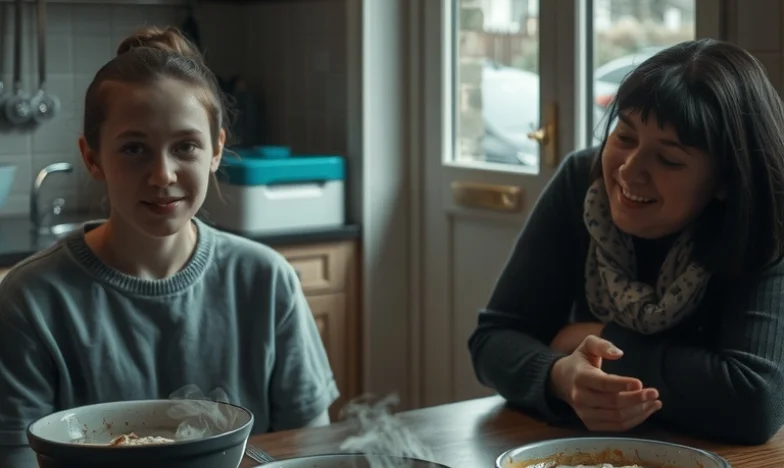
“You’re having that again?” My stepbrother, Oliver, stands in the doorway, his voice dripping with something between pity and disdain. He’s just come in from the rain, his trainers squeaking on the kitchen floor, a takeaway bag swinging from his hand. My mother and I are already seated at the table, two chipped bowls of porridge steaming in front of us. I look up, spoon halfway to my mouth, and force a smile. “It’s what we’ve got, isn’t it?” I say, trying to sound light, but my voice cracks.
He shrugs, glances at his sister, Amelia, who’s scrolling on her phone, and they both disappear upstairs, laughter echoing behind them. The door slams. I stare at the closed door, the silence that follows louder than their laughter. My mother sighs, pushing her bowl away. “Don’t mind them, love. They’ve never had to worry about money.”
But I do mind. I mind every time I see their father’s car pull up, boot full of shopping bags from Waitrose, while Mum and I count pennies at the till in Lidl. I mind when they order Deliveroo and the smell of pizza fills the house, while we eat porridge for the third night in a row. I mind when they talk about their plans for Ibiza in the summer, while I wonder if I’ll even be able to afford the school trip to York.
It wasn’t always like this. Before Mum married David, it was just the two of us, scraping by but happy. We had our routines, our little jokes, our Friday night movie marathons with popcorn and hot chocolate. Then David came along, with his big house in Surrey and his two perfect children. At first, I thought it would be like the families on telly – blended, happy, everyone getting along. But reality is messier. David’s money is his, and his children are his. Mum and I are… well, we’re just here.
I remember the first time I realised things wouldn’t be fair. It was Christmas, our first together. David gave Oliver and Amelia the latest iPhones, wrapped in shiny paper with gold ribbons. I got a scarf. Mum got a candle. I tried not to care, but I saw the look in Mum’s eyes, the way she blinked back tears as she thanked David. “It’s the thought that counts,” she whispered to me later, but I could see she didn’t believe it.
Now, every day feels like a reminder of what we don’t have. David works late, always busy, always tired. When he’s home, he talks to his children about their grades, their sports, their friends. He barely looks at me. Mum tries to bridge the gap, but she’s tired too, working shifts at the hospital, coming home with aching feet and dark circles under her eyes. Sometimes I hear her crying in the bathroom at night, and I want to go to her, but I don’t know what to say.
Tonight, after Oliver and Amelia disappear, Mum and I eat in silence. The porridge is bland, but I force it down. “Do you want some jam?” Mum asks, her voice small. I shake my head. We both know there’s only enough for one slice of toast tomorrow morning.
After dinner, I go upstairs to my room. I can hear music thumping from Oliver’s room, laughter from Amelia’s. I open my laptop, the screen cracked from when it fell off my bed last year. It takes ages to load. I check my emails, hoping for something – a reply from the school about the bursary, maybe. Nothing. I scroll through Instagram, see photos of my friends at Nando’s, at the cinema, on holiday. I close it quickly, the ache in my chest growing.
Later, I hear voices in the hallway. David is home. “Did you eat?” he asks, his voice muffled. “Yeah, we got pizza,” Oliver replies. I hear the rustle of bags, the clink of bottles. “Where’s your mother?” David asks. “Downstairs, I think.”
I hear footsteps on the stairs, then the living room door creaks open. I creep out onto the landing, peering down. David stands in the doorway, looking at Mum. “You alright?” he asks, not unkindly, but distracted. “Yes, just tired,” Mum replies. He nods, already turning away. “I’ll be in my office.”
I go back to my room, close the door, and curl up on my bed. I think about fairness, about justice. Why do some people get everything, while others have to fight for scraps? Why does David treat us like guests in our own home? Why do Oliver and Amelia look at me like I’m something they scraped off their shoe?
The next morning, I wake to the smell of bacon. My stomach growls. I go downstairs, hoping maybe there’s enough for everyone. But the kitchen is a mess of plates and crumbs, the frying pan still greasy on the hob. Oliver and Amelia are gone, their laughter echoing from the driveway as they get into their dad’s car. Mum is already at work. I make myself a cup of tea, the last of the milk swirling in the mug. I sit at the table, staring at the empty chairs, and feel the weight of loneliness settle over me.
At school, I try to forget. I focus on my lessons, on my friends. But even here, the divide follows me. My uniform is second-hand, the hem coming loose. My shoes are scuffed. I laugh along with my friends, but I can’t join them when they go out for lunch. “Maybe next time,” I say, forcing a smile. They don’t ask anymore.
One afternoon, I come home to find Mum sitting at the kitchen table, a letter in her hand. Her face is pale. “What’s wrong?” I ask, my heart pounding. She hands me the letter. It’s from the council – our housing benefit has been cut. “We can’t afford to stay here,” she whispers. “Not unless David helps.”
I feel anger rise in my chest. “He won’t,” I say. “He never does.”
That night, after everyone’s gone to bed, I go downstairs and find David in his office, staring at his computer. I stand in the doorway, my hands shaking. “Can I talk to you?” I ask. He looks up, surprised. “Of course,” he says, but his eyes are already drifting back to the screen.
I take a deep breath. “Mum and I… we’re struggling. The benefit’s been cut. We can’t afford to stay here unless you help.”
He sighs, rubs his temples. “I already pay the mortgage. I pay for the bills. What more do you want?”
I swallow hard. “It’s not just about money. It’s about… fairness. About feeling like we belong.”
He looks at me, really looks at me, for the first time in months. “I’m doing my best,” he says quietly. “It’s not easy, blending families. There’s only so much I can do.”
I want to scream, to tell him that his best isn’t enough, that we’re drowning while his children float above us, untouched. But I just nod, turn, and leave.
In bed that night, I listen to the rain tapping against the window. I think about justice, about what it means to be a family. Is it just about sharing a roof, or is it about sharing everything – the good and the bad, the joy and the pain? I don’t have the answers. All I know is that I’m tired of pretending everything is fine.
The next morning, I find Mum in the kitchen, her eyes red. “We’ll figure something out,” she says, trying to sound brave. I hug her, holding on tight. “We always do,” I whisper, but I’m not sure I believe it anymore.
As I leave for school, I glance back at the house – our house, but not really ours. I wonder how long we’ll be able to stay, how long we’ll keep scraping by while others feast. I wonder if things will ever change, if justice will ever find its way to our doorstep.
Do you ever feel like you’re on the outside, looking in? Like justice is something that happens to other people, but never to you? I do. Every single day.