The Day My Mother Vanished: A British Family’s Unravelling

“Where’s Mum?” I asked, my voice trembling as I stood in the hallway, clutching the edge of my too-tight bridesmaid’s dress. Dad’s face was ashen, his hands shaking as he fumbled with his phone, dialling and redialling. The house was filled with the scent of lilies and the distant sound of church bells, but all I could hear was the thud of my own heart. Auntie Jean was crying in the kitchen, mascara streaking down her cheeks, while my little brother, Jamie, sat on the stairs, swinging his legs and staring at the floor. It was supposed to be the happiest day of Mum’s life. Instead, it was the day she disappeared.
I was twelve, old enough to understand the importance of a wedding, but too young to grasp how someone could simply vanish. The police came, their voices low and serious, asking questions I couldn’t answer. Did she seem upset? Had she argued with anyone? Did she say anything strange? I shook my head, replaying the morning in my mind: Mum humming as she did my hair, her hands gentle but distracted. The way she paused at the window, staring out at the garden, her eyes distant. I’d asked if she was nervous. She’d smiled, but it hadn’t reached her eyes. “Just a bit, love. It’s a big day.”
The days that followed blurred into one long ache. Dad barely spoke, moving through the house like a ghost. The wedding cake sat untouched in the dining room, the flowers wilted, the cards unopened. People whispered in the village shop, their voices dropping as I passed. “Such a shame. Poor children. Do you think she ran off?” The vicar came round with casseroles and prayers, but nothing filled the hollow space where Mum should have been.
Years passed, and life moved on, or at least pretended to. Dad remarried—a quiet woman named Linda, who tried her best but could never quite fill the gap. Jamie grew sullen, getting into fights at school. I threw myself into my studies, desperate for control, for answers. Every birthday, every Christmas, I waited for a sign—a letter, a phone call, anything. But the silence was absolute.
It wasn’t until I was twenty-four, living in a cramped flat in Canterbury, that the past came crashing back. I was wandering through a car boot sale in Whitstable, half-heartedly browsing for books, when I saw it: a wedding dress, yellowed with age, draped over a folding chair. My breath caught. I recognised the lace, the tiny pearl buttons. I’d seen it in old photos, in the box under Mum’s bed. My mother’s dress.
I approached the stall, my hands shaking. The woman behind the table was older, her hair dyed a brassy blonde. “Lovely, isn’t it?” she said, smoothing the fabric. “Came from a house clearance in Ashford. Shame to see it go to waste.”
I stared at her, my mind racing. “Do you know who owned it?”
She shrugged. “No idea, love. Just turned up with a load of other bits. You interested?”
I nodded, barely trusting myself to speak. I bought the dress for a tenner, clutching it to my chest as I hurried back to my car. My hands shook as I examined it, searching for clues. In the lining, I found a scrap of paper, yellowed and brittle. A name and address, written in Mum’s handwriting: “Eleanor Marsh, 17 Willow Lane, Ashford.”
I drove to Ashford that afternoon, my heart pounding. The house was small, tucked behind overgrown hedges. I knocked, half-hoping no one would answer. But the door opened, and a woman peered out—older, her hair grey, but unmistakably my mother.
“Mum?” My voice broke on the word. She stared at me, her face crumpling. “Oh, Sophie…”
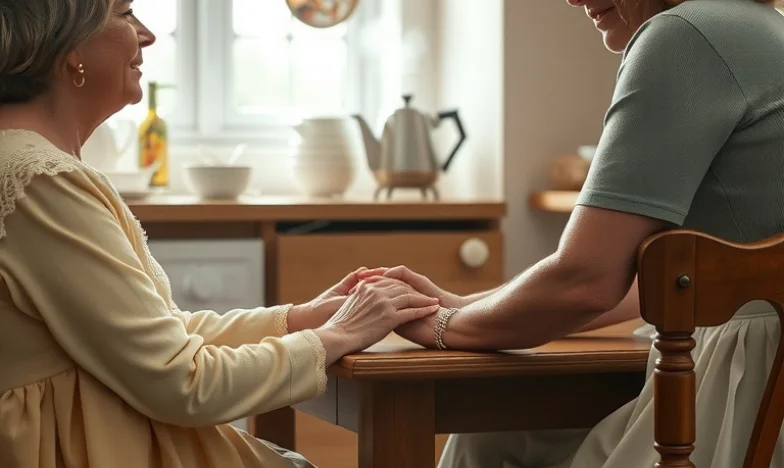
We sat in her tiny kitchen, mugs of tea cooling between us. She told me everything—how she’d panicked on the morning of the wedding, overwhelmed by fear and doubt. How she’d felt trapped, suffocated by expectations, by the weight of being the perfect wife and mother. She’d packed a bag and walked out, leaving behind the life she’d built. She’d tried to call, to write, but couldn’t find the words. Shame kept her away, year after year, until it was too late to come back.
I listened, anger and grief warring inside me. “You left us,” I whispered. “You left me.”
She reached for my hand, her eyes shining with tears. “I know. And I’m so sorry. I thought I was doing the right thing, but I was wrong. I’ve regretted it every day.”
We talked for hours, picking over old wounds, trying to make sense of the past. She told me about her new life—her job at the library, her friends, the quiet routines she’d built. She asked about Dad, about Jamie. I told her the truth: that we’d survived, but never really healed.
When I left, the sun was setting, painting the sky with gold and pink. I drove home in silence, the dress beside me, heavy with memories. I didn’t know if I could forgive her, or if I even wanted to. But for the first time in years, I felt something shift—a crack in the wall I’d built around my heart.
Back in my flat, I hung the dress in my wardrobe, unsure what to do with it. I called Jamie, told him what I’d found. He was silent for a long time, then said, “Maybe it’s time we stopped looking for answers and started living again.”
I don’t know if I’ll ever understand why Mum left, or if we can ever be a family again. But I do know this: sometimes, the truth hurts more than the lies we tell ourselves. And sometimes, finding the truth is the only way to move on.
Would you have forgiven her? Or would you have walked away, too?