The Locks on Rosewood Lane

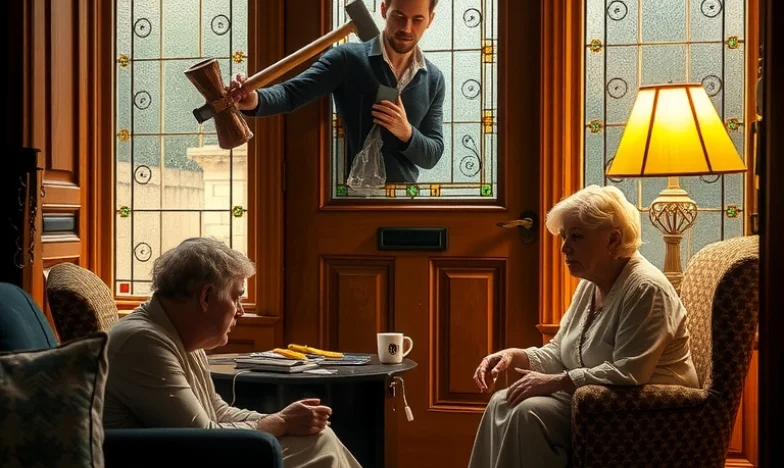
The banging started before the sun had even risen, rattling the stained-glass panels of the front door and echoing through the narrow hallway of my house on Rosewood Lane. I jolted upright in my armchair, heart pounding, the mug of cold tea slipping from my hand and shattering on the parquet floor. My daughter-in-law’s shrill voice pierced the morning silence: “Margaret! Margaret, open this door! We know you’re in there!”
I pressed my palm to my chest, trying to steady my breathing. The house, my sanctuary for nearly forty years, felt suddenly small and fragile. The night before, I’d changed every lock, the metallic click of the locksmith’s tools still ringing in my ears. I’d watched him work, his hands steady, his eyes kind but curious. “You sure about this, love?” he’d asked, glancing at the family photos lining the mantelpiece. I’d nodded, unable to explain the knot of dread in my stomach.
Now, as the door shook under the force of my son’s fists, I wondered if I’d made a terrible mistake. “Mum!” Tom’s voice was rough, desperate. “Let us in! We need to talk!”
I stayed silent, clutching the phone in my hand. I could call the police, but the thought made me sick. My own son, standing on my doorstep with his wife, both of them acting as if the house was already theirs. I heard a metallic clatter, then a low, furious muttering. “She’s lost it, Tom! She’s lost her mind!” That was Sophie, her words sharp as broken glass. “We have every right to be here!”
A pause, then Tom’s voice, lower now, but no less angry. “She’s not listening. I’ll get in, one way or another.”
I peered through the frosted glass, my hands trembling. Tom was standing on the path, his face red, his jaw clenched. Sophie hovered behind him, arms folded, her blonde hair wild in the wind. Then I saw it: Tom hefted a sledgehammer, the same one his father had used to break up the old shed in the garden. My breath caught in my throat.
“Tom, don’t you dare!” I shouted, my voice cracking. “This is my house!”
He ignored me, raising the sledgehammer high. “Of course it’s your house, Mum, but you’re not thinking straight! We just want to help!”
“Help?” I spat the word out. “By breaking down my door?”
Sophie stepped forward, her face twisted with rage. “You’re being unreasonable, Margaret! We’ve got a right to be here. Tom’s your only son!”
I felt the weight of her words, heavy and cold. Only son. As if that gave him the right to take everything from me. As if my grief, my memories, meant nothing.
Suddenly, a voice behind me, calm and firm: “Stop. I’ll handle this.”
I spun around. It was Alice, my neighbour from across the road, standing in her dressing gown, her grey hair pulled back in a bun. She must have heard the commotion and slipped in through the back door I’d forgotten to lock. She put a gentle hand on my shoulder and walked to the door, unlocking it with a swift motion.
The door swung open, and Tom froze, sledgehammer still raised. Sophie’s mouth fell open. Alice stared them down, her eyes steely. “What do you think you’re doing?” she demanded. “This isn’t your house. Margaret’s grieving. You should be ashamed.”
For a moment, no one spoke. The cold morning air rushed in, carrying the scent of wet earth and distant traffic. Tom lowered the sledgehammer, his face crumpling. “Mum, we just… we’re worried about you. You’ve been shutting us out.”
I stepped forward, my voice shaking. “You’re not worried. You’re angry because I changed the locks. Because you think you’re entitled to this house.”
Sophie scoffed. “We’re family, Margaret. We’re just trying to help you move on. You can’t live here alone forever.”
Alice cut in, her voice sharp. “She’s not alone. She’s got friends. And she’s got her own mind. You two need to leave, before I call the police.”
Tom looked at me, his eyes pleading. “Mum, please. Let’s just talk. Inside. Like a family.”
I shook my head, tears burning my eyes. “You tried to break down my door, Tom. Your father would be ashamed.”
He flinched, the words hitting him like a slap. Sophie grabbed his arm, pulling him back. “Come on, Tom. She’s not going to listen.”
They turned and walked away, the sledgehammer dragging behind them. I watched them go, my heart breaking. Alice closed the door gently, locking it again. She turned to me, her eyes softening. “You did the right thing, Margaret. Don’t let them bully you.”
I sank to the floor, sobbing. Alice knelt beside me, holding my hand. “You’re not alone,” she whispered. “Not ever.”
The rest of the day passed in a blur. I sat by the window, watching the rain streak down the glass, replaying the morning over and over in my mind. The house felt different now—emptier, somehow, but also safer. I thought of my husband, his laughter echoing in the kitchen, his hands warm on my shoulders. He’d worked so hard for this house, every brick and beam a testament to his love for me.
That evening, Tom called. I let it ring, my hands shaking. He left a message: “Mum, I’m sorry. I just… I miss Dad. I don’t know how to do this without him. Please call me.”
I listened to the message three times, tears streaming down my face. I wanted to call him back, to tell him I loved him, that I understood his pain. But I couldn’t forget the look in his eyes, the way he’d raised that sledgehammer, ready to destroy the only thing I had left.
Days passed. The phone rang, the postman knocked, but I didn’t answer. I wandered the house, touching the photos, the worn armchairs, the chipped mugs. Everything reminded me of what I’d lost—and what I was fighting to keep.
One afternoon, Sophie appeared at the gate, her face pale. She didn’t shout this time. She just stood there, shivering in the drizzle. I opened the window, wary.
“Margaret,” she called softly. “I’m sorry. We shouldn’t have come like that. We’re just scared. Tom’s not coping. Neither am I.”
I wanted to believe her, but the memory of her voice, sharp and accusing, lingered. “You need to give me space,” I said. “This house is all I have left of him. I can’t let it go. Not yet.”
She nodded, wiping her eyes. “I understand. I do. But please, don’t shut us out forever.”
I closed the window, my heart aching. I knew I couldn’t live like this—locked away, haunted by ghosts. But I also knew I couldn’t let them take everything from me, not while I still had breath in my body.
That night, I sat in the living room, the house quiet around me. I thought of Tom as a boy, his laughter ringing through the garden, his small hand in mine. I thought of Sophie, her kindness before grief twisted her into someone I barely recognised. I thought of my husband, gone now, but still here in every corner of this house.
I picked up the phone, dialled Tom’s number, and waited. He answered on the first ring, his voice thick with tears. “Mum?”
“I’m here,” I said, my own voice trembling. “But things have to change. I won’t be bullied in my own home. If you want to talk, you come as my son, not as someone trying to take what isn’t yours.”
He was silent for a long time. Then, quietly: “I’m sorry, Mum. I just… I miss him so much.”
“I know,” I whispered. “So do I.”
We talked for a while, the words awkward but honest. When I hung up, I felt lighter, as if a weight had shifted. The house was still mine, but maybe—just maybe—I could let a little light in again.
Now, as I sit here, watching the dawn break over Rosewood Lane, I wonder: How do you protect what you love without losing those you love most? And when the locks are changed, can the heart ever truly open again?