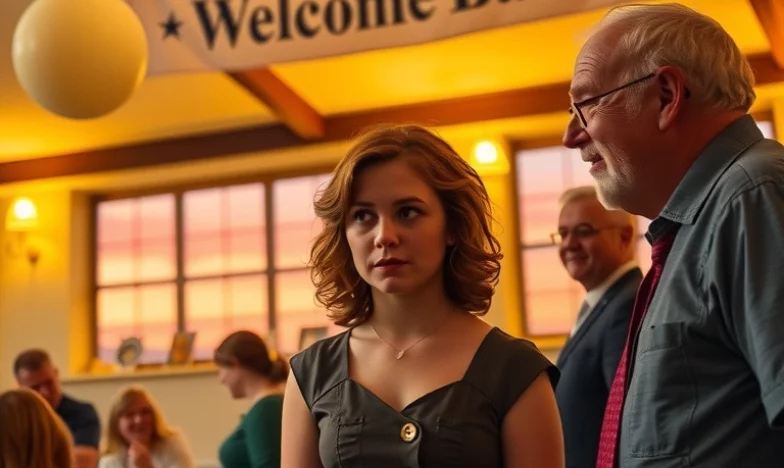
The Wallflower at the Reunion

“You’re going to be late, Suzie. Again.” Mum’s voice echoed from the kitchen, sharp as ever, as I stood in front of the mirror, tugging at the hem of my dress. My hair, a wild tangle of copper, refused to be tamed, and my freckles seemed to have multiplied overnight. I could hear the clatter of her teacup, the familiar sound that always meant she was anxious.
I stared at my reflection, remembering the words she’d always said: “You’ll blossom, love, just you wait. I was a late bloomer too.” But I was twenty-eight now, and still waiting. I’d always been the least remarkable girl in my class—short, skinny, with hair the colour of autumn leaves and a face that never quite fit in. I envied the tall, blonde girls with their easy laughter and effortless confidence. Even now, the thought of seeing them again made my stomach twist.
The invitation to the class reunion had arrived two weeks ago, a glossy card with gold lettering and a photo of our old school. I’d almost thrown it away, but something stopped me. Maybe it was curiosity, or maybe it was the hope that I’d finally prove to myself that I’d changed. That I was no longer the invisible girl.
Mum appeared in the doorway, arms folded. “You look lovely, Suzie. Stop fussing.”
I forced a smile. “Do I really, Mum? Or are you just saying that?”
She sighed, coming over to smooth my hair. “You’re beautiful. You always have been. They just didn’t see it.”
I wanted to believe her, but the old doubts clung to me like a second skin. I grabbed my coat and headed out, the cold evening air biting at my cheeks as I walked to the bus stop. The streets of our little town in Yorkshire were quiet, the sky streaked with the last pinks of sunset. I could see the lights of the community hall in the distance, and my heart thudded harder with every step.
Inside, the hall was buzzing with laughter and music. Balloons bobbed against the ceiling, and a banner read: “Class of 2012 – Welcome Back!” I hesitated in the doorway, scanning the crowd for a familiar face. There they were—Sophie, with her platinum hair and perfect smile, surrounded by a gaggle of old friends. I felt twelve years old again, awkward and out of place.
“Susannah! Is that you?”
I turned to see Mr. Davies, our old English teacher, beaming at me. “You look wonderful! What are you doing these days?”
I stammered, “Oh, I’m working at the library in Leeds. Nothing too exciting.”
“Nonsense! Books are magic, Susannah. You always had your nose in one.”
His kindness warmed me, but I could feel eyes on me—Sophie’s, in particular. She sauntered over, glass of wine in hand, her friends trailing behind.
“Well, if it isn’t little Suzie. I almost didn’t recognise you!” Her voice was syrupy sweet, but her eyes flickered with something sharper.
“Hi, Sophie,” I managed, forcing a smile.
She looked me up and down. “You look… different. Grown up.”
I wasn’t sure if it was a compliment or an insult. “Thanks. You look the same as ever.”
She laughed, tossing her hair. “Some things never change, right?”
I felt the old jealousy flare up. Sophie had always been the centre of attention, the girl everyone wanted to be. I remembered the way she’d whispered about me in the corridors, the way she’d laughed when I tripped over my own feet in PE. I tried to push the memories away, but they clung to me, sharp and painful.
As the evening wore on, I drifted from group to group, making small talk, laughing at jokes I didn’t find funny. I watched as old friendships rekindled, as couples who’d once dated eyed each other across the room. I felt like a ghost, haunting the edges of my own life.
At the buffet table, I bumped into Tom, the boy I’d had a hopeless crush on in Year 10. He was taller now, broader, with a kind smile that made my heart ache.
“Susannah! How are you?”
“I’m good, thanks. You?”
He grinned. “Can’t complain. Working in Manchester now. Still playing football on Sundays.”
We chatted for a while, and for the first time that night, I felt at ease. He asked about my job, my family, my life. I told him about the library, about Mum’s garden, about the little flat I’d just moved into. He listened, really listened, and I realised how rare that was.
“Do you remember that time in Year 11, when you read your poem in assembly?” he said suddenly.
I blushed. “God, don’t remind me. I was terrified.”
He laughed. “You were brilliant. I always thought you were brave, you know. You just didn’t see it.”
His words stunned me. Brave? Me? I’d always felt like a coward, hiding behind my books and my silence. But maybe, just maybe, I’d been wrong.
The night wore on, and I found myself relaxing, even enjoying myself. I danced with old friends, shared stories, and laughed until my sides hurt. For the first time, I felt like I belonged.
But as midnight approached, the old insecurities crept back in. I caught sight of Sophie, still surrounded by admirers, her laughter ringing out across the hall. I wondered if I’d ever be like her—confident, adored, untouchable.
On the walk home, the streets were empty, the air crisp and still. I thought about the girl I’d been, the girl I still was in so many ways. I thought about Mum’s words, about Tom’s kindness, about the way I’d finally let myself be seen.
When I got home, Mum was waiting up, a cup of tea in her hands. “Well?” she asked, eyes twinkling.
I smiled, sinking into the sofa beside her. “It was… good. Really good.”
She squeezed my hand. “See? I told you. You’re more than you think, Suzie.”
I looked at her, at the lines on her face, the warmth in her eyes. Maybe I’d never be the girl in the centre of the room, but maybe that was okay. Maybe being seen wasn’t about being the loudest or the prettiest. Maybe it was about being real.
I lay awake that night, staring at the ceiling, thinking about all the ways I’d hidden myself over the years. I wondered what would happen if I stopped. If I let people see me—the real me, freckles and all.
Do we ever really outgrow the shadows of our past? Or do we just learn to live in the light, one small step at a time?