The Weight of Old Wounds: A Family Story from Lublin to London

“You can’t just turn up after all these years and expect everything to be fine!” My voice echoed off the kitchen tiles, sharp and trembling. The kettle whistled behind me, but I barely heard it. My mother, her hands shaking as she reached for her mug, didn’t meet my eyes. The silence between us was thick, the kind that settles in after a storm but promises another soon.
I am Kasia Kowalska, and my family has never been a model of harmony. I grew up in Lublin, in a cramped flat where the walls were thin and the arguments even thinner. My mother, Anna, was always tired, always anxious, and my father, when he was around, was usually drunk. My grandmother, Jadwiga, ruled the roost with a sharp tongue and a sharper eye for gossip. But it was my great-grandmother, Helena, who cast the longest shadow over us all.
Helena was a force of nature, the kind of woman who survived wars, hunger, and heartbreak, but left a trail of bitterness in her wake. She was the one who, when I was twelve, told my mother she should have married someone better, someone with prospects. She was the one who, when my cousin Marek’s wife lost their baby, whispered that it was probably for the best, given the family’s luck. And she was the one who, when I needed her most, turned her back on me.
I was sixteen when it happened. I’d come home late from school, my face bruised from a fight I hadn’t started. My father was gone, again, and my mother was crying in the bedroom. I stood in the kitchen, blood on my lip, and Helena looked at me with those cold blue eyes. “You’re just like your father,” she spat. “Weak. Trouble follows you.”
That was the last time I spoke to her. I packed my things and left for university in Warsaw, then London, determined to carve out a life that had nothing to do with the Kowalska legacy. I worked two jobs, studied at night, and built a new family of friends who didn’t know the weight of my surname. I met Tom, a kind-hearted Englishman who loved me for my stubbornness and my stories, and together we had a daughter, Emily.
But the past has a way of finding you, even across borders. My mother called last week, her voice thin and desperate. “Helena wants to meet Emily,” she said. “She’s old, Kasia. She doesn’t have much time.”
I laughed, bitter and sharp. “She never wanted to meet me. Why should I let her near my daughter?”
“She’s changed,” my mother pleaded. “She’s sorry.”
But can people like Helena ever really change? Or do they just grow old and lonely, haunted by the ghosts of their own making?
I spent the next few days haunted by memories. The smell of vodka on my father’s breath. The sound of my mother’s sobs through the wall. The way Helena’s words could cut deeper than any slap. I remembered the Christmas when Marek, my cousin, showed up drunk and smashed the good china, and Helena blamed his wife for not keeping him in line. I remembered the time my mother tried to leave my father, only to be told by Helena that “a woman’s place is with her husband, no matter what.”
And yet, there were moments of tenderness, too. Helena teaching me how to make pierogi, her hands surprisingly gentle as she guided mine. The way she sang old songs from her childhood, her voice soft and wistful. The stories she told of surviving the war, of losing everything and starting again. I wondered if, beneath the hardness, there was a woman who had simply never learned how to love without hurting.
Tom found me crying in the kitchen one night, the letter from my mother crumpled in my fist. “You don’t have to do anything you’re not ready for,” he said, wrapping his arms around me. “But maybe… maybe it would help to see her. For closure, if nothing else.”
I shook my head. “She doesn’t deserve it. She never apologised. She never even tried.”
“But do you?” he asked gently. “Deserve to carry this forever?”
The question lingered, heavy and uncomfortable. I watched Emily sleep that night, her small hand curled around her favourite bear, and wondered what kind of legacy I was passing on to her. Was I protecting her from pain, or teaching her to hold grudges as tightly as I did?
The next day, I called my mother. “If Helena wants to meet Emily, she can come here. But I’m not promising anything.”
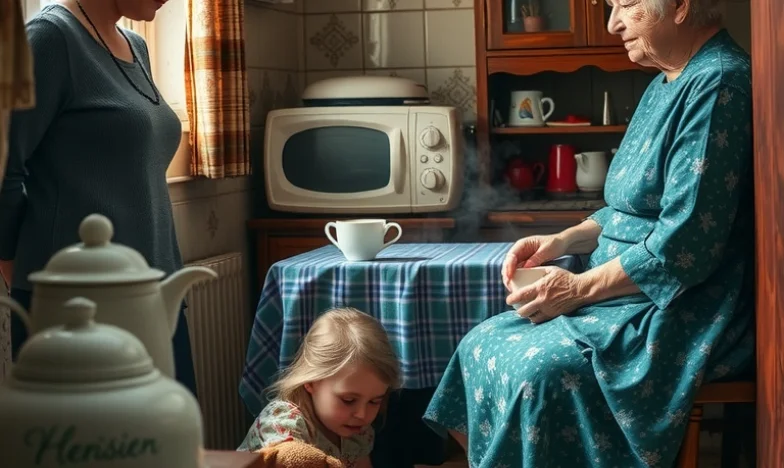
The day of the visit, I was a bundle of nerves. I cleaned the flat until it sparkled, then sat by the window, watching for the familiar figure. When Helena finally arrived, she looked smaller than I remembered, her once-imposing frame stooped with age. Her eyes, though, were still sharp, scanning the room with a mixture of curiosity and caution.
Emily, oblivious to the tension, ran up to her. “Are you my great-grandma?” she asked, her voice bright.
Helena smiled, a real smile, and knelt down to Emily’s level. “Yes, darling. I am.”
I watched them, my heart pounding. Helena looked up at me, her eyes softening. “You have a beautiful daughter, Kasia.”
I nodded, unable to speak. The silence stretched between us, filled with all the things we’d never said.
After tea, Helena turned to me. “I know I wasn’t a good mother. Or grandmother. I thought I was doing what was right, but I see now how much I hurt you. I’m sorry, Kasia. Truly.”
The words hung in the air, fragile and uncertain. I wanted to believe her, to let go of the anger I’d carried for so long. But forgiveness isn’t a switch you can flip. It’s a slow, painful process, one that starts with a single step.
We sat in silence, the three generations of Kowalska women, bound by blood and brokenness. Emily chattered away, oblivious to the storm raging beneath the surface. For the first time, I wondered if it was possible to break the cycle, to build something new from the ashes of the past.
As Helena left, she squeezed my hand. “Thank you for letting me see her. I hope… I hope you can find it in your heart to forgive me one day.”
I watched her go, my heart heavy but lighter than it had been in years. Maybe forgiveness isn’t about letting someone off the hook. Maybe it’s about freeing yourself from the weight of old wounds.
I look at Emily now, her laughter filling the flat, and I wonder: Can we ever truly escape the shadows of our past? Or do we simply learn to live with them, one day at a time?