Shadows of the Past: A Journey Towards Family Warmth

“You’re not even listening, are you, Mark?” Kasia’s voice cut through the fog in my head as I stood by the window, watching the rain streak down the glass. I turned, startled, clutching Tom’s tiny Spider-Man backpack a little too tightly.
“I am, love. Just… thinking.”
She sighed, her eyes softening. “It’s only a weekend. My parents are excited to see Tom. Please, just try.”
Try. That word again. I’d been trying for years—trying to fit in, trying to be a good husband, a good father, trying to forget the cold silences of my own childhood. But the past clings, doesn’t it? Like the damp in the walls of our old council flat in Leeds, it seeps in, no matter how many layers of paint you slap on.
Tom burst into the room, his cheeks flushed. “Are we leaving yet? I want to see the river!”
I forced a smile, ruffling his hair. “Almost, mate. Go help Mummy with her bag.”
The train journey was a blur of grey fields and rain-lashed windows. Tom pressed his nose to the glass, narrating every sheep and tractor, while Kasia read quietly, her hand resting on my knee. I watched the landscape roll by, feeling the old dread settle in my stomach. Her parents had always been kind, but I couldn’t shake the feeling that I was an outsider, a reminder of everything Kasia had left behind when she moved to the city.
We arrived at the tiny station just as dusk fell, the platform slick with rain. Kasia’s dad, Stan, was waiting, his battered Ford idling by the kerb. He gave me a firm handshake, his eyes crinkling in a smile that never quite reached his lips.
“Good journey?” he asked, already loading our bags into the boot.
“Not bad,” I replied, glancing at Kasia. She squeezed my hand, her silent reassurance both a comfort and a weight.
Their house was warm, the air thick with the smell of stew and fresh bread. Tom darted off to explore, his laughter echoing down the hallway. Kasia’s mum, Ewa, enveloped us in hugs, her Polish accent still strong after decades in England.
“Mark, you look tired. Sit, eat. You’re family.”
Family. The word stung. My own parents had never said it with such warmth. My father, a hard man broken by factory closures and cheap lager, had taught me that silence was safer than love. My mother, a ghost in her own home, had faded long before she died. I’d spent years running from that emptiness, only to find it lurking in every quiet moment.
Dinner was a blur of stories and laughter, Tom chattering about school and superheroes. I tried to join in, but every question from Stan felt like a test. Did I have a good job? Was I saving for a house? Was I raising Tom right? I answered politely, feeling the old resentment simmering beneath my skin.
Later, as Kasia put Tom to bed, I slipped outside for a cigarette. The garden was dark, the river a silver ribbon beyond the fence. I heard footsteps behind me and turned to see Stan, hands in his pockets.
“Didn’t know you smoked,” he said quietly.
“Trying to quit,” I muttered, flicking ash into the wet grass.
He nodded, staring out at the river. “You’re a good dad, Mark. Tom’s a lucky boy.”
I laughed, bitter. “Am I? Sometimes I feel like I’m just repeating the same mistakes.”
Stan was silent for a moment. “We all do, lad. But you’re here. That counts for something.”
I wanted to believe him, but the old doubts gnawed at me. Was being present enough? Or was I doomed to pass on the same coldness I’d inherited?
The next morning, Tom woke us before dawn, bouncing on the bed. “Can we go to the river, Daddy? Please?”
Kasia groaned, pulling the duvet over her head. I smiled, ruffling Tom’s hair. “Alright, mate. Let’s go.”
The riverbank was shrouded in mist, the air sharp with the promise of rain. Tom skipped stones, his laughter ringing out across the water. I watched him, a lump in my throat. How could something so simple feel so foreign?
“Daddy, why are you sad?” Tom’s voice was small, uncertain.
I knelt beside him, struggling for words. “I’m not sad, mate. Just… thinking.”
He frowned, unconvinced. “Mummy says you think too much.”
I laughed, pulling him into a hug. “She’s probably right.”
Back at the house, Kasia was making breakfast, her hair a wild halo in the morning light. She smiled, but I saw the worry in her eyes.
“Did you sleep?” she asked softly.
“Not much.”
She reached for my hand. “You don’t have to do this alone, you know.”
I looked away, ashamed. “I don’t want to ruin this for you. For Tom.”
She squeezed my fingers. “You’re not ruining anything. But you have to let me in.”
The day passed in a haze of small talk and awkward silences. Stan took Tom fishing, while Ewa fussed over Kasia in the kitchen. I wandered the town, lost in memories of my own childhood—grey streets, shouting matches, the sting of a belt. I’d sworn I’d be different, but the past has a way of creeping in, doesn’t it?
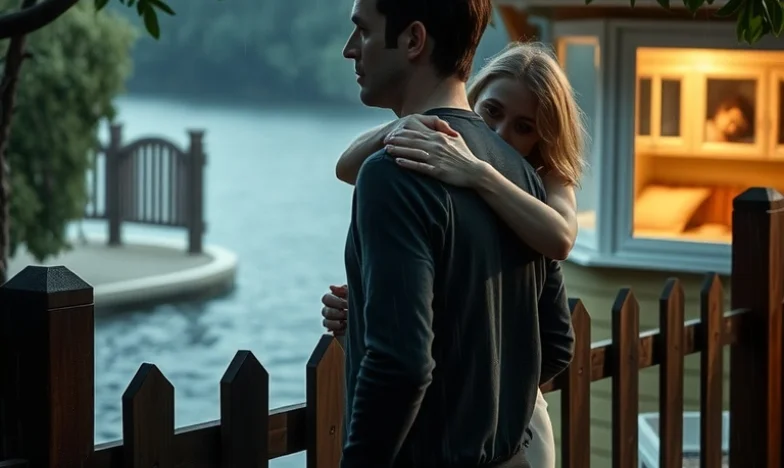
That evening, after Tom was asleep, Kasia found me in the garden, staring at the river.
“Talk to me, Mark. Please.”
I hesitated, the words caught in my throat. “I don’t know how. Every time I try, it’s like I’m back there. With him.”
She wrapped her arms around me, her warmth a balm. “You’re not him. You’re not your father.”
I broke then, the tears coming hot and fast. “What if I am? What if I can’t change?”
She held me, rocking gently. “You already have. Look at Tom. Look at us. You’re here. That’s more than he ever gave you.”
I clung to her, the weight of years pressing down. For the first time, I let myself hope that maybe, just maybe, I could be the father Tom deserved.
The next day, as we packed to leave, Stan pulled me aside. “You’re doing alright, Mark. Don’t let the past steal your future.”
On the train home, Tom curled up in my lap, his head heavy on my chest. Kasia smiled, her hand in mine. The countryside blurred past, but for once, I wasn’t running from anything.
I stared out the window, my reflection ghostly in the glass. Can we ever truly escape the shadows of our past? Or is it enough to keep moving forward, one small act of love at a time?