Treasure in the Garden: A Family Drama in the Heart of Yorkshire

“Gran! Grandad! Come quick, you won’t believe what I’ve found!”
The shrillness in Oliver’s voice made me drop the tea towel, hands still damp, heart thumping. I glanced at Stan, who was dozing in his battered armchair, the telly mumbling away in the background. He startled awake at the commotion, glasses askew. “What’s all that racket?” he grumbled, but I was already halfway out the back door, apron strings flapping.
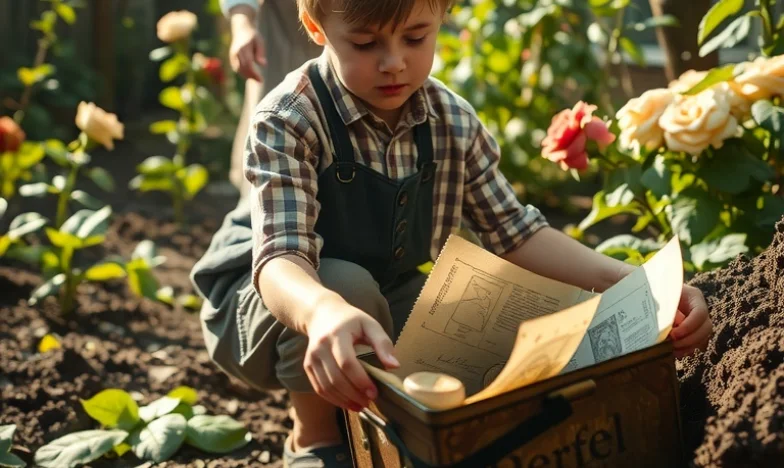
The garden was our pride and joy, a patchwork of runner beans, roses, and the old apple tree that had stood since before I married Stan. But today, it was the scene of chaos. Oliver, all of ten and always up to mischief, was kneeling in the mud, hands deep in the earth. His little sister, Emily, hovered nearby, eyes wide as saucers. Between them, something glinted in the weak Yorkshire sun.
“Look, Gran!” Oliver held up a battered tin box, caked in soil. “I was digging for worms for fishing and found this!”
Stan lumbered over, rubbing his knees. “Let’s have a look, lad.” He took the box, turning it over in his calloused hands. The lid creaked open, and inside—wrapped in yellowed newspaper—were coins, old photographs, and a faded letter.
My breath caught. The handwriting on the letter was unmistakable. My father’s. I hadn’t seen it in over thirty years, not since the day he died and left the house to me, with nothing but a cryptic warning: “Some things are best left buried, Zofia.”
Stan frowned, squinting at the coins. “These are old. Pre-war, by the look of them.”
Emily tugged at my sleeve. “What does it mean, Gran?”
I swallowed hard, memories flooding back. The arguments, the silences, the way my mother would stare out the window for hours after the war, clutching that same letter. I’d never dared to open it. Until now.
Oliver, impatient as ever, snatched the letter and began to read aloud. “To my dearest Zofia, if you’re reading this, then you’ve found what I could never bring myself to explain…”
Stan shot me a look. “You alright, love?”
I nodded, but my hands were shaking. The words blurred as Oliver read on, revealing secrets I’d long suspected but never confirmed. My father had hidden the family’s savings during the war, terrified the Germans would take everything. But there was more—a confession. He’d been forced to betray a neighbour to protect us, and the guilt had eaten at him ever since.
The children stared at me, waiting for an explanation. Stan put a gentle hand on my shoulder. “You never told me any of this.”
I shook my head. “I didn’t know. Not really. I always wondered why he was so distant, why Mum never spoke about the old days.”
Oliver, ever the detective, was already examining the coins. “Are they worth a lot, Gran?”
I managed a weak smile. “Maybe. But some things are worth more than money.”
That night, after the children were in bed, Stan and I sat at the kitchen table, the tin box between us. The letter lay open, its secrets finally out. Stan poured us each a cup of tea, his hands steady despite the tremor in mine.
“Do you think we should tell the rest of the family?” he asked quietly.
I stared at the letter, thinking of my sister, Margaret, who hadn’t spoken to me in years. The rift between us had started over something small—a misunderstanding about Mum’s jewellery—but it had grown, fed by old resentments and unspoken words. Would this revelation heal the wound, or make it worse?
“I don’t know,” I whispered. “But I can’t keep it to myself anymore.”
The next morning, I rang Margaret. The phone rang and rang, and just as I was about to hang up, she answered, her voice wary. “Zofia?”
“Margaret, I… I need to see you. There’s something you need to know.”
A long pause. “Is it about Dad?”
I swallowed. “Yes. Please, just come.”
She arrived that afternoon, her face pinched, eyes wary. We sat in the garden, the tin box between us, as I told her everything. She listened in silence, tears glistening in her eyes as I read the letter aloud.
“I always wondered,” she said finally, voice trembling. “He was never the same after the war. I thought he blamed us.”
“No,” I said, reaching for her hand. “He was trying to protect us. But it cost him everything.”
We sat together, the years of silence melting away. For the first time in decades, I felt the weight lift from my shoulders.
But not everyone was ready to forgive. When my son, David, heard about the treasure, he saw only pound signs. “We should sell the coins, Mum. It could pay for Emily’s school fees, or fix up the house.”
Stan bristled. “It’s not about the money, lad. It’s about family.”
David rolled his eyes. “Easy for you to say. You’re not the one worrying about bills.”
The argument simmered for days, dividing the family. Oliver and Emily watched, confused and hurt, as the adults bickered over what to do. The garden, once a place of peace, became a battleground.
One evening, as rain lashed the windows, I found Oliver sitting by the apple tree, the tin box in his lap.
“Gran, why is everyone so angry?”
I knelt beside him, pulling him close. “Sometimes, when people are scared or hurt, they lash out. But we can choose to be better.”
He nodded, solemn. “Can we keep the box? Just for us?”
I smiled through my tears. “Yes, love. We’ll keep it safe. For the family.”
In the weeks that followed, we tried to mend what had been broken. Margaret and I met for tea every Sunday, slowly rebuilding our bond. David apologised, admitting he’d let his worries get the better of him. The children buried a new box in the garden, filled with their own treasures—a toy car, a drawing, a note promising to always look after each other.
As spring turned to summer, the garden bloomed again. The scars of the past remained, but they no longer defined us. We’d unearthed more than coins and secrets—we’d found forgiveness, and the courage to face the future together.
Now, as I sit beneath the apple tree, the tin box beside me, I wonder: How many families are torn apart by secrets left buried? And what might we find if we dared to dig a little deeper?