Sleeping on a Bed of Lies: The Test That Changed Everything

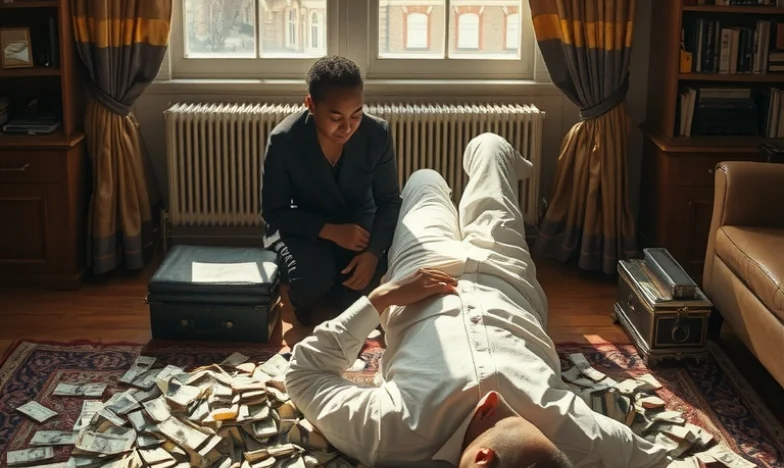
The first thing I remember is the sound of my own breathing, shallow and deliberate, as I lay motionless atop a ridiculous mound of fifty-pound notes in my study. The curtains were drawn against the late afternoon sun, casting the room in a golden haze. I could hear the faint clatter of crockery from the kitchen, the distant hum of London traffic, and the soft, measured footsteps of Grace, my housekeeper. My heart thudded in my chest, not from fear, but from the thrill of my own cleverness. I was Richard Lawson, CEO of Lawson Holdings, master of my own universe, and today I would finally know if the people around me were as trustworthy as they claimed.
I’d always prided myself on my instincts, but lately, paranoia had crept in. My brother, Charles, had warned me: “You can’t trust anyone, Richard. Not when you’ve got as much to lose as we do.” I’d laughed it off at first, but after the incident with the missing cufflinks and the odd way Grace had looked at me last week, suspicion gnawed at me. So, I devised a test. I’d leave a fortune in plain sight, feign sleep, and see what Grace would do.
As I lay there, feigning gentle snores, I heard the door creak open. Grace’s footsteps paused at the threshold. I could almost feel her gaze on me, weighing the absurdity of the scene. I’d always found her inscrutable—her face a mask of polite efficiency, her voice soft but firm. She was a black woman from Brixton, a single mother, and the only person in my house who didn’t seem to care about my money. Or so I thought.
She moved closer, her steps careful on the Persian rug. I kept my breathing steady, resisting the urge to peek. I heard her sigh, a sound heavy with something I couldn’t name. Then, to my astonishment, she began to speak, her voice barely above a whisper.
“Mr Lawson, I don’t know what you’re playing at, but this isn’t right.”
I nearly broke character, but forced myself to remain still. Grace’s hands brushed the edge of the cash pile, but she didn’t take a single note. Instead, she knelt beside me, her voice trembling now.
“I know you think people like me are desperate. Maybe you think I’d steal from you if given the chance. But I’ve got my pride, sir. I’ve got my son to think of. I won’t be part of your games.”
She stood abruptly, her footsteps retreating. I heard the door close with a soft click. For a moment, I lay there, stunned. I’d expected her to pocket a note or two, maybe even confront me. But her words stung more than any theft could have. I sat up, the money cascading around me like autumn leaves, and stared at the closed door.
Later that evening, I found Grace in the kitchen, scrubbing the sink with a ferocity I’d never seen before. She didn’t look up as I entered.
“Grace,” I began, my voice uncertain. “About earlier—”
She cut me off, her back still turned. “You don’t have to explain, Mr Lawson. I know what you think of me.”
“That’s not true,” I protested, but the words felt hollow. “I just… I needed to know I could trust you.”
She spun around, her eyes blazing. “Trust me? Or test me? There’s a difference, sir. You’ve never trusted anyone who doesn’t look like you, who hasn’t had your advantages. You think money is the only thing that matters.”
Her words hit me like a slap. I opened my mouth to argue, but she shook her head.
“I come here every day, clean your house, cook your meals, and you still see me as a threat. I’ve worked hard for everything I have. I won’t let you take my dignity, not for all the money in the world.”
I stood there, speechless, as she brushed past me, her shoulders squared with defiance. For the first time in years, I felt ashamed.
That night, I sat alone in my study, the pile of money still scattered across the floor. I thought of my own upbringing—Eton, Oxford, the endless parade of privilege. I’d never had to worry about rent or food, never had to choose between heating and eating. My father had always told me, “People respect power, Richard. Never let them see you weak.” But tonight, I felt weaker than I ever had.
The next morning, I found Grace in the hallway, her coat already on, her bag slung over her shoulder.
“I’m leaving, Mr Lawson,” she said quietly. “I can’t work for someone who thinks so little of me.”
Panic surged in my chest. “Grace, please. I made a mistake. I’m sorry.”
She looked at me, her expression softening just a fraction. “You can’t fix this with an apology. You have to change.”
I watched her walk out the door, the silence of the house closing in around me. For days, I wandered from room to room, haunted by her words. My brother called, eager for gossip.
“So, did she take the bait?” Charles asked, his voice oily with satisfaction.
“No,” I replied, my voice flat. “She didn’t.”
He laughed. “You’re too soft, Richard. That’s your problem.”
But I didn’t feel soft. I felt hollow.
A week later, I found myself in Brixton, standing outside a modest flat. I’d tracked down Grace’s address, unsure of what I hoped to achieve. I knocked, my heart pounding. The door opened, and a young boy peered up at me.
“Is your mum home?” I asked, my voice trembling.
He nodded, disappearing inside. Moments later, Grace appeared, her face wary.
“What do you want, Mr Lawson?”
I took a deep breath. “I came to apologise. Not just for the test, but for everything. For not seeing you. For not understanding.”
She studied me for a long moment. “Why now?”
“Because you were right. I’ve spent my whole life thinking money could solve everything. But it can’t buy respect. Or trust. Or forgiveness.”
She sighed, her shoulders relaxing. “It’s not about the money, Mr Lawson. It’s about how you treat people. You have the power to make a difference. Use it.”
I nodded, humbled. “Will you come back?”
She shook her head. “I can’t. But I hope you learn from this.”
As I walked away, the weight of my actions pressed down on me. I realised I’d lost more than a housekeeper—I’d lost a chance to be better.
Back in my empty townhouse, I stared at the pile of money, now just paper and ink. I thought of Grace, her dignity, her strength. I wondered how many others I’d misjudged, how many opportunities I’d squandered.
Is it ever too late to change? Or are some mistakes too big to fix? I suppose that’s what I’ll be asking myself for a long time to come.