Lost My Health, But Not My Family: A Tale of Pride, Pain, and Redemption

“You don’t have to help me, Sarah! I’m not a child!” My voice echoed off the kitchen tiles, sharp and desperate. I watched her flinch, her hands trembling as she tried to steady the mug of tea she’d made for me. The wheelchair felt like a prison, the walls of our semi-detached in Reading closing in tighter every day. I hated the way she looked at me now—gentle, careful, as if I might shatter at any moment.
Before the accident, I was David Turner—Managing Director of Turner & Sons Construction, Sunday league football captain, the bloke who always bought the first round at the pub. I was the man who fixed things, who never asked for help. Now, I couldn’t even get myself to the loo without someone’s arm under mine.
It happened on a rainy Thursday in February. I’d been up on scaffolding, checking a site after a subcontractor’s complaint. One slip, one missed footing, and my world turned upside down. The doctors at Royal Berkshire Hospital told me the truth in clipped, professional tones: spinal cord injury, T8, permanent paralysis from the waist down. I remember staring at the ceiling tiles, counting the cracks, refusing to cry in front of Sarah. She held my hand, her knuckles white, her eyes red-rimmed but dry. “We’ll get through this, Dave,” she whispered. I didn’t believe her.
The first weeks at home were a blur of painkillers, physiotherapy, and awkward visits from friends who didn’t know what to say. Our son, Tom, sixteen and surly, hovered at the edge of my vision, headphones glued to his ears. Our daughter, Emily, twelve, tried to help—fetching things, tidying up—but I snapped at her too. I couldn’t stand the pity in their eyes, the way they tiptoed around me.
One night, after Sarah had helped me into bed, I lay staring at the ceiling, listening to the rain against the window. I heard their voices in the hallway—Tom’s low and angry, Sarah’s tired and pleading. “He’s not the same, Mum. He just yells at us.”
“He’s hurting, love. He doesn’t mean it.”
I wanted to shout, to tell them I was still here, but the words stuck in my throat. Instead, I lay there, silent, feeling the weight of my useless legs and the heavier burden of my pride.
Days blurred into weeks. I refused to go to physio, refused to see friends, refused to let Sarah touch me unless absolutely necessary. I watched her shoulders sag under the weight of my bitterness. She went back to work at the primary school, juggling lesson plans and my care. I heard her crying in the bathroom one night, muffling the sound with a towel. I pretended not to notice.
One afternoon, my old mate Pete came round. He stood awkwardly in the doorway, hands shoved in his pockets. “Alright, Dave?”
“Yeah. Living the dream,” I muttered.
He looked at me, really looked, and then sat down across from me. “You know, you’re still you, mate. Just… a bit more stubborn, if that’s possible.”
I wanted to laugh, but it came out as a sob. Pete didn’t flinch. He just sat there, letting me cry, until I finally ran out of tears. “Sarah’s worried about you,” he said quietly. “We all are.”
I shrugged, wiping my face. “I’m no good to anyone like this.”
“Bollocks,” Pete said, and for the first time in months, I almost believed him.
That night, Sarah sat on the edge of the bed, her face pale and drawn. “I can’t do this alone, Dave. I love you, but you have to let us in. The kids need their dad. I need my husband.”
I looked at her, really looked, and saw the exhaustion in her eyes, the lines etched deeper by worry and sleepless nights. I reached for her hand, my voice shaking. “I’m scared, Sarah. I don’t know how to be this person.”
She squeezed my hand, tears slipping down her cheeks. “We’ll figure it out together. But you have to try.”
The next morning, I agreed to go to physio. It was humiliating at first—being hoisted onto parallel bars, struggling to move muscles that no longer listened. But the physio, a no-nonsense woman named Janet, didn’t let me wallow. “You’re not broken, David. Just different. Let’s work with what you’ve got.”
Slowly, painfully, I started to reclaim pieces of my life. Tom began to talk to me again, telling me about his football matches, asking for advice. Emily brought her homework to the kitchen table, asking for help with maths. Sarah and I found a new rhythm—less about what I could do, more about what we could do together.
But it wasn’t easy. There were days when I wanted to give up, when the pain and frustration threatened to swallow me whole. I lashed out, said things I didn’t mean. One evening, after a particularly bad day, I shouted at Emily for spilling juice on the carpet. She burst into tears and ran upstairs. Sarah followed, leaving me alone with my guilt.
Later, Emily crept back down, her eyes swollen. She stood in front of me, her voice trembling. “I miss my old dad.”
Her words cut deeper than any injury. I reached out, pulling her into my lap. “I miss him too, love. But I’m trying. I promise.”
We cried together, and for the first time, I let myself believe that maybe, just maybe, things could get better.
Months passed. I learned to drive a modified car, started helping Tom with his university applications, and even went back to the office a few days a week. The lads at work welcomed me back with awkward jokes and too many cups of tea. I wasn’t the same boss, but I was still their Dave.
Sarah and I found moments of laughter again—watching rubbish telly, arguing over who made the best cuppa, planning a holiday to Cornwall. Our marriage wasn’t perfect, but it was real, forged in fire and stubborn love.
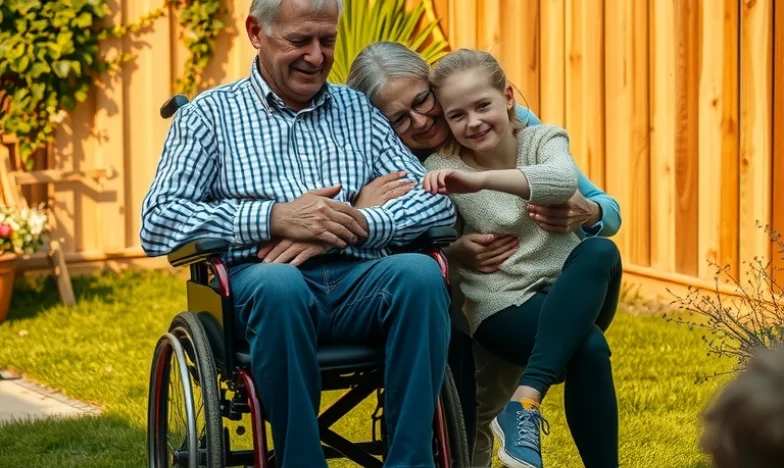
One evening, as we sat in the garden, Emily curled up beside me, Tom kicking a ball against the fence, Sarah’s hand in mine, I realised I hadn’t lost everything. I’d lost my health, yes, but not my family. Not my pride. Not my place in the world.
Sometimes, late at night, I still wonder who I might have been if the accident hadn’t happened. But then I look at Sarah, at our kids, at the life we’ve rebuilt together, and I know I wouldn’t trade this hard-won love for anything.
Do we ever truly know our own strength until we’re tested? Or is it the people who stand by us—no matter how hard we push them away—who show us what we’re really made of?