We Need to Talk: A Night That Changed Everything

“We need to talk.”
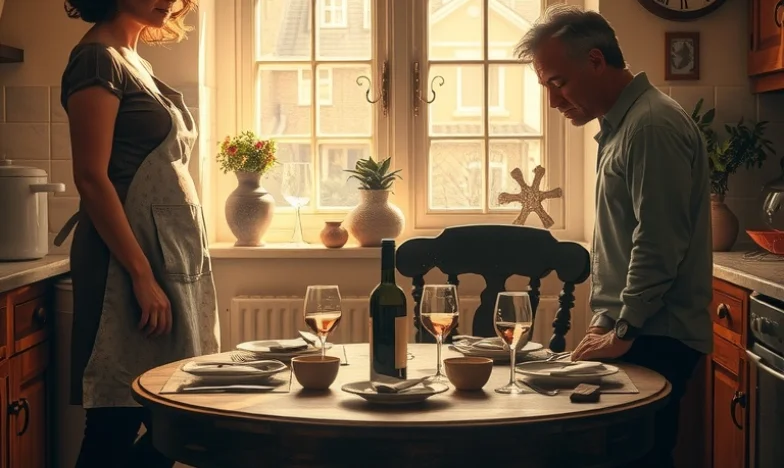
Those four words echoed in my mind, bouncing off the walls of our small London flat as I stood in the kitchen, hands sticky with flour, heart thudding in my chest. I glanced at the clock—just four hours until our anniversary dinner. Ten years. A decade of shared laughter, arguments, and quiet Sunday mornings. I’d spent the afternoon preparing his favourite meal, humming along to the radio, imagining the look on his face when he saw the table set with our best china and the old bottle of red I’d been saving. But now, all I could hear was his voice, low and urgent, from the call just moments ago.
“Magda, it’s important. Can we talk before dinner?”
I tried to steady my breathing, wiping my hands on my apron. What could be so urgent? Was he ill? Had he lost his job? My mind raced through possibilities, each more dreadful than the last. I forced myself to focus on the task at hand—folding the napkins, lighting the candles, checking the roast. But my hands shook, and I dropped a glass, watching it shatter on the floor. The sound was sharp, final, like the crack of something breaking inside me.
He came home early, the door clicking shut with a softness that felt deliberate. I heard him pause in the hallway, the rustle of his coat, the slow, measured steps. I turned to face him, my heart in my throat. He looked tired, older than his forty years, with lines etched deep around his eyes. He didn’t smile.
“Magda, can we sit down?”
We sat at the kitchen table, the one we’d bought together from that little shop in Camden, the one with the wobbly leg he’d promised to fix. He reached for my hand, but I pulled away, sensing the gravity of what was coming.
“There’s something I need to tell you,” he began, his voice barely above a whisper. “It’s about Alicja.”
Alicja. The name hit me like a slap. My old colleague from the publishing house, the one who’d left for Manchester two years ago. We’d lost touch, but I remembered her—her quick wit, her easy laugh, the way she’d always seemed to know more than she let on. I stared at him, waiting.
He swallowed hard. “We’ve been in contact. For a while now. It started as emails, just catching up. But then… it became more.”
I felt the room tilt, the walls closing in. “More?”
He nodded, unable to meet my eyes. “I didn’t mean for it to happen. I was lonely, you were always so busy with work, with your mother… I just needed someone to talk to.”
I laughed, a bitter, hollow sound. “So you talked to her? Behind my back?”
He flinched. “It wasn’t like that. At first, it was innocent. But then we met for coffee, and… I don’t know. I felt alive again. She listened. She understood.”
I stood up, my chair scraping against the floor. “And what about me? Did you ever think to talk to me?”
He looked up, his eyes shining with tears. “I tried, Magda. But you were always somewhere else. At the hospital with your mum, on the phone with your sister, working late. I felt invisible.”
I wanted to scream, to throw something, to make him hurt the way I was hurting. But all I could do was stand there, numb, as the truth settled over me like a shroud.
“So what now?” I whispered.
He shook his head. “I don’t know. I just… I couldn’t keep lying to you. I ended it with her. I want to fix this, if you’ll let me.”
I stared at him, searching his face for the man I’d married. The man who’d held my hand in the rain outside St. Pancras, who’d danced with me in our living room to old Beatles records, who’d whispered promises in the dark. Was he still there, beneath the guilt and the fear?
The rest of the evening passed in a blur. I cancelled the dinner, packed away the food, and retreated to the spare room. I lay awake, staring at the ceiling, replaying every moment of our marriage, every missed opportunity, every word left unsaid. I thought of Alicja—did she feel guilty? Did she love him? Or was I just collateral damage in someone else’s story?
The days that followed were a haze of awkward silences and forced politeness. We went through the motions—work, chores, family obligations—but nothing felt real. My mother called, sensing something was wrong, but I brushed her off. I couldn’t bear to explain, to admit that my perfect life was crumbling.
One evening, as I was washing up, he came into the kitchen, his face drawn. “Magda, can we talk?”
I nodded, bracing myself.
“I’m sorry,” he said, his voice breaking. “I never wanted to hurt you. I just… I lost myself. I forgot what mattered.”
I looked at him, really looked at him, and saw the pain in his eyes. For the first time, I wondered if I bore some of the blame. Had I been so wrapped up in my own world that I’d failed to see his loneliness? Had I taken him for granted, assuming he’d always be there?
We talked for hours that night—about everything and nothing. About the early days, when we’d scraped by on cheap wine and takeaways, about the dreams we’d had, the disappointments we’d weathered. We cried, we laughed, we argued. It wasn’t easy, and it wasn’t pretty, but it was real.
In the weeks that followed, we tried to rebuild. We went to counselling, forced ourselves to have the hard conversations. Some days, I hated him. Other days, I hated myself. But slowly, painfully, we began to find our way back to each other.
It wasn’t the ending I’d imagined for our anniversary. It wasn’t the story I’d wanted to tell. But it was ours—messy, complicated, and painfully human.
Now, as I sit here, pen in hand, I wonder: how many of us are living lives built on secrets and silence? How many of us are one conversation away from losing everything? And if we are, do we have the courage to face the truth, no matter how much it hurts?