The Key to Doubt

“You know, Anna, you’re braver than I am. I wouldn’t dare marry into Michael’s family,” Sarah whispered, her eyes darting around the crowded café as if Michael’s mother herself might be lurking behind the pastry counter. I tried to laugh it off, but her words clung to me like the drizzle outside, seeping into my bones.
It was a Thursday evening in Manchester, and the city’s grey skies matched the mood that had settled over me. I’d just accepted Michael’s proposal, and the ring still felt foreign on my finger, a cold circle of promise and uncertainty. My friends had wasted no time in sharing their own tales of woe: Emma’s mother-in-law had demanded a loan within weeks of the wedding; Rachel’s had sabotaged her birthday dinner with a passive-aggressive tirade about her cooking; and poor Lizzie’s had simply refused to acknowledge her existence at all.
“Don’t let her get to you,” Michael said later, as we sat in his tiny flat, the hum of the city muffled by double glazing. He was making tea, his back to me, and I watched the way his shoulders tensed when I mentioned his mother. “Mum’s… complicated, but she means well.”
I wanted to believe him. I wanted to believe that all the horror stories were just that—stories. But the seed of doubt had been planted, and it grew with every passing day. The first time I met Mrs. Thompson, she greeted me with a smile that didn’t quite reach her eyes. Her home was immaculate, every cushion plumped, every photo frame dusted, and I felt like an intruder in a museum of her life. She offered me tea, but when I reached for the milk, she hesitated. “We usually take it black in this house, Anna.”
I smiled, apologised, and sipped the bitter liquid, feeling the heat rise in my cheeks. Michael tried to bridge the gap, chatting about work and the weather, but his mother’s gaze never left me. Later, as we left, she pressed a hand to my arm. “I hope you know what you’re getting into, dear. Michael’s always needed looking after.”
The words echoed in my mind for days. Was she warning me off? Testing me? Or was it just the awkwardness of a mother losing her son to another woman? I tried to brush it aside, but every interaction seemed to confirm my friends’ warnings. She called Michael every evening, sometimes twice, and when we announced our engagement, she insisted on planning the wedding herself. “It’s tradition,” she said, her tone brooking no argument. “And I know what’s best for my son.”
The arguments began quietly, like distant thunder. Michael wanted a small ceremony in the Lake District; his mother insisted on a grand affair in her local church. I tried to mediate, but every suggestion I made was met with a tight smile and a dismissive wave. “You’ll understand when you’re a mother,” she said, as if that explained everything.
One evening, after another tense phone call, Michael slammed his fist on the kitchen table. “Why can’t she just let us be?” he muttered, his voice raw. I reached for his hand, but he pulled away, retreating into himself. I felt the distance growing between us, a chasm neither of us knew how to cross.
The weeks leading up to the wedding were a blur of fittings, tastings, and endless negotiations. Mrs. Thompson scrutinised every detail, from the flowers to the seating plan. “You can’t put Aunt Margaret next to Uncle John,” she hissed, “they haven’t spoken since the incident.” I didn’t dare ask what the incident was.
My own mother tried to help, but she was outmatched by Mrs. Thompson’s steely determination. “She’s just anxious,” Mum said, patting my hand. “It’ll settle down after the wedding.” But I wasn’t so sure. The night before the ceremony, I lay awake in the guest room of Michael’s childhood home, listening to the creaks and sighs of the old house. I heard voices downstairs—Mrs. Thompson and Michael, arguing in hushed tones. I pressed my ear to the door, straining to catch their words.
“She’s not like us, Michael. She doesn’t understand our ways.”
“She’s my fiancée, Mum. You have to accept that.”
A long silence, then a sigh. “I just want what’s best for you.”
I crept back to bed, my heart pounding. Was I really so different? Was love not enough to bridge the gap between us?
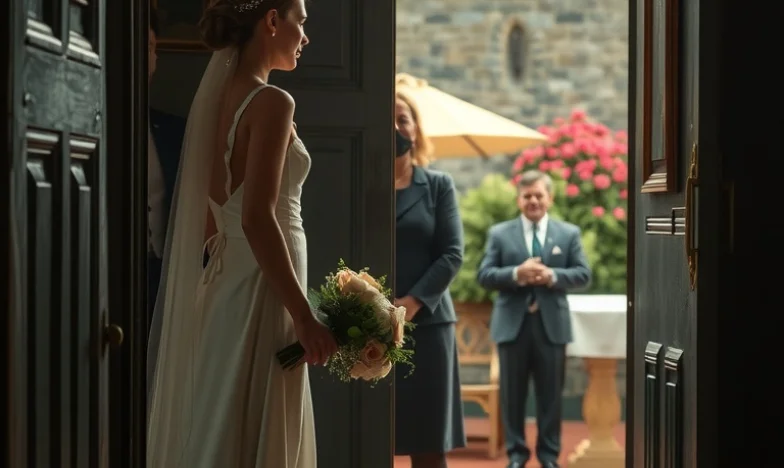
The wedding day dawned grey and wet, the kind of persistent drizzle that soaks through even the sturdiest umbrella. As I stood in the cramped church vestry, my dress clinging to my skin, Mrs. Thompson appeared at the door. She looked me up and down, her lips pursed. “You look… nice,” she said, and for a moment I thought I saw a flicker of something softer in her eyes. “Take care of him, Anna.”
The ceremony passed in a blur, and the reception was a minefield of small talk and forced smiles. Mrs. Thompson hovered at the edge of every conversation, her presence a constant reminder of the gulf between us. When Michael and I finally escaped to our hotel room, I burst into tears. “I can’t do this,” I sobbed. “She hates me.”
Michael held me, his own eyes shining with unshed tears. “She doesn’t hate you. She’s just… scared. She’s always been scared of losing me.”
We tried to build a life together, but Mrs. Thompson’s shadow loomed large. She called every day, offering advice, criticism, and thinly veiled warnings. When we bought our first flat in Salford, she insisted on helping us decorate. “You’ll want neutral colours,” she declared, painting over my favourite teal wall with a bland shade of beige. I bit my tongue, not wanting to cause another row.
The breaking point came one Sunday afternoon. We’d invited her for lunch, hoping to show her that we could manage on our own. I spent hours preparing a roast, determined to impress her. She arrived early, sniffed the air, and frowned. “Lamb? Michael’s never liked lamb.”
I forced a smile, but inside I was seething. Over dinner, she picked at her food, offering unsolicited advice on everything from our finances to our future children. When Michael tried to defend me, she turned on him. “You’ve changed, Michael. She’s changed you.”
He stood up, his chair scraping against the floor. “Maybe I needed to change, Mum. Maybe we both do.”
She left in a huff, and for weeks she refused to speak to either of us. Michael was torn between loyalty to his mother and his love for me. I felt like an outsider in my own marriage, constantly second-guessing myself, wondering if I was the problem.
One evening, as I sat alone in the flat, I found an old photo album tucked away in a drawer. It was filled with pictures of Michael as a child—birthdays, holidays, family outings. In every photo, Mrs. Thompson was there, her arm around her son, her smile genuine and unguarded. I realised then how much she had sacrificed for him, how fiercely she loved him, and how terrified she was of losing him.
I called her the next day. “Mrs. Thompson, can we talk?”
There was a long pause. “Of course, Anna.”
We met in a quiet café, the same one where my friends had first warned me about mothers-in-law. I told her how I felt—how much I loved Michael, how hard I was trying, how much I wanted to be part of her family. She listened, her eyes shining with tears. “I’m sorry, Anna. I never meant to make you feel unwelcome. It’s just… hard, letting go.”
We talked for hours, sharing stories, fears, and hopes. It wasn’t a miracle cure, but it was a start. Michael was overjoyed when I told him. “I knew you two would work it out,” he said, pulling me into a hug.
Things aren’t perfect. We still argue, still clash over traditions and expectations. But there’s a new understanding between us, a fragile truce built on honesty and empathy. I’ve learned that love isn’t just about two people—it’s about families, histories, and the messy, beautiful process of learning to trust.
Sometimes, late at night, I wonder: how many of our doubts are just stories we tell ourselves, keys that lock us out of happiness? And how many are invitations to open the door and step inside, no matter how uncertain we feel?