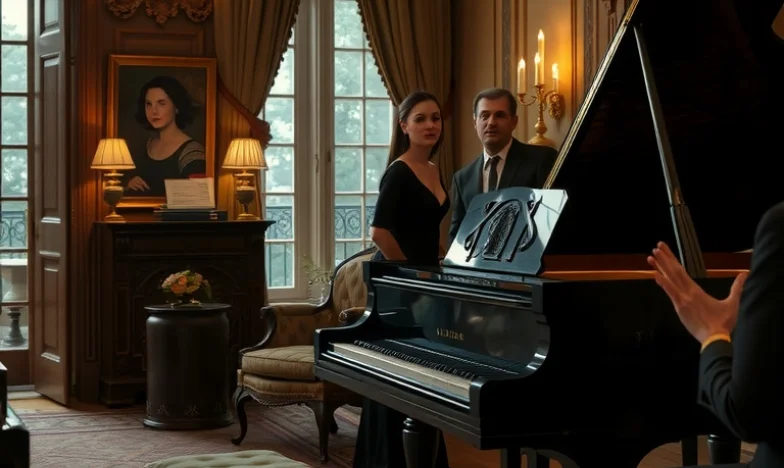
The Night I Played for the Ashcrofts

“Play for us, would you, Alice?” Lady Ashcroft’s voice sliced through the laughter in the drawing room, her words dripping with the kind of cold amusement that made my stomach twist. I stood by the door, tray in hand, cheeks burning as the guests turned to look at me. The Ashcrofts’ eldest son, Henry, smirked from his armchair, swirling his whisky. “Go on, Alice. Show us what you’ve got. Or are you afraid you’ll embarrass yourself?”
I wanted to disappear. The grand piano gleamed in the corner, a beast I’d only ever dusted, never dared to touch in their presence. I glanced at Mrs. Jennings, the housekeeper, but she looked away, her lips pressed in a thin line. There was no escape. I set the tray down, smoothed my apron, and walked to the piano, every step echoing in the hush that had fallen over the room.
My hands trembled as I sat. I could feel their eyes on me—Lady Ashcroft’s icy gaze, Henry’s mocking smile, the other guests’ curiosity. I’d been the Ashcrofts’ maid for nearly two years, ever since Mum died and I had to leave college to help Dad with the bills. I’d scrubbed their floors, polished their silver, and kept my head down. I’d never been asked to perform for them, never been put on display like this.
“Any requests?” I managed, my voice barely above a whisper.
Henry snorted. “Something lively, Alice. None of that dreary classical stuff.”
Lady Ashcroft arched an eyebrow. “Let’s see if you can manage Chopin’s Nocturne in E-flat. Or is that too much for you?”
I swallowed hard. Chopin had been Mum’s favourite. She used to play it on our battered upright, her fingers dancing over the keys, filling our tiny flat with music. I hadn’t played since she died. The pain was still too raw, the memories too sharp. But now, with the Ashcrofts watching, I had no choice.
I placed my fingers on the keys, closed my eyes, and began to play. At first, my hands shook, the notes stumbling over each other. I could hear Henry sniggering, feel Lady Ashcroft’s impatience. But then, as the melody unfolded, something shifted. The music took over, flowing through me, drowning out the whispers and the laughter. I played for Mum, for the nights we’d spent together, for the life I’d lost.
The room grew quiet. Even Henry stopped smirking. When I finished, there was a long silence. Then, unexpectedly, someone clapped. It was Mr. Ashcroft, who rarely spoke to me at all. “Remarkable,” he said, his voice gruff. “Where did you learn to play like that?”
I looked down, my cheeks burning. “My mother taught me, sir.”
Lady Ashcroft pursed her lips. “Well, that was… unexpected.” She turned to her guests, forcing a brittle smile. “Who knew our Alice had such hidden talents?”
I stood, my hands still shaking. I wanted to run, to hide, but I forced myself to meet her gaze. “Thank you, madam.”
The rest of the evening passed in a blur. The guests left, murmuring about the maid who played Chopin. Henry avoided my eyes. Lady Ashcroft was silent, her expression unreadable. I finished my chores and slipped out into the garden, the cool night air a relief after the stifling tension inside.
I found Dad waiting for me at the gate, his coat pulled tight against the chill. “You alright, love?” he asked, concern etched on his face.
I nodded, though my heart was pounding. “They made me play, Dad. In front of everyone.”
He frowned. “That’s not right. You’re not there for their entertainment.”
I shrugged. “It’s their house. Their rules.”
He put an arm around my shoulders. “You’re worth more than that, Alice. Don’t let them make you forget it.”
I wanted to believe him, but it was hard. The Ashcrofts’ world was so different from ours—grand, untouchable. I was just the help, invisible until they wanted something. But tonight, for a moment, I’d been seen. Not as a maid, but as someone with a voice, a story.
The next morning, Lady Ashcroft called me to her study. She sat behind her desk, her posture rigid, her eyes cold. “Alice, about last night. I hope you understand that your… performance was a one-off. We can’t have the staff thinking they’re part of the family.”
I nodded, biting back a retort. “Of course, madam.”
She studied me for a moment. “You have talent. It’s a shame it’s wasted here.”
I didn’t know what to say. I wanted to scream, to tell her that my life wasn’t a waste, that I had dreams once. But I just stood there, silent.
As I turned to leave, she spoke again. “There’s a charity gala next month. We need someone to play during dinner. I suppose you’ll do.”
It wasn’t a request. I nodded, my heart sinking. Another performance, another chance for them to parade me in front of their friends. But maybe, just maybe, it was also a chance for something more.
The weeks passed in a blur of chores and rehearsals. I practised late at night, after everyone had gone to bed, my fingers aching, my heart heavy. Dad worried about me, but I told him I was fine. I had to be.
The night of the gala arrived. The house was filled with guests—politicians, business leaders, celebrities. I wore a plain black dress, my hair pulled back, my hands trembling as I sat at the piano. Lady Ashcroft introduced me as “our talented maid, Alice,” her voice laced with condescension.
I played. This time, I didn’t hold back. I poured everything I had into the music—the pain, the anger, the longing. The room fell silent, the guests transfixed. When I finished, there was a moment of stunned silence, then a wave of applause.
Afterwards, a woman approached me. She was elegant, her accent refined. “You have a gift, my dear. Have you ever considered studying music formally?”
I shook my head. “I can’t afford it.”
She smiled. “Talent like yours shouldn’t go to waste. Here’s my card. Call me.”
Lady Ashcroft watched from across the room, her expression unreadable. I knew she wouldn’t be pleased. I was her maid, not her equal. But for the first time, I felt hope.
That night, I sat in my tiny room, staring at the card. I thought of Mum, of all the dreams we’d shared. I thought of Dad, working himself to the bone to keep us afloat. I thought of the Ashcrofts, their world of privilege and power.
I picked up the phone.
Now, as I look back, I wonder—how many of us are trapped by the roles others force upon us? How many dreams are lost to silence and fear? If I hadn’t played that night, would I ever have found my voice again? What would you have done, in my place?