Shadows Over Red Hill: A Grandson’s Reckoning

“You know, Jakub, there are some things you only see when you’re not looking for them.” My grandfather’s voice was rough, like gravel underfoot, as we trudged through the bracken behind his cottage. The air was thick with the scent of wet earth and pine, and I was clutching his hand, my wellies squelching in the mud. I was seven, and the world was still full of magic and mystery, especially here, in this forgotten corner of Poland, where my mother had grown up before she moved to England.
I’d asked him, half in jest, half in hope, “Dziadek, have you ever seen the krasnoludki? The little people in the woods?” He stopped, looked down at me with those tired blue eyes, and smiled, but there was something sad in it. “Nie, Jakubku. I’ve never seen them. But I’ve seen things that are harder to believe.”
That was the first time I realised my grandfather carried secrets. Not just the kind you keep from children, but the kind that weigh on your soul. I didn’t understand then, but I felt it, like a chill in the air that had nothing to do with the weather.
Years later, after we moved back to the UK, I’d lie awake in my cramped bedroom in Croydon, listening to the rain against the window, replaying his stories in my mind. My mother, Marta, never spoke much about her childhood. She’d left Poland in the late ‘80s, just before the Wall came down, and she wore her past like an old coat—useful, but never quite comfortable. She worked long hours at the hospital, and when she came home, she was tired, her hands always cold, her eyes always searching for something she never found.
It was only when my grandfather died, suddenly, that everything unravelled. I was twenty-one, home from university for the summer, when the call came. Mum was in the kitchen, making tea, when her mobile rang. I watched her face crumple, watched her grip the counter so hard her knuckles turned white. “Tata nie żyje,” she whispered, and the world shifted beneath my feet.
We flew to Poland for the funeral. The village was smaller than I remembered, the lake greyer, the house emptier. My uncle Piotr was there, red-eyed and silent, and my aunt Zofia, who hugged me so hard I thought my ribs would crack. The funeral was a blur of incense and old hymns, the church packed with faces I barely recognised. Afterward, we gathered in the kitchen, drinking bitter coffee and eating poppy seed cake, the air thick with grief and unspoken words.
That night, I couldn’t sleep. I wandered through the house, touching the worn banister, the faded photographs on the walls. In my grandfather’s study, I found his old pipe, still smelling faintly of tobacco, and a battered notebook, its pages filled with his spidery handwriting. I sat at his desk, the lamp casting a pool of yellow light, and began to read.
The stories were familiar at first—tales of childhood mischief, of fishing on the lake, of the war and the years that followed. But as I turned the pages, the tone shifted. There were entries about my mother, about the arguments they’d had before she left, about the things he wished he’d said. And then, near the end, a passage that stopped me cold:
“I saw Jakub in the woods today. He asked about the krasnoludki. I told him I’d never seen them, but the truth is, I see ghosts everywhere. The past follows me, even here. I wish I could tell him everything, but some stories are too heavy for a child.”
I sat there for a long time, the words burning in my mind. What ghosts was he talking about? What stories had he kept from us?
The next morning, I confronted my mother. We were sitting at the kitchen table, the sun streaming through the window, dust motes dancing in the light. “Mum,” I said, “what happened before you left? Why did you and dziadek stop speaking?”
She looked at me, her eyes tired, her mouth set in a hard line. For a moment, I thought she’d brush me off, but then she sighed, her shoulders slumping. “It’s complicated, Jakub. Your grandfather… he was a good man, but he was stubborn. He didn’t want me to leave. He thought I was abandoning him, abandoning Poland. We argued. I said things I regret. He said things he couldn’t take back.”
I reached across the table, took her hand. “He loved you, Mum. He wrote about you in his notebook. He wished he’d said sorry.”
She closed her eyes, tears slipping down her cheeks. “I know. I just wish I’d had the chance to say it, too.”
We spent the rest of the week sorting through his things, packing up memories in cardboard boxes. I found more notebooks, more fragments of his life—letters he’d never sent, photographs of people I’d never met. Each discovery felt like a piece of a puzzle I’d never known I was missing.
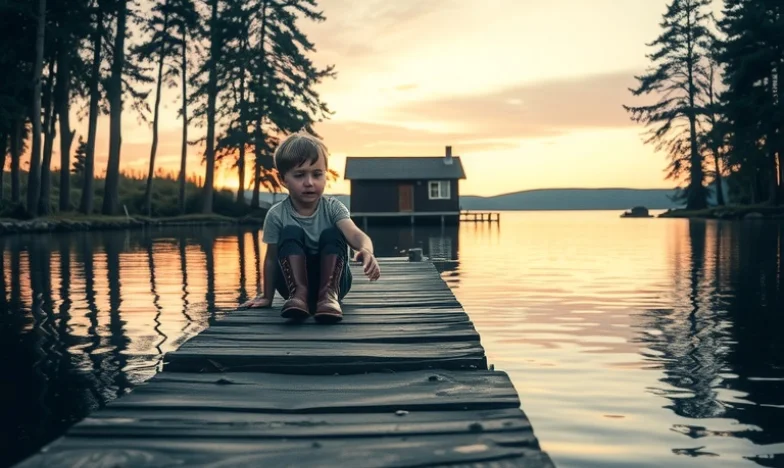
On our last night, I walked down to the lake. The water was still, the sky streaked with pink and gold. I sat on the old jetty, my feet dangling above the surface, and let the silence wash over me. I thought about my grandfather, about the stories he’d told and the ones he’d kept to himself. I thought about my mother, about the distance between us, about the ways we hurt the people we love without meaning to.
When we returned to England, everything felt different. My mother and I were closer, but there was a sadness between us, a sense of something unfinished. I started asking questions—about our family, about Poland, about the things we’d left behind. I joined a Polish society at university, started learning the language properly, trying to piece together the parts of myself that had always felt out of place.
But the ghosts my grandfather wrote about followed me, too. I saw them in the way my mother flinched at loud noises, in the way she hoarded food in the cupboards, in the way she never quite relaxed, even at home. I saw them in myself, in my restlessness, my longing for something I couldn’t name.
One night, after a particularly bad argument with my mother—about nothing and everything, as usual—I found myself back at the lake in my mind, listening for the voices in the woods. I realised then that the krasnoludki weren’t real, but the ghosts were. They were the memories we carried, the regrets we couldn’t let go of, the love we never quite managed to say out loud.
I started writing letters to my grandfather, even though I knew he’d never read them. I wrote about my life in England, about the things I was afraid of, about the ways I missed him. I wrote about my mother, about how much I wished she could forgive herself, about how much I wished I could help her heal.
Slowly, things began to change. My mother started talking more about her childhood, about the village, about the friends she’d left behind. We cooked Polish food together, listened to old songs on the radio, laughed about the things that used to make us cry. It wasn’t perfect, but it was something.
Sometimes, late at night, I’d sit by my window, looking out at the rain-soaked streets of Croydon, and think about Red Hill, about the lake, about the stories that shaped us. I wondered if my grandfather had ever really seen ghosts, or if he’d just been haunted by his own regrets. I wondered if we all were.
Now, years later, I still carry his notebook with me, its pages worn and creased. I read his words when I feel lost, when I need to remember where I come from. I think about the things we inherit from our families—the pain, the love, the secrets—and I wonder if we ever really escape them, or if we just learn to live with them.
Do we ever truly know the people we love, or are we always chasing shadows? And if we are, is that enough?