The Garden of Our Moments

‘Mum, why didn’t you ever tell me?’ Zosia’s voice trembled, echoing through the kitchen as she clutched the letter in her hand. The kettle shrieked behind me, but I barely heard it. My heart pounded so loudly I thought it might drown out her words. I stared at the faded wallpaper, the pattern of roses I’d chosen when the children were small, and wondered how everything could unravel so quickly on an ordinary Tuesday afternoon.
I never thought the past would come for us like this. I’d spent years building a home on Maple Lane, a place where laughter echoed through the garden and the scent of fresh bread drifted from the oven. My husband, David, had left us when the children were young, and I’d learned to be both mother and father, patching up scraped knees and broken hearts with equal determination. Zosia, my eldest, always had a fierce curiosity, while Jamie, her younger brother, was quieter, content to lose himself in books and the wild corners of our garden.
But now, at 27, Zosia stood before me, her eyes brimming with betrayal. She’d found the letter in the attic, tucked inside an old biscuit tin beneath piles of photographs. It was from David, written just before he left, and it spoke of another woman, another life. I’d hidden it, thinking I was protecting my children from pain, but now I saw the cost of my silence.
‘You always said he left because he couldn’t handle the responsibility,’ Zosia whispered, her knuckles white. ‘But you never told us about… her.’
I wanted to reach for her, to explain, but the words caught in my throat. How could I tell her that I’d been afraid? That I’d thought the truth would shatter us? The house felt suddenly too small, the walls closing in with every second of silence.
Jamie appeared in the doorway, his face pale. ‘What’s going on?’ he asked, glancing between us. I saw the confusion in his eyes, the fear that the fragile peace we’d built was slipping away.
‘It’s nothing,’ I lied, but Zosia shook her head.
‘No, Mum. It’s everything.’
The days that followed blurred together. Zosia barely spoke to me, retreating to her old bedroom and slamming the door. Jamie tried to mediate, but I could see the strain in his posture, the way he avoided my gaze. I spent hours in the garden, my hands buried in the soil, trying to find solace in the rhythm of planting and pruning. The roses bloomed defiantly, their petals soft and fragrant, but I felt brittle, as if one harsh wind might break me.
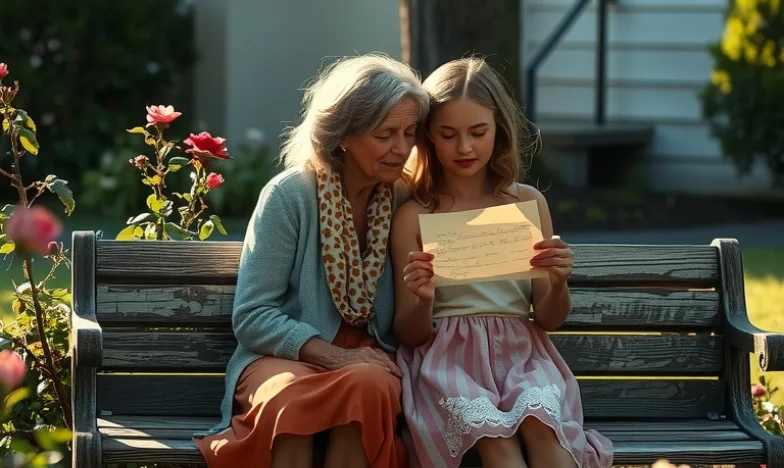
One evening, as the sun dipped behind the neighbour’s fence, I found Zosia sitting on the old wooden bench beneath the apple tree. She looked so much like her father in that moment—stubborn, proud, and heartbreakingly vulnerable.
‘I just wanted to protect you,’ I said quietly, sitting beside her. ‘I thought if you didn’t know, you could remember him as he was, not as he became.’
She stared at her hands, twisting the letter between her fingers. ‘But I needed the truth, Mum. Even if it hurt.’
A robin hopped across the grass, searching for crumbs. I watched it, remembering the afternoons when the children were small, chasing butterflies and building forts from old sheets. I’d tried so hard to give them a safe haven, but I realised now that safety built on secrets was no safety at all.
‘I’m sorry,’ I whispered. ‘I was scared. I didn’t want you to think he didn’t love you.’
Zosia’s shoulders shook, and for a moment I thought she might walk away. But then she leaned into me, her head resting on my shoulder. ‘I just wish you’d trusted me,’ she said, her voice muffled. ‘We could have faced it together.’
Jamie joined us, his book forgotten. He sat at our feet, looking up at the sky as the first stars appeared. ‘We’re still a family,’ he said softly. ‘A bit battered, maybe, but still together.’
We sat there in silence, the three of us, as the garden grew dark around us. I thought of all the moments I’d tried to hold onto, the laughter and the tears, the birthdays and the quiet evenings by the fire. I realised that families aren’t built on perfection, but on forgiveness and the courage to face the truth.
The next morning, I made tea and toast, the way I always had. Zosia came downstairs, her eyes red but determined. ‘I want to meet her,’ she said. ‘Dad’s… the other woman. I need to understand.’
My heart clenched, but I nodded. ‘If that’s what you want, I’ll help you.’
Jamie squeezed my hand under the table. ‘We’ll do it together, Mum.’
The weeks that followed were a blur of phone calls and awkward meetings. The woman, Margaret, was nothing like I’d imagined—kind, nervous, and just as haunted by the past as we were. Zosia asked questions, her voice trembling but steady, and Margaret answered as best she could. There were tears, and anger, and moments of unexpected laughter. I watched my children navigate the messiness of forgiveness, and I realised I was learning too.
One afternoon, as we walked home from Margaret’s flat, Zosia slipped her arm through mine. ‘I think I understand now,’ she said. ‘Dad was flawed. But so are we. Maybe that’s okay.’
I smiled, feeling a weight lift from my chest. ‘It is okay. We don’t have to be perfect. We just have to be honest.’
The house on Maple Lane still creaks in the wind, and the paint still peels, but it feels warmer now, filled with the messy, beautiful truth of our lives. The garden flourishes, wild and untamed, a testament to resilience and hope.
Sometimes, late at night, I sit by the window and watch the moonlight spill across the lawn. I think about the choices I made, the secrets I kept, and the family we’ve become. I wonder—can love really survive the truth? Or is it the truth that finally sets us free?
What would you have done in my place? Would you have protected your children from pain, or trusted them with the truth, no matter how hard it was to hear?