In the Hallway, With My Children: The Night That Changed Everything

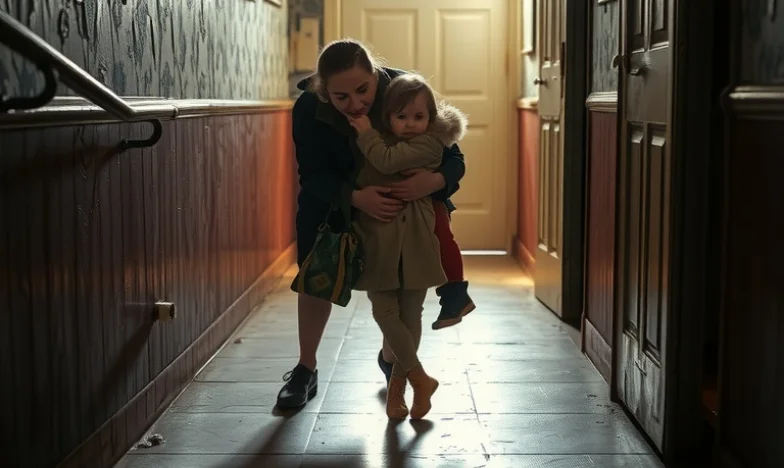
“Mum, are we safe now?” Leila’s voice trembled, her small hand gripping mine so tightly it hurt. I knelt down, pulling her and Ethan into my arms, my back pressed against the peeling wallpaper of the council flat hallway. The fluorescent light above flickered, casting long shadows that danced like ghosts across the linoleum floor. My breath came in short, sharp bursts, every sound from the stairwell making me flinch. I could still hear his voice in my head, venomous and slurred, echoing through the years: “You’re nothing without me, Sarah. No one will help you.”
I’d spent years believing him. Years of hiding bruises with foundation, of making excuses at the school gates, of shrinking into myself whenever someone asked, “Are you alright, love?” But tonight, something inside me snapped. When he raised his hand to Ethan, I saw red. I grabbed the kids, my coat, and my battered old handbag, and ran. I didn’t even stop to put on shoes. The cold pavement bit into my feet as we fled through the estate, past the kebab shop where the owner always nodded kindly, past the playground where Leila used to laugh before she learned to be afraid of loud voices.
Now, in this hallway, I dialled the only number I could think of. “Please, Claire, I need somewhere to stay. Just for tonight. Please.”
There was a pause. I could hear her breathing, the muffled sound of her telly in the background. “Sarah, I… I don’t think that’s a good idea. You know how Mark is about… situations like this. I’m sorry, love.”
The line went dead. I stared at my phone, the screen blurry with tears. I’d always thought that, if it came to it, my friends would help. But now, with nowhere to go, I realised how alone we truly were.
Ethan tugged at my sleeve. “Mum, I’m cold.”
I wrapped my coat around him, trying to hide the tremor in my hands. “It’s alright, sweetheart. We’ll find somewhere.”
But where? The city felt suddenly vast and hostile, every window dark, every door closed. I thought of my parents, but they’d washed their hands of me years ago, when I’d chosen him over their warnings. “He’s not right for you, Sarah. You deserve better.” I’d been too proud, too in love, too desperate to prove them wrong.
A door opened at the end of the hall. An old woman peered out, her hair in curlers, dressing gown pulled tight. “Are you alright, dear?”
I tried to smile. “Just waiting for a taxi.”
She nodded, but her eyes lingered on the children, on my bare feet, on the tears I couldn’t quite hide. She closed the door softly, and I heard the click of the lock.
I sank to the floor, pulling Leila and Ethan close. “We’re going to be okay,” I whispered, though I didn’t believe it. The city outside was silent, the only sound the distant wail of a siren. I wondered if it was coming for us, or for someone else whose screams went unheard.
The hours dragged. My phone battery dwindled. I tried the women’s refuge, but the line was busy. I tried again. And again. Each time, the same recorded message: “All our lines are busy. Please hold.”
Leila fell asleep in my lap, her thumb in her mouth, her hair tangled. Ethan curled up beside me, shivering. I stroked their heads, my mind racing. What if he found us? What if the neighbours called the police? What if no one ever answered?
At dawn, I heard footsteps on the stairs. My heart leapt into my throat. But it was only the postman, whistling as he stuffed letters through the slot. I stood up, legs numb, and tried the refuge again. This time, someone answered.
“Women’s Aid, how can I help?”
I burst into tears. “Please, I need help. I’ve got two kids. We’ve nowhere to go.”
The woman’s voice was calm, gentle. “You’re safe now, love. Can you get to the community centre on Oak Street? We’ll meet you there.”
I woke the children, my voice shaking. “Come on, we’re going somewhere safe.”
We walked through the early morning streets, the city waking up around us. People hurried past, eyes fixed on their phones, on the pavement, anywhere but on us. I wondered if they saw us at all, or if we were just another part of the scenery, another story they’d rather not hear.
At the community centre, a woman in a bright scarf greeted us. She gave the children juice and biscuits, wrapped me in a blanket, and listened as I told my story. For the first time in years, I felt seen. I felt heard.
But the fear didn’t leave me. Even as we settled into the refuge, even as the children made friends and I started to breathe again, I couldn’t shake the feeling that we were still outsiders. The other mums were kind, but wary. The staff were overworked, stretched thin. The city outside still felt dangerous, full of memories I couldn’t escape.
One afternoon, as I watched Leila draw pictures of our old house, she looked up at me. “Will we ever go home, Mum?”
I swallowed hard. “We are home, darling. Wherever we’re together, that’s home.”
But I missed the life I’d lost, even with all its pain. I missed the friends who’d turned away, the parents who’d given up on me, the sense of belonging I’d never really had. I wondered if we’d ever find a place in this city, or if we’d always be running, always looking over our shoulders.
The weeks passed. I found a job cleaning offices at night, leaving the kids with a neighbour from the refuge. I saved every penny, dreaming of a flat of our own. But the waiting list was long, and the benefits office was a maze of forms and questions. “You’ll have to be patient,” the woman behind the desk told me, her eyes tired. “There’s a lot of people in your situation.”
Sometimes, late at night, I lay awake listening to the sounds of the city: the distant traffic, the shouts from the street, the laughter from flats where families still held together. I wondered if anyone ever thought of us, if anyone cared.
One evening, as I walked home from work, I saw him. Across the street, under the orange glow of the streetlights, he stood watching me. My heart froze. I ducked into a shop, waited until he was gone. I told the staff at the refuge, and they called the police. “We’ll keep you safe,” they promised. But I knew how easy it was to slip through the cracks.
The next day, I got a call from my mother. “Sarah, I heard what happened. Your father… he wants to see you.”
I hesitated. “Why now?”
She sighed. “We were wrong. We should have helped you. Please, come home.”
I wanted to believe her. I wanted to believe that people could change, that forgiveness was possible. But I’d learned the hard way that trust was fragile, easily broken.
Still, I took the children to see them. My father hugged me for the first time in years, his hands shaking. “I’m sorry, love. I should have protected you.”
We sat in their kitchen, drinking tea, talking about the past. It wasn’t easy. There were tears, accusations, apologies. But for the first time, I felt a glimmer of hope.
We moved in with them for a while, saving for a place of our own. The children started at a new school, made new friends. I found a better job, started to rebuild my life. But the scars remained, invisible but deep.
Sometimes, when I walk through the city, I see women like me: tired, wary, clutching their children’s hands. I want to tell them it gets better, that there’s hope. But I know how hard it is to believe.
Now, as I tuck Leila and Ethan into bed, I whisper, “We’re safe. We’re together. That’s all that matters.”
But late at night, I still wonder: will this city ever truly welcome us? Or are there some wounds that never heal? What would you do, if you saw someone like me in your hallway, asking for help?