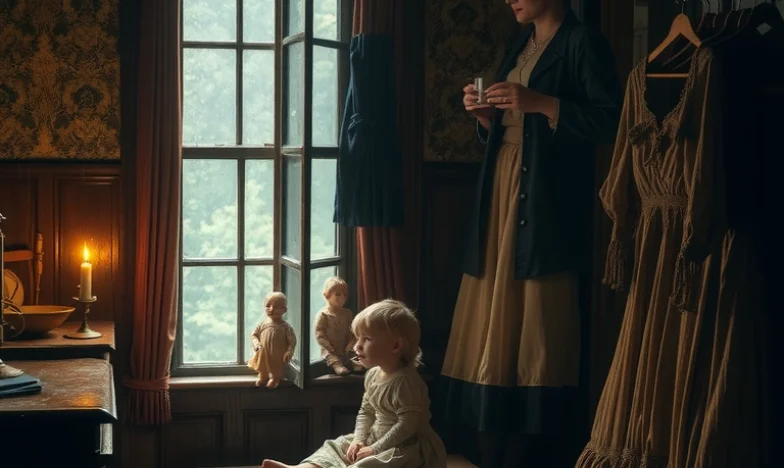
The Forgotten Heir of Belmonte: A Tale of Obsession and Betrayal

The first thing I remember is the sound of rain hammering against the attic window, the glass rattling in its frame as if the house itself was shivering. I was crouched in the corner, knees drawn to my chest, listening to the footsteps below—heavy, deliberate, echoing through the empty corridors of Belmonte House. My name was never spoken aloud, not by the master, not by his wife, not by the servants who scurried past me with eyes averted. To them, I was simply “the child,” a secret kept in the attic, a living contradiction that no one dared to name.
It was the autumn of 1851, and the world outside was changing, though the walls of Belmonte seemed determined to hold back the tide. My earliest memories are of Mrs. Ashcroft, the master’s wife, standing over me with a candle, her face half-lit, half-shadowed. “You must never leave this room,” she whispered, her voice trembling with something I would later recognise as fear. “If anyone asks, you do not exist.”
But secrets have a way of seeping through the cracks, and mine was no exception. I was born with a body that defied the neat categories of man and woman, a fact that both fascinated and repulsed those who discovered it. The master, Mr. Ashcroft, found out first. I was twelve, scrubbing the floor when he burst in, his face flushed with drink and anger. “What are you?” he demanded, grabbing my arm so tightly I thought the bone would snap. I had no answer, only tears.
From that day, everything changed. Mr. Ashcroft began to visit me at night, his footsteps soft on the attic stairs. He would sit beside me, his breath sour with whisky, and ask questions I didn’t understand. “Do you feel more like a boy or a girl?” “Does it hurt?” “Do you want to be touched?” I learned quickly that the right answer was silence. But silence, I soon realised, was its own kind of answer.
Mrs. Ashcroft, too, became obsessed. She would brush my hair, her hands trembling, her eyes never meeting mine. “You are a miracle,” she would murmur, as if trying to convince herself. “A sign from God, perhaps.” But her kindness was laced with something darker—a hunger for control, for possession. She dressed me in her old gowns, paraded me before her friends as a curiosity, a living doll. I hated the way they stared, their eyes lingering on my body, their whispers sharp as knives.
The servants, for their part, treated me with a mixture of pity and fear. Old Martha, the cook, would sneak me scraps from the kitchen, her hands rough but gentle. “Don’t let them break you, child,” she would say, pressing a crust of bread into my palm. “You’re stronger than you know.” But even Martha kept her distance, crossing herself whenever she left the room.
As I grew older, the tension in the house became unbearable. Mr. Ashcroft’s visits grew more frequent, his questions more invasive. He began to touch me, at first gently, then with increasing urgency. I learned to dissociate, to float above my body, watching as he used me to satisfy desires he could not name. Mrs. Ashcroft, too, became more possessive, locking me in the attic for days at a time, her jealousy burning like acid.
One night, I overheard them arguing in the parlour below. Their voices rose and fell, sharp as broken glass. “You think I don’t know what you’ve been doing?” Mrs. Ashcroft hissed. “You think I can’t see the way you look at her—at it?”
“She’s mine,” Mr. Ashcroft spat back. “You have no claim.”
“She is not yours to own!” Mrs. Ashcroft screamed, and for a moment, I thought she might kill him. But the violence passed, replaced by a cold, brittle silence that settled over the house like a shroud.
It was around this time that the rumours began to spread. The villagers whispered about the strange child in the attic, the unnatural goings-on at Belmonte. Some said I was a witch, others that I was cursed. The Ashcrofts became pariahs, shunned by their neighbours, their once-prosperous estate falling into ruin.
One evening, as the sun set behind the hills, Mrs. Ashcroft came to me, her face streaked with tears. “We have to leave,” she whispered, her voice barely audible. “They’re coming for us.”
I didn’t understand, not fully, but I could see the fear in her eyes. That night, we packed what little we could carry and fled into the darkness, leaving Belmonte behind. We wandered for weeks, hiding in abandoned barns, begging for food at the doors of strangers. Mr. Ashcroft grew more desperate, his temper flaring at the slightest provocation. Mrs. Ashcroft became withdrawn, her mind slipping further from reality with each passing day.
Eventually, we were caught. The villagers found us hiding in the woods, their faces twisted with hatred and fear. They dragged us back to Belmonte, now little more than a shell, and locked us in the cellar. For days, we languished in the darkness, the only sound the drip of water from the ceiling and the distant howl of the wind.
It was there, in the suffocating blackness, that Mrs. Ashcroft finally broke. She turned on her husband, accusing him of unspeakable acts, of bringing ruin upon their family. He denied everything, but the damage was done. The villagers, eager for a scapegoat, seized him and dragged him away. I never saw him again.
Mrs. Ashcroft died soon after, her body wasted by grief and hunger. I was left alone, the last living remnant of Belmonte’s shame. The villagers debated what to do with me—some wanted to burn me as a witch, others to send me to an asylum. In the end, it was Martha who saved me, smuggling me out of the cellar under cover of darkness and taking me to her cottage on the edge of the moor.
For years, I lived in hiding, never venturing beyond the safety of Martha’s walls. She taught me to read and write, to cook and sew, to find beauty in the smallest things. But the scars of my past never truly healed. I was haunted by memories of Belmonte, by the faces of those who had loved and hated me in equal measure.
Now, as I sit by the fire, pen in hand, I wonder if my story will ever be told. Will anyone remember the forgotten heir of Belmonte, the child who was both boy and girl, loved and reviled, desired and despised? Or will my life, like so many others, be lost to the shadows of history?
Sometimes, late at night, I ask myself: Was I a curse upon the Ashcrofts, or merely a mirror reflecting their own obsessions? And if you were in my place, would you have chosen to survive, or to disappear?