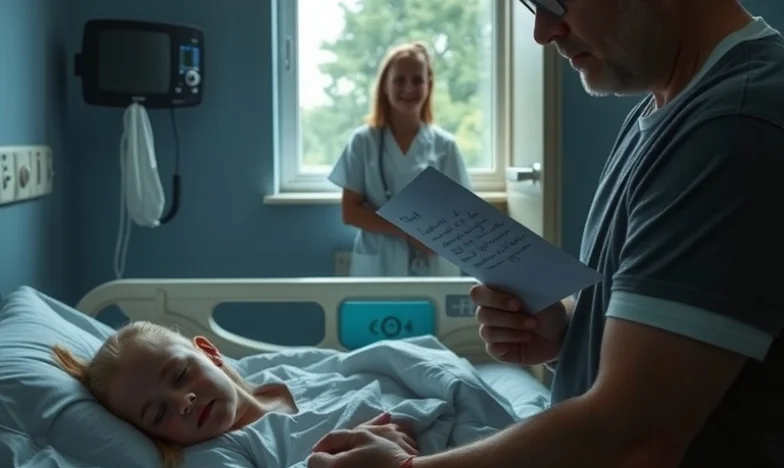
When My Daughter’s Illness Unveiled the Truth: A Father’s Battle to Rebuild

“Dad, why is Mum not answering her phone?”
The question echoed through the sterile hospital room, bouncing off the pale blue walls and settling in the pit of my stomach. I looked at Emily, my fifteen-year-old daughter, her face pale against the pillow, a drip in her arm. The beeping of the monitors was the only sound for a moment. I swallowed hard, trying to keep my voice steady. “She’s probably just busy, love. You know what your mum’s like.”
But I knew. I knew something was wrong. It had been three days since Sarah, my wife, had left the house, supposedly to visit her sister in Manchester. She hadn’t called, hadn’t texted, hadn’t even left a note. At first, I’d made excuses for her, both to myself and to Emily. But as the hours dragged on, and then days, the excuses dried up, replaced by a gnawing dread.
Emily’s illness had come out of nowhere. One morning, she’d woken up with a fever and a rash. By the afternoon, she was struggling to breathe. The ambulance ride was a blur of sirens and panic. Now, as I sat by her bedside, clutching her hand, I felt utterly helpless.
The doctors ran test after test. I answered questions about family medical history, allergies, genetic conditions. I told them what I knew: my mum had diabetes, my dad had died of a heart attack, Sarah’s side was mostly healthy. But the doctors kept coming back, asking for more details, more specifics. They wanted to run genetic tests, they said. It might help them understand what was happening to Emily.
That night, after Emily finally drifted off to sleep, I stepped out into the corridor. The hospital was quiet, the kind of quiet that makes your ears ring. I called Sarah again. Voicemail. I left another message, my voice cracking. “Sarah, please. Emily’s in hospital. She needs you. I need you. Please call me.”
The next morning, a consultant sat me down. He was gentle, but his words were sharp. “Mr. Thompson, we’re having trouble matching Emily’s genetic markers with what you’ve told us about your family history. Are you sure there’s nothing else we should know?”
I shook my head, confused. “I’ve told you everything. Why? What’s wrong?”
He hesitated. “Some of Emily’s markers don’t seem to match yours. It’s possible there’s a discrepancy. Sometimes, in rare cases, children are adopted or there’s a mix-up at birth. Is there any chance—”
“No,” I interrupted, my voice rising. “She’s my daughter. I was there when she was born. I cut the cord.”
He nodded, apologetic. “Of course. We just need to be thorough.”
But the seed of doubt had been planted. I spent the next hours pacing the corridor, replaying every moment of Emily’s life, every memory of Sarah. Had there been signs? Had I missed something?
The hospital called Sarah’s sister. She hadn’t seen Sarah in months. I called Sarah’s work. She hadn’t shown up. Her phone was off. Her bank card hadn’t been used. The police were called. A missing person’s report was filed. I tried to hold it together for Emily, but inside, I was falling apart.
A week passed. Emily’s condition stabilised, but the doctors still had no answers. Then, one afternoon, a nurse handed me an envelope. “This came for you,” she said, her eyes kind but wary.
Inside was a letter, written in Sarah’s handwriting. My hands shook as I read:
Tom,
I’m sorry. I can’t do this anymore. There are things I should have told you a long time ago. Emily isn’t your biological daughter. I had an affair, just before we got married. I thought it was over, but then I found out I was pregnant. I was scared. I wanted to tell you, but you were so happy, so excited to be a dad. I convinced myself it didn’t matter. You loved her as your own. I never thought it would come out. But now, with her illness, I can’t keep lying. I’m so sorry. Please forgive me.
Sarah
The letter slipped from my hands. The world tilted. I sat there, numb, as the truth crashed over me. Fifteen years. Fifteen years of birthdays, school runs, bedtime stories. Fifteen years of believing I was Emily’s father. And now, with a few lines of ink, it was all gone.
I wanted to scream, to smash something, to find Sarah and demand answers. But Emily was still in that hospital bed, still needing me. I wiped my eyes and went back to her room.
She looked up at me, her eyes searching my face. “Did Mum call?”
I shook my head. “No, love. Not yet.”
The days blurred together. The doctors found a treatment that helped Emily improve, but they needed more information. They needed to find her biological father. I had to tell Emily the truth.
I sat by her bed, holding her hand. My voice trembled. “Em, there’s something I need to tell you. It’s about your mum. And about me.”
She listened, silent, as I explained. Tears streamed down her face. “So you’re not my dad?”
I squeezed her hand. “I am your dad. I’ve always been your dad. Nothing changes that. I love you, Em. More than anything.”
She turned away, sobbing. I sat there, helpless, my own tears falling. The nurses gave us space. The doctors kept asking questions. The police still hadn’t found Sarah.
Word got out. My parents were shocked. My mum cried. My friends didn’t know what to say. Some people whispered behind my back. Others avoided me altogether. I felt like a stranger in my own life.
Emily withdrew. She stopped talking to me, stopped eating. She stared at the ceiling, silent and broken. I tried everything—her favourite books, her favourite songs, jokes, stories. Nothing worked.
One night, I sat by her bed, my head in my hands. “Please, Em. Talk to me. I know you’re hurting. I am too. But we’re still a family. We have to be.”
She looked at me, her eyes red. “Why did Mum lie to us?”
I shook my head. “I don’t know. Maybe she was scared. Maybe she thought it was for the best. But I know one thing—I love you. That’s never going to change.”
Slowly, Emily started to come back. She let me read to her again. She let me hold her hand. She started to eat, to smile, to laugh. The doctors found her biological father—a man named David, living in Leeds. He came to the hospital, awkward and nervous. He agreed to the tests. He was a match. He donated what Emily needed.
Afterwards, David tried to get to know Emily. She was polite, but distant. He was a stranger. I was her dad. The one who’d raised her, who’d loved her, who’d never left.
Sarah was never found. The police said she’d probably left the country. I tried to hate her, but I couldn’t. I just felt empty.
Emily came home. The house felt different—quieter, emptier. We muddled through, the two of us. Some days were good. Some days were awful. But we kept going.
One night, as I tucked Emily into bed, she looked at me. “Dad?”
“Yes, love?”
“Do you think Mum ever loved us?”
I hesitated. “I think she did. But sometimes, people make mistakes. Big ones. That doesn’t mean we stop loving them. Or each other.”
She nodded, silent. I kissed her forehead and turned off the light.
Now, months later, we’re still picking up the pieces. Emily’s health is better. She’s back at school. I’m back at work. We talk more. We laugh more. We cry, too. But we’re healing.
Sometimes, late at night, I lie awake, staring at the ceiling. I wonder if I could have done something differently. If I missed the signs. If I was enough.
But then I remember Emily’s smile, her laugh, the way she hugs me tight. I remember that love isn’t about blood. It’s about being there, every day, no matter what.
So I ask you—what makes a family? Is it blood, or is it love? And if love is enough, why does it hurt so much when the truth comes out?