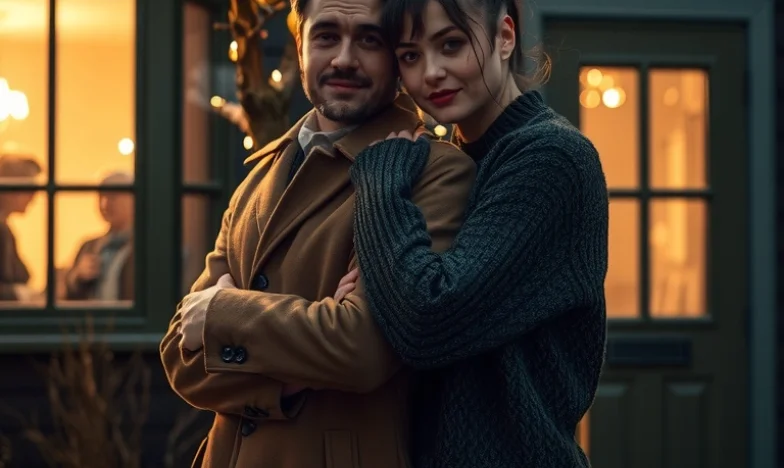
A Hundred Times I Regretted That Christmas Visit

“You’re not wearing that, are you?” Mum’s voice sliced through the hallway as soon as Jakub and I stepped inside, her eyes darting from my battered boots to the bottle of wine in Jakub’s hand. The house was already heaving with bodies, coats piled on the banister, laughter and shrill voices bouncing off the walls. I felt Jakub’s hand squeeze mine, a silent plea for reassurance, but I was already regretting bringing him here.
It was meant to be a proper family Christmas, the first since Dad died, and the first time I’d introduced anyone to Mum since the divorce. But as soon as I saw the crowd—my three sisters, Kinga, Weronika, and Amelia, their partners, their kids, and even Auntie Jean from Bristol—I wanted to turn around and run. The kitchen was a warzone of flour, icing sugar, and passive-aggressive comments. Mum’s partner, Dave, was already half-cut, holding court in the living room with his endless stories about his days on the railway.
Jakub, bless him, tried to make small talk. “Lovely home, Mrs Nowak,” he said, his Polish accent softening the edges of his words. Mum barely nodded, already fussing over the roast potatoes. Kinga rolled her eyes at me from across the room, mouthing, ‘Good luck’. I felt my cheeks burn.
We squeezed around the table, elbows knocking, knees bumping. The smell of roast lamb and overcooked sprouts mingled with the tension in the air. I tried to catch Jakub’s eye, but he was deep in conversation with Amelia’s husband, Tom, about Brexit and the price of petrol. Mum kept glancing at me, her lips pursed, as if daring me to say something she could disagree with.
“So, Jakub,” Mum said suddenly, her voice carrying over the clatter of cutlery, “what do your parents do back in Poland?”
Jakub smiled politely. “My father is a teacher, my mother works in a bakery.”
Mum sniffed. “A bakery, how nice. I suppose you’re used to hard work, then.”
I felt the table stiffen. Weronika shot me a look, her eyebrow arched. I wanted to disappear. Jakub just nodded, unfazed. “Yes, very much so.”
The conversation turned to politics, as it always did. Dave started on about ‘bloody foreigners’ taking jobs, oblivious to Jakub’s presence. I saw Jakub’s jaw tighten, but he said nothing. I wanted to scream at Dave, to tell him to shut up, but Mum just topped up his wine and changed the subject to the cost of living.
After dinner, the kids tore through the lounge, shrieking with sugar-fuelled energy. Kinga and Weronika bickered over who would do the washing up. Amelia was crying in the hallway, her husband nowhere to be seen. I found Jakub in the garden, shivering in the December air, staring at the fairy lights Mum had strung up in the apple tree.
“Are you alright?” I asked, wrapping my arms around myself.
He smiled, but it didn’t reach his eyes. “It’s just… different, isn’t it? Your family.”
I laughed, but it sounded hollow. “You have no idea.”
He took my hand. “I like them. They’re… lively.”
I wanted to believe him, but I could see the strain on his face. I wondered if I’d made a mistake bringing him here, if I’d made a mistake ever thinking I could fit him into this mess of a family.
Back inside, Mum was in full flow, telling everyone about my ‘latest job’—as if my career in graphic design was some sort of phase. “She’s always changing her mind, our Sophie. Never sticks at anything.”
I felt the old anger rise up. “That’s not fair, Mum. I’ve been at the agency for two years.”
She waved her hand dismissively. “Well, you know what I mean. You’re not like your sisters, are you?”
Kinga snorted. “Thank God for that.”
The room erupted in laughter, but I saw the look on Mum’s face. Disappointment, sharp as a knife. I wanted to cry, to scream, to run. Jakub squeezed my knee under the table.
Later, as we opened presents, the tension simmered just below the surface. Mum gave Jakub a box of shortbread and a mug with ‘Best Guest’ printed on it. I got a self-help book about ‘finding your path’. Kinga got a new handbag, Weronika a spa voucher, Amelia a set of wine glasses. I tried not to let it show, but I felt like a child again, desperate for approval I’d never get.
After everyone left, Mum cornered me in the kitchen. “He seems nice enough, your Jakub. But you could do better, love. Someone local, someone who understands us.”
I stared at her, stunned. “What’s that supposed to mean?”
She shrugged. “You know. It’s hard enough fitting in as it is. You don’t need to make things harder for yourself.”
I felt something snap inside me. “Maybe I don’t want to fit in, Mum. Maybe I’m tired of pretending.”
She looked at me, her eyes softening for a moment. “I just want you to be happy, Sophie.”
I shook my head. “No, you want me to be like you. But I’m not.”
I left her standing there, the smell of burnt gravy hanging in the air. Jakub was waiting by the door, his coat already on. “Ready?” he asked.
I nodded, tears stinging my eyes. As we walked out into the cold night, I wondered if I’d ever feel at home again—here, or anywhere.
On the drive back to London, Jakub reached over and took my hand. “You’re not alone, you know.”
I squeezed his hand, grateful for the warmth. But I couldn’t shake the feeling that something had shifted, that I’d crossed a line I couldn’t uncross.
Now, weeks later, I still replay that night in my head. The laughter, the arguments, the way Mum looked at me like she didn’t recognise me at all. I wonder if families ever really change, or if we just learn to live with the cracks.
Do we ever stop wanting our parents’ approval? Or do we just learn to live without it?