The Only Crust

The rain was relentless, drumming on the cracked pavement, soaking through my threadbare hoodie as I huddled beneath the flickering streetlamp outside King’s Cross. My hands were numb, fingers curled around the last crust of bread I’d managed to scrounge from the bins behind the bakery. I was hungry—starving, really—but I’d learned to ignore the ache. What I couldn’t ignore was the sound of someone crying, raw and desperate, echoing through the night like a wounded animal.
I peered through the drizzle and saw her—a woman in a sleek black coat, knees drawn to her chest, mascara streaked down her cheeks. She looked out of place, like a swan fallen into a muddy pond. I recognised her face from the tabloids scattered in the station: Isabella Rossi, the business tycoon, the woman who’d bought half of Canary Wharf and was rumoured to be richer than the Queen herself. What was she doing here, alone, sobbing on the kerb at midnight?
I hesitated, torn between curiosity and the instinct to keep my head down. People like her didn’t see people like me. But something in her sobs—so broken, so human—made me shuffle closer. I cleared my throat, voice hoarse from days without speaking. “Are you alright, miss?”
She flinched, startled, and looked up. Her eyes were red, but sharp, assessing me in a heartbeat. “Do I look alright?” she snapped, then winced, as if ashamed of her own harshness. “Sorry. I just… I just need a minute.”
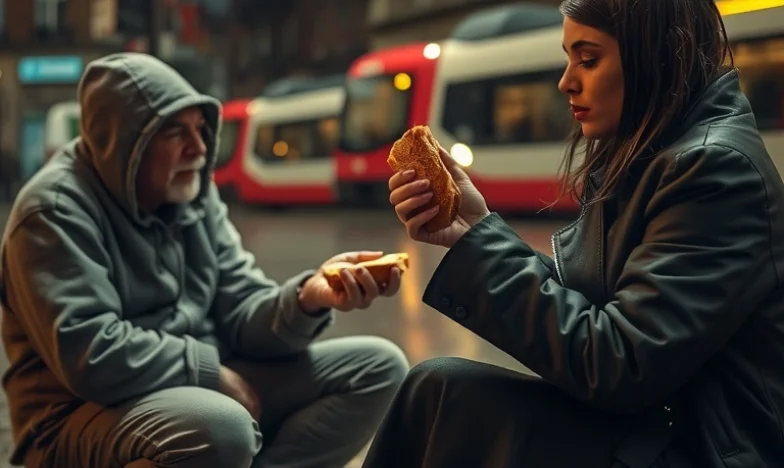
I nodded, awkward, shifting from foot to foot. The crust of bread felt heavy in my palm. I glanced at it, then at her. She looked like she hadn’t eaten in days, though I knew it was probably just the misery weighing her down. Still, I crouched beside her, holding out the bread. “It’s not much, but… you look like you could use it more than me.”
She stared at the offering, disbelief flickering across her face. “You’re giving me your food?”
I shrugged. “It’s all I’ve got. But you look like you need it.”
For a moment, she just stared, then a laugh—bitter and hollow—escaped her lips. “I could buy every bakery in London, and yet here I am, being offered bread by a stranger.”
I didn’t know what to say, so I just sat there, rain pooling around us. She took the crust, turning it over in her hands as if it were made of gold. “What’s your name?” she asked quietly.
“Tommy,” I replied. “Tommy Evans.”
She nodded, tucking a strand of wet hair behind her ear. “Isabella.”
“I know,” I said, and she gave a sad smile.
We sat in silence, the city’s noise muffled by the rain. After a while, she spoke again, her voice barely above a whisper. “Do you ever feel like you’re invisible?”
I laughed, a short, sharp sound. “Every day. People walk past, don’t even see me. Like I’m part of the pavement.”
She nodded, tears welling up again. “I know the feeling. Except everyone sees me, but no one really knows me. They see the money, the power, but not… me.”
I looked at her, really looked, and saw the loneliness etched into her features. “Why are you out here, Isabella? Shouldn’t you be in some fancy penthouse?”
She hesitated, then sighed. “My father died last week. We hadn’t spoken in years. I thought I’d feel… something. Relief, maybe. But all I feel is empty. My family’s torn apart. My brother blames me for everything. The business, the money, it’s all just noise now.”
I nodded, understanding more than she knew. “My mum died when I was twelve. Dad drank himself to death a year later. My sister ran off to Manchester. Haven’t seen her since.”
She looked at me, eyes softening. “I’m sorry.”
“Don’t be,” I said. “We all lose people. Some of us just lose more than others.”
She smiled, a real one this time, and broke the crust in half, handing me a piece. “Share it with me?”
We ate in silence, the bread stale but somehow sweeter for being shared. For a moment, the world shrank to just the two of us, two lost souls on a London street, finding comfort in each other’s company.
After a while, she stood, brushing off her coat. “Thank you, Tommy. For reminding me that kindness still exists.”
I shrugged, embarrassed. “It’s nothing.”
She reached into her bag, pulling out a crisp envelope. “Take this. It’s not charity. It’s gratitude.”
I shook my head. “I don’t want your money.”
She smiled, pressing the envelope into my hand. “It’s not just money. There’s a card in there. My number. If you ever need anything—anything at all—call me.”
I watched her walk away, heels clicking on the wet pavement, and felt something shift inside me. For the first time in years, I felt seen.
Days passed. I kept the envelope tucked inside my jacket, unopened. I went about my routine—begging outside the station, dodging the police, sharing jokes with the other rough sleepers. But something had changed. I started looking people in the eye, started believing that maybe, just maybe, I mattered.
One evening, as I was settling down for the night, a group of lads stumbled out of the pub, laughing and shouting. One of them, a big bloke with a shaved head, spotted me. “Oi, got any change, mate?” he jeered, his mates sniggering.
I ignored them, pulling my hood lower. But they didn’t move on. The big one grabbed my arm, yanking me to my feet. “I said, got any change?”
I tried to pull away, but he was too strong. Panic rose in my chest. Suddenly, a voice rang out—clear, commanding. “Let him go.”
Isabella stood at the edge of the pavement, flanked by two men in suits. The lads hesitated, then slunk away, muttering under their breath.
She hurried over, concern etched on her face. “Are you alright?”
I nodded, shaken. “What are you doing here?”
She smiled. “I was hoping I’d find you. I’ve been thinking about what you said. About being invisible. I want to help. Not just you—all of you.”
I frowned, wary. “How?”
She knelt beside me, her coat pooling on the wet ground. “I’m starting a foundation. For the homeless. Jobs, housing, support. But I need someone who understands what it’s like. Someone who can help me make it real.”
I stared at her, disbelief warring with hope. “You want me to work for you?”
She nodded. “If you’ll have me.”
I laughed, the sound bubbling up from somewhere deep inside. “I don’t even have a clean shirt.”
She grinned. “We’ll sort that. Come on, Tommy. Let’s change the world.”
That night, I slept in a warm bed for the first time in years. The next morning, I put on new clothes, ate a hot meal, and walked into Isabella’s office, heart pounding. She introduced me to her team, listened to my ideas, treated me like an equal. For the first time, I felt like I belonged.
The foundation grew. We opened shelters, started job programmes, gave people hope. I found my sister—she’d been living in a hostel in Manchester, lost and alone. We reconnected, slowly, painfully, but we found our way back to each other.
Isabella and I became friends—real friends. She taught me about business; I taught her about resilience. We argued, laughed, cried. She faced her own demons, reconciled with her brother, learned to let go of the past.
Years later, as I stood on the stage at the opening of our newest shelter, I looked out at the crowd—politicians, journalists, rough sleepers, families—and felt a surge of pride. Isabella stood beside me, her hand on my shoulder.
“Funny, isn’t it?” I whispered. “How a crust of bread can change everything.”
She smiled, tears in her eyes. “It wasn’t the bread, Tommy. It was you.”
Now, when I walk through London, I see the invisible people. I stop, I listen, I remember. Because kindness isn’t about money or power—it’s about seeing each other, really seeing. And I wonder: how many lives could we change if we just stopped to share what little we have?
Do you ever wonder how different the world could be if we all offered our only crust to a stranger in need? Would you have done the same?