Four Winters Gone: The Silence Beneath the Floorboards

‘Mum, where’s Sophie?’ I remember asking that question, my voice trembling, the morning after the snowstorm. The kettle whistled, steam curling in the cold kitchen, but Mum just stared out the frosted window, her hands shaking around her mug. ‘She’s probably at Emily’s,’ she said, but I could see the lie in her eyes. That was four years ago, in our little village on the edge of the Peak District, where everyone knows everyone, and secrets are meant to stay buried under the snow.
The police came, their boots leaving muddy prints on our hallway tiles. They asked questions, took photos, and promised they’d find Sophie and Emily. But as the days turned into weeks, and the search parties dwindled, hope faded like the winter sun. I was only twelve, but I learned quickly how to live with silence. Dad stopped going to work, Mum stopped cooking, and I stopped asking questions. The village changed too—curtains twitched, whispers grew sharp, and every parent clutched their children a little tighter.
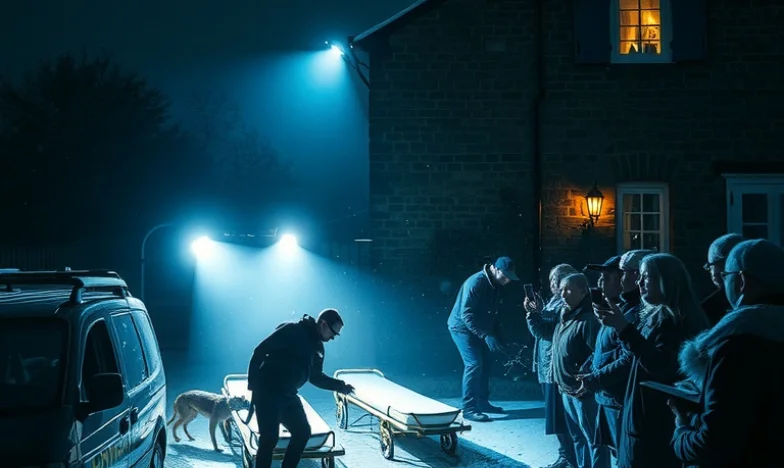
I remember the night the dog barked. Four years had passed, and I was sixteen, taller, quieter, my heart wrapped in layers of numbness. I was walking home from the bus stop, the streetlights flickering, when I saw the police cars outside the old Miller house next door. The house had always been odd—shutters closed, garden overgrown, Mr Miller rarely seen. But that night, the blue lights painted the snow electric, and a German Shepherd was barking, frantic, at the cellar door.
‘What’s going on?’ I asked, my voice barely more than a whisper. PC Harris, who’d watched me grow up, looked at me with something like pity. ‘Go home, Lily,’ he said. ‘It’s not safe here.’
But I couldn’t move. I watched as they pried open the cellar, torch beams slicing through the darkness. The barking grew louder, echoing off the stone walls. Then—silence. For a moment, the world held its breath. Then a shout: ‘We’ve found them! Oh God, we’ve found them!’
The next hours blurred together—sirens, shouting, neighbours gathering in the street, Mum sobbing into her hands. They carried two girls out on stretchers, pale and thin, blinking against the light. Sophie and Emily. My sister, alive. Four years gone, and now she was back, but the girl on the stretcher was not the sister I remembered.
The village erupted in chaos. Reporters swarmed, police cordoned off the house, and everyone wanted to know how two girls could disappear for four years, right under our noses. The answer was as chilling as the winter air: Mr Miller, our quiet neighbour, had kept them in his cellar, hidden from the world. He’d been kind, everyone said. He’d brought us biscuits at Christmas, mowed his lawn every Sunday. No one suspected a thing.
Sophie wouldn’t speak at first. She sat in her room, staring at the wall, flinching when anyone came near. Mum hovered, desperate to help, but every touch made Sophie shrink away. Dad tried to joke, to bring back the old days, but his laughter sounded hollow. I wanted to scream, to shake her, to ask what happened, but I was afraid of the answer.
The village turned inward. Some blamed the police, others blamed Mr Miller’s wife, who’d died years before. Some whispered that Sophie and Emily must have done something to deserve it, as if two little girls could invite such horror. I hated them for it. I hated everyone.
One night, I found Sophie in the kitchen, staring at the snow falling outside. ‘Do you remember the snowman we built?’ I asked, my voice soft. She nodded, tears slipping down her cheeks. ‘I thought you’d forgotten me,’ she whispered. I hugged her then, feeling her bones beneath my arms, and promised I never would.
The trial was a circus. Mr Miller sat in the dock, his face blank, as the prosecutor described the horrors of the cellar—the chains, the darkness, the endless days. Sophie and Emily testified, their voices shaking but strong. The whole village watched, some in the courtroom, others glued to their televisions. When the verdict came—guilty on all counts—there was relief, but no joy. Nothing could give us back those four years.
Afterwards, life didn’t return to normal. How could it? Sophie had nightmares, waking up screaming in the night. Mum started drinking, Dad left for good, and I became the glue holding us together. School was a minefield—some kids were kind, others cruel, whispering behind our backs. I learned to fight, to protect Sophie from the world’s curiosity and cruelty.
But there were moments of hope. Sophie started drawing again, filling sketchbooks with pictures of the outside world. We went for walks in the hills, the wind sharp and clean, and sometimes she’d smile, just for a moment. I clung to those moments, believing that one day, the darkness would lift.
I still wonder how we missed it. How could we live next door and not know? How many other secrets lie hidden behind closed doors, in villages like ours? Sometimes, late at night, I walk past the old Miller house, now boarded up and silent. I imagine Sophie’s voice, calling out from the darkness, and I promise myself I’ll always listen.
Do we ever truly know the people we live beside? Or do we just see what we want to see, until it’s too late to change anything at all?