Seven Words in Court: The Day My Daughter Changed Everything

“Daddy, why are you crying?” Lily’s voice cut through the sterile hush of the courtroom, her tiny hand gripping mine as if she could anchor me to the earth. I blinked away tears, trying to steady my breathing, but the knot in my chest wouldn’t loosen. The judge, a stern woman with silver hair and tired eyes, glanced over her glasses at me, then at Lily, perched on the edge of her seat in her favourite yellow dress. My ex-wife, Sarah, sat across the aisle, her lips pressed into a thin line, her solicitor whispering something in her ear. I could feel the weight of everyone’s gaze—solicitors, clerks, even the bailiff—waiting for me to answer my daughter’s question. But how could I explain to a five-year-old that her world was about to be split in two?
Six months ago, I would have laughed if someone had told me I’d be here. Back then, life was a predictable routine: breakfast at seven, school run at eight, work at the council offices until five, home for tea, bath, and bedtime stories. Sarah and I had our problems—who doesn’t?—but I thought we were managing. We argued about money, about her long hours at the hospital, about my mother’s constant visits. But I never imagined those cracks would become chasms. I never saw the late-night texts on her phone, the secret smiles, the way she started coming home later and later. Until one night, she didn’t come home at all.
The weeks that followed were a blur of accusations and slammed doors. Sarah moved in with her new partner, a man called David, who drove a BMW and wore expensive aftershave. She wanted Lily to live with them in their new flat in Richmond. I fought back, desperate not to lose my daughter, but the odds were stacked against me. Sarah had the better job, the nicer home, the stable relationship. I was just a council worker with a rented flat and a broken heart.
The day of the hearing arrived, grey and drizzling, as if the weather itself was mourning the end of my marriage. My mum came with me, clutching her handbag like a shield. “You’ll be alright, love,” she whispered, squeezing my arm. But I could see the worry in her eyes. She knew, as I did, that fathers rarely win these battles.
Inside the courtroom, the air was thick with tension. Sarah’s solicitor painted a picture of me as unreliable, unstable, even neglectful. She brought up the time I forgot to pick Lily up from ballet, the night I let her eat ice cream for dinner, the weekend I took her to the seaside without telling Sarah. Each mistake, magnified and twisted, made me feel smaller and smaller.
When it was my turn, my solicitor tried to fight back. She talked about my devotion to Lily, the bedtime stories, the school projects, the way I’d rearranged my work schedule to be there for her. But I could see the judge’s scepticism. She asked me pointed questions: “How will you manage childcare with your work hours? What support do you have? Can you provide a stable environment?”
I answered as best I could, but my voice trembled. I felt like I was failing a test I hadn’t studied for. And all the while, Lily sat between us, swinging her legs, clutching her battered teddy bear.
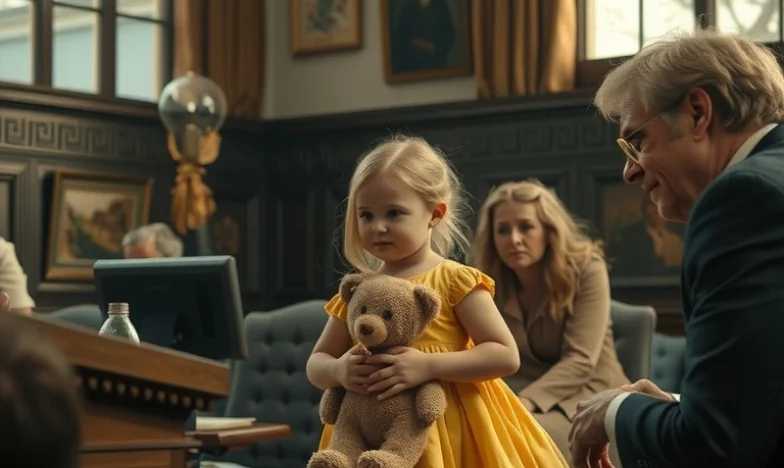
Then the judge did something I hadn’t expected. She asked to speak to Lily. My heart lurched. I wanted to object, to protect her from this, but the judge assured us she would be gentle. Lily was led to the front of the room, her small figure dwarfed by the high-backed chair. The judge smiled kindly. “Lily, can you tell me where you like to live?”
Lily looked at me, then at her mum. She fiddled with her teddy’s ear. “I like being with Daddy,” she said quietly. My heart soared, but I saw Sarah’s face harden. The judge nodded. “And why is that, sweetheart?”
Lily’s brow furrowed, as if she was searching for the right words. The room held its breath. Then she spoke, her voice clear and steady: “Because Daddy listens when I’m sad.”
Seven words. That was all. But in that moment, the entire courtroom seemed to freeze. The judge’s pen hovered above her notepad. Sarah’s solicitor stopped whispering. Even my mum gasped. I felt tears prick my eyes again, but this time they were different—hopeful, grateful.
The judge leaned forward. “That’s very important, Lily. Thank you for telling me.” She turned to Sarah and me. “It’s clear that Lily feels safe and heard with her father. That must be considered.”
The rest of the hearing passed in a blur. The judge asked more questions, weighed the evidence, and finally delivered her decision. Shared custody, with Lily spending equal time with both parents. It wasn’t everything I’d hoped for, but it was more than I’d dared to expect.
Afterwards, outside the courtroom, Sarah wouldn’t meet my eyes. She gathered her things in silence, her new partner waiting by the door. My mum hugged me, tears streaming down her cheeks. “You did it, Marcus. You did it.”
But it wasn’t me. It was Lily. My brave, honest little girl, who spoke the truth when it mattered most.
That night, as I tucked her into bed in my tiny flat, she looked up at me. “Are you still sad, Daddy?”
I smiled, brushing her hair from her face. “Not anymore, love. Not anymore.”
Now, months later, life isn’t perfect. Sarah and I still argue, and Lily still asks hard questions. But we’re finding our way. I’ve learned that being a good father isn’t about having the best house or the most money—it’s about listening, about being there, about loving your child enough to let them speak their truth.
Sometimes I wonder: if Lily hadn’t spoken those seven words, would I have lost her? How many other fathers never get the chance to prove themselves, to show that love is more than a bank statement or a postcode? What would you have done, standing in my shoes, with everything on the line and only your child’s voice to save you?