When the House Falls Silent: A British Mother’s Reckoning with the Empty Nest

“You’re not listening, Mum! I’m not coming back for Sunday roast, I’ve got plans!” The phone line crackled with my daughter’s frustration, and I felt the sting of her words as if she’d slapped me. I stared at the faded wallpaper in my kitchen, the same pattern that had watched over scraped knees, birthday cakes, and late-night confessions. Now, it bore silent witness to my loneliness. My hands trembled as I set the phone down, the echo of her voice lingering in the air like a ghost.
For thirty-five years, this house in the outskirts of York had been filled with the chaos of family life. Three children, each with their own tempers and dreams, had grown up within these walls. My husband, David, and I had poured every ounce of ourselves into them—school runs in the rain, scraped together holidays in Scarborough, endless arguments over curfews and homework. We’d sacrificed holidays abroad, new clothes, even our own ambitions, just to give them a better start. Now, at sixty-five, I found myself sitting at the kitchen table, a cup of tea cooling in my hands, wondering what was left of me.
David shuffled in, newspaper under his arm, his face drawn and tired. “Any word from Tom?” he asked, not meeting my eyes. I shook my head. Our eldest, always the quiet one, had moved to London for work and rarely called. “He’s busy,” I muttered, but the words tasted bitter. David grunted, settling into his chair with a sigh that seemed to carry the weight of all our years. We sat in silence, the only sound the ticking of the clock and the distant hum of traffic.
I tried to fill my days—gardening, volunteering at the charity shop, even joining a book club—but nothing filled the ache. The house felt too big, every room echoing with memories. I’d walk past Emily’s old bedroom and catch a whiff of her perfume, or find one of Tom’s football trophies gathering dust on the shelf. Sometimes, I’d stand in the doorway, willing the past to come back, just for a moment.
One evening, as rain lashed the windows, I found David in the garage, tinkering with his old motorbike. “Do you ever feel… lost?” I asked, my voice barely above a whisper. He looked up, surprise flickering in his eyes. “All the time,” he admitted. “It’s like we built our whole lives around them, and now—” He trailed off, shrugging helplessly. For the first time, I realised he was just as adrift as I was.
We started arguing more. Silly things, like who forgot to buy milk or left the back door unlocked. But underneath, I knew it was grief. Grief for the life we’d had, for the noise and mess and purpose that had vanished overnight. One night, after a particularly bitter row, David stormed out, slamming the door behind him. I sat on the stairs, tears streaming down my face, feeling utterly alone.
The next morning, I found a note on the kitchen table: “Gone for a walk. Need to clear my head. D.” My heart clenched with fear—what if he didn’t come back? What if, like the children, he decided he was better off without me? I spent the day pacing the house, replaying every harsh word, every moment I’d taken him for granted. When he finally returned, soaked to the bone, I threw my arms around him, sobbing into his shoulder. “I’m scared, David,” I whispered. “I don’t know who I am anymore.”
He held me tight, his own tears mingling with mine. “We’ll figure it out. Together.”
Slowly, we began to rebuild. We started taking walks in the countryside, just the two of us, rediscovering the quiet joys we’d forgotten. We talked—really talked—for the first time in years. About our fears, our regrets, our hopes for the future. I confessed how lost I felt without the children, how I worried I’d wasted my life. David admitted he missed his old mates, the ones he’d drifted from while raising a family.
One afternoon, as we sat on a bench overlooking the moors, David turned to me. “What did you want, before all this?” he asked. The question caught me off guard. I thought back to my younger self, the girl who’d dreamed of painting, of travelling, of seeing more than the inside of a semi-detached in Yorkshire. “I wanted to paint,” I said, surprising myself. “I used to love it, before the kids.”
“Then why not start again?” David smiled, a spark of mischief in his eyes. “It’s not too late, you know.”
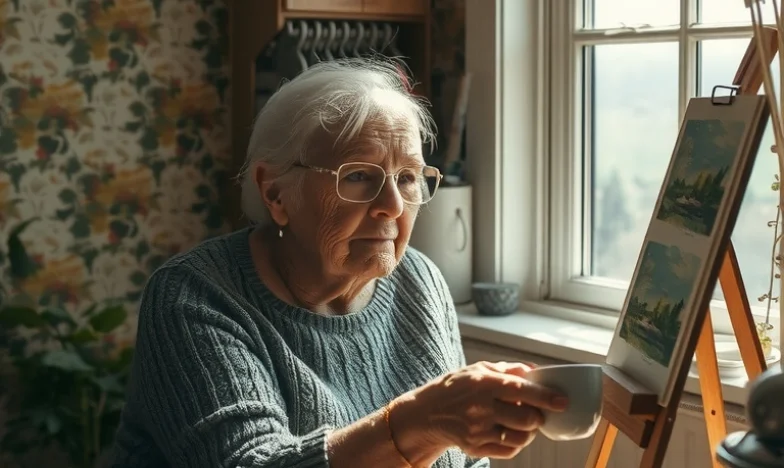
That evening, I dug out my old watercolours from the loft, the brushes stiff with age. I set up a small easel by the window and began to paint. At first, my hands shook, and the colours bled together, but slowly, the old joy returned. I lost myself in the swirl of blues and greens, the world outside fading away. For the first time in years, I felt alive.
Word spread quickly in our small village. “Didn’t know you were an artist, Zena!” Mrs. Cartwright from next door exclaimed, peering at my latest landscape. I blushed, unused to the attention. Soon, I was invited to display my work at the local community centre. David beamed with pride, telling anyone who’d listen about my “hidden talent.”
The children noticed the change, too. Emily called more often, curious about my paintings. Tom surprised us with a visit, bringing his new girlfriend. Even our youngest, Sophie, who’d moved to Edinburgh, sent postcards with sketches of her own. The house felt warmer, fuller, even if the children weren’t always there.
But the ache never fully disappeared. There were still nights when I’d lie awake, listening to the wind, wondering if we’d done enough, if we’d loved them well. Sometimes, I’d catch David staring at old photos, a faraway look in his eyes. We’d hold hands in the dark, drawing comfort from each other’s presence.
One Sunday, as we sat in the garden, Emily arrived unannounced, her arms full of flowers. “Thought you might like some company,” she grinned. We spent the afternoon laughing, sharing stories, and for a moment, it felt like old times. As the sun set, Emily hugged me tight. “I’m proud of you, Mum. You’re more than just our mother, you know.”
Her words echoed in my mind long after she’d gone. More than just a mother. It was a revelation, a challenge, and a comfort all at once. I realised I could honour the past without being trapped by it. I could love my children fiercely, but also learn to love myself.
Now, as I sit at my kitchen table, brush in hand, I look out at the world with new eyes. The house is quieter, yes, but it’s also filled with possibility. David and I are learning to live for ourselves, to find joy in the small things—a shared joke, a walk in the rain, a splash of colour on canvas.
Sometimes, I wonder: How many of us lose ourselves in the roles we play, forgetting the dreams we once held dear? And when the house falls silent, who do we become?