Today Could Be My Mum: A British Tale of Hope and Belonging

‘Please… today, you could be my mum.’
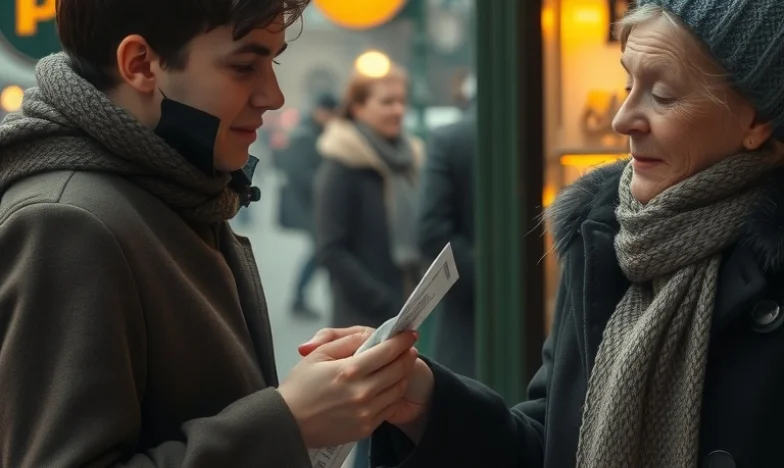
My voice cracked as I said it, the words hanging in the air like the fog that clung to the streets of King’s Cross. My hand shook—not from the January chill, but from the terror that she’d say no. The crumpled train ticket in my palm was my last hope, the only thing I had left after my father’s funeral and the cold, echoing silence of our mansion in Hampstead. I was Oliver, son of the late Richard Ashcroft, a man whose name opened doors but whose heart had been locked away since my mother died when I was six.
The woman in front of me—her name was Beatrice—looked at me with a mixture of shock and something else, something softer. She was nothing like the women who’d flitted through my father’s life: no designer coat, no manicured nails, just a faded woollen scarf and hands rough from work. She was standing outside the Pret, clutching a paper bag, probably her lunch. I’d seen her before, cleaning the offices on Euston Road, always with a tired smile, always alone.
‘Are you alright, love?’ she asked, her voice gentle but wary. ‘You look frozen to the bone.’
I tried to speak, but the words caught in my throat. I was seventeen, old enough to know better, but grief had stripped me raw. My father’s friends had all but vanished after the will was read, and my stepmother—if you could call her that—had made it clear I was not welcome in the only home I’d ever known. I’d spent the night in a hostel, the kind where the walls are thin and the air smells of despair.
‘Please,’ I managed, thrusting the ticket towards her. ‘I just… I need someone. Just for today. Pretend to be my mum. I can pay you.’
Her eyes widened, and for a moment I thought she’d walk away. But instead, she took the ticket, her fingers brushing mine, and nodded slowly. ‘Alright, Oliver. Let’s get you warm first.’
We sat in the corner of the café, steam rising from our mugs. I told her everything—the loneliness, the fights with my father’s new wife, the way the house felt haunted by memories of my real mum. Beatrice listened, her eyes never leaving mine. She told me about her own son, lost to a knife in a South London alley, and how she’d never stopped looking for him in the faces of boys on the street.
‘You don’t have to pay me, love,’ she said quietly. ‘No one should have to beg for a bit of kindness.’
I wanted to cry, but I held it in. Instead, I asked her to come with me to the solicitor’s office, to sit beside me as I faced the woman who’d stolen my father’s affection and now wanted everything else. Beatrice squeezed my hand. ‘I’ll be right there, Oliver. You’re not alone.’
The office was cold, all glass and steel, the kind of place where people like Beatrice were invisible. My stepmother, Miranda, sat across from us, her lips pursed, her eyes flicking over Beatrice’s worn coat with barely concealed disgust.
‘Who is this?’ she demanded.
‘My mum,’ I said, my voice steady. ‘She’s here for me.’
Miranda scoffed. ‘Your mother is dead, Oliver. Let’s not play games.’
Beatrice leaned forward, her voice calm but firm. ‘He’s not playing. He needs someone, and I’m here. That’s what matters.’
The solicitor cleared his throat, shuffling papers. ‘We’re here to discuss Oliver’s inheritance. As per Mr Ashcroft’s will, Oliver is entitled to a trust fund, but only if he completes his A-levels and remains in the family home.’
Miranda smiled, all teeth. ‘Which, as you know, is my home now. And I don’t think it’s appropriate for Oliver to stay, given his… behaviour.’
I felt the old anger rising, the sense of injustice that had burned in me since my father’s death. ‘You mean since I refused to call you mum? Since I wouldn’t pretend everything was fine?’
Miranda’s face hardened. ‘You’re a child, Oliver. You don’t understand how the world works.’
Beatrice squeezed my hand again. ‘He understands more than you think. He’s lost more than you ever will.’
The meeting ended with no resolution. Miranda stormed out, her heels clicking on the marble floor. The solicitor offered a weak smile, promising to “look into alternative arrangements.”
Outside, I slumped against the wall, the weight of it all pressing down on me. Beatrice stood beside me, silent for a moment, then said, ‘You know, when my son died, I thought I’d never feel needed again. But today, you gave me a purpose. Maybe we can help each other.’
We spent the afternoon walking along the Thames, the city grey and beautiful in the winter light. Beatrice told me stories of her childhood in Hackney, of her dreams and disappointments. I told her about my mum, how she used to sing to me when I couldn’t sleep, how the house had felt alive when she was there.
‘You don’t have to be blood to be family,’ Beatrice said softly. ‘Sometimes, you just have to choose each other.’
That night, I stayed at her flat in a council estate in Islington. It was small, but warm, filled with photos and laughter. For the first time in months, I slept without nightmares.
The weeks that followed were a blur of court dates, social workers, and whispered conversations in the corridors of my old school. Some of my friends drifted away, uncomfortable with my new reality. Others rallied around me, bringing food and jokes and the kind of loyalty that only comes from shared struggle.
Beatrice became my anchor. She helped me revise for my exams, cooked me proper meals, and listened when I needed to rage or cry. She stood up for me when the school tried to exclude me for missing too many days, marching into the headteacher’s office with a fierceness that left him speechless.
‘He’s been through enough,’ she said, her voice shaking with emotion. ‘Give him a chance.’
Slowly, things began to change. The solicitor found a loophole in the will, allowing me to access part of my trust to pay for a small flat. Beatrice moved in with me, and together we built something that felt like home. We argued, of course—about chores, about money, about my tendency to leave socks everywhere—but it was the kind of arguing that comes from love, not resentment.
Miranda tried to contest the arrangement, but the courts sided with me. For the first time, I felt seen, not as the son of a millionaire, but as a person with my own story, my own pain, and my own hope.
On the day I got my A-level results, Beatrice hugged me so tightly I thought I’d burst. ‘Your mum would be so proud,’ she whispered.
I looked at her, tears in my eyes. ‘You are my mum.’
Now, as I write this, I wonder how many others are out there, lost in the cracks of this city, desperate for someone to choose them. How many Beatrices walk past us every day, carrying their own grief, their own hope?
Would you have stopped for me? Would you have been my mum, even for a day?