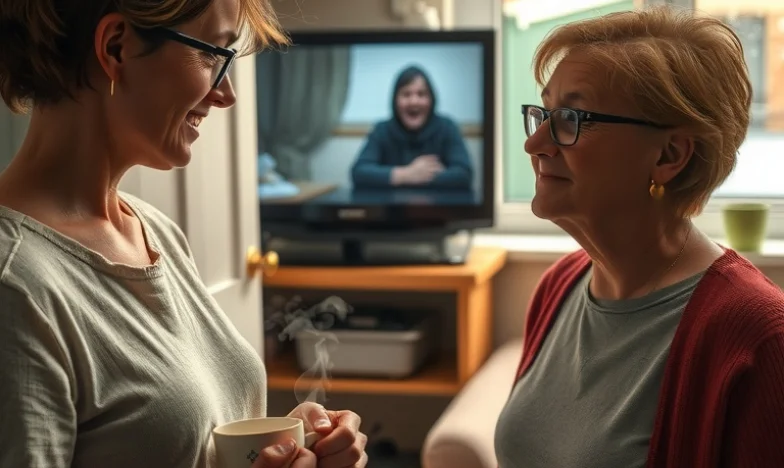
Fractures and Forgiveness: A British Family Story

“You’ll never be good enough for my son, Emma. Not in this house.”
The words hung in the air, sharp as a slap, as I stood in the cramped kitchen of the Harris family’s semi-detached in Reading. My hands trembled around the chipped mug of tea, the steam curling up between us like a barrier I could never cross. Margaret Harris, my mother-in-law, glared at me over her glasses, her lips pressed into a thin, unforgiving line. I could hear the telly blaring in the lounge, the laughter of my husband, Tom, and his younger brother, Jamie, oblivious to the storm brewing just a room away.
I’d always thought the stories about difficult mothers-in-law were exaggerated, the stuff of sitcoms and gossip. My own mum, gentle and warm, had always welcomed people with open arms. I’d grown up in a house where disagreements were settled with a cup of tea and a hug, not icy silence or barbed remarks. But from the moment Tom and I said our vows, it was as if I’d crossed an invisible line. Margaret’s smiles at the wedding had been brittle, her congratulations perfunctory. I told myself it was nerves, or maybe sadness at seeing her eldest son start a new life. I never imagined it would be the start of a cold war.
The first few months were a blur of small slights and awkward dinners. Margaret would correct my cooking, criticise my job at the local library, and make pointed remarks about how things were done “properly” in the Harris household. Tom, ever the peacemaker, would laugh it off, telling me not to take it personally. “She’s just set in her ways, love. Give her time.”
But time only deepened the cracks. The real breaking point came that April, on the day of Tom’s birthday. I’d spent hours preparing his favourite meal, determined to show Margaret that I could be part of the family. The table was set, the roast in the oven, and I’d even managed to bake a Victoria sponge without burning it. Margaret arrived early, arms full of shopping bags, and immediately took over the kitchen. She tutted at my gravy, re-seasoned the potatoes, and rearranged the table settings. When I tried to protest, she snapped, “If you want things done right, you do them yourself.”
I retreated to the garden, blinking back tears, the laughter from inside the house twisting like a knife. Tom found me there, sitting on the cold stone steps, my hands clenched in my lap. “Emma, what’s wrong?” he asked, concern etched on his face.
“It’s your mum,” I whispered. “I can’t do anything right. She hates me.”
Tom sighed, running a hand through his hair. “She doesn’t hate you. She’s just… difficult. She’ll come round, I promise.”
But she didn’t. The months dragged on, each family gathering a minefield. Jamie, always quick with a joke, tried to lighten the mood, but even he couldn’t bridge the gap. My father-in-law, Alan, kept his head down, retreating behind his newspaper whenever tensions flared. I felt like an outsider in my own home, tiptoeing around Margaret’s moods, my confidence slowly eroding.
The final straw came one rainy Sunday afternoon. We were all gathered in the lounge, the rain lashing against the windows, when Margaret made a snide comment about my family. “Some people just don’t know how to raise their children properly,” she said, her eyes fixed on me. The room fell silent. I felt the heat rise in my cheeks, my hands shaking with anger.
“That’s enough,” I said, my voice trembling. “I won’t let you talk about my family like that.”
Margaret’s eyes narrowed. “You’re in my house, Emma. Don’t forget that.”
Tom stood up, his face pale. “Mum, stop it. You’ve gone too far.”
But Margaret wouldn’t back down. “If she can’t handle a bit of honesty, maybe she shouldn’t be here.”
I left the house that day, the rain soaking through my coat as I walked the long way home. Tom caught up with me halfway down the street, his umbrella useless against the storm. “Emma, please. Don’t let her get to you.”
“I can’t do this anymore, Tom,” I said, my voice breaking. “I can’t keep pretending everything’s fine.”
We spent the next few weeks barely speaking, the tension between us thick as fog. I threw myself into work, staying late at the library, avoiding home. Tom tried to reach out, but I pushed him away, afraid that if I let myself feel, I’d break completely.
It was Jamie who finally forced a reckoning. He showed up at the library one evening, rain-soaked and breathless. “You need to come home, Emma. Mum’s had a fall.”
My heart lurched. I rushed to the hospital, fear and guilt warring inside me. Margaret lay in a stark white bed, her face pale and drawn. Tom sat by her side, his eyes red-rimmed. I hesitated in the doorway, unsure if I was welcome.
Margaret looked up, her eyes meeting mine. For the first time, I saw something other than disdain—fear, vulnerability, maybe even regret. “Emma,” she said, her voice weak. “I’m sorry.”
The words caught me off guard. I sat beside her, unsure what to say. “You don’t have to—”
She shook her head. “I do. I’ve been awful to you. I was scared of losing Tom, of losing my family. But I see now I was pushing you all away.”
Tears pricked my eyes. “I just wanted to be part of the family.”
Margaret reached for my hand, her grip surprisingly strong. “You are, love. You always were. I was just too stubborn to see it.”
The days that followed were a blur of hospital visits and quiet conversations. Margaret softened, her sharp edges dulled by illness and reflection. Tom and I found our way back to each other, the walls between us slowly crumbling. Jamie, ever the peacekeeper, joked that it took a broken hip to fix a broken family.
We moved into our own flat soon after, a tiny place above a bakery that always smelled of fresh bread. Margaret visited often, sometimes bringing homemade scones, sometimes just herself. The old tensions never disappeared completely, but they no longer defined us. We learned to forgive, to let go of old hurts, to build something new from the ashes of the past.
Now, as I sit by the window, watching the rain trace patterns on the glass, I wonder: Can families ever truly heal, or do we just learn to live with the cracks? What would you do if forgiveness was the only way forward?