The Lonely Birthday: A Tale of Two Worlds Colliding

“Why won’t anyone come?” I whispered, my hands clenched tight around the arms of my wheelchair as the clock in the hallway chimed three. The living room was a palace of silence, the kind that presses on your chest and makes you want to scream. Balloons in pastel pink and gold hovered at the ceiling, their strings trailing like forgotten wishes. The cake—three tiers, covered in sugar roses—sat untouched on the table. My father, Richard, stood by the window, his phone glued to his ear, barking orders at someone about quarterly reports and deadlines. He caught my eye and forced a smile, but it didn’t reach his eyes.
“Darling, your friends are probably just running late,” he said, but we both knew it was a lie. My mother, elegant in her navy dress, fussed with the napkins, her lips pressed into a thin line. She’d sent out invitations to every girl in my class at St. Agnes’—even the ones who’d never spoken to me. But none of them had come. Not one.
I heard the faint sound of laughter drifting from the park across the road. Children were playing, their voices bright and free. I pressed my forehead to the cold windowpane and watched them. I wondered what it felt like to run, to tumble in the grass, to be part of something instead of always watching from behind glass.
The doorbell rang, sharp and unexpected. My heart leapt. My mother hurried to answer it, smoothing her hair. I heard her voice, polite but wary: “Can I help you?”
A boy’s voice, quiet but clear: “Can I join you?”
I craned my neck as my mother led him in. He was small for his age, with messy brown hair and a faded football shirt. His trainers were scuffed, and his jeans had a patch on one knee. He looked around, wide-eyed, at the chandelier, the marble fireplace, the mountain of unopened presents.
“I’m Jamie,” he said, his accent rougher than mine, but his smile was warm. “I saw the balloons. Thought maybe you could use some company.”
My father frowned, but I grinned. “I’m Emily. It’s my birthday.”
Jamie’s eyes lit up. “Happy birthday, Emily.”
He didn’t stare at my wheelchair. He didn’t look away, embarrassed, like the girls at school. He just sat down beside me and asked, “What games do you like?”
We played pass-the-parcel with just the two of us, and Jamie made silly faces every time the music stopped. He told me about his dog, Buster, and how he sometimes sneaked him into the park even though the signs said no dogs allowed. I told him about my favourite books, and how I wished I could climb trees like the characters did.
My parents watched from the doorway, uncertain. My father kept glancing at his phone, but for once, he didn’t answer it. My mother brought us lemonade and slices of cake, her eyes softening as she listened to us laugh.
After a while, Jamie asked if we could go outside. My father hesitated. “The garden’s not really—”
But Jamie was already wheeling me towards the French doors. “Come on, Emily. I’ll race you to the apple tree.”
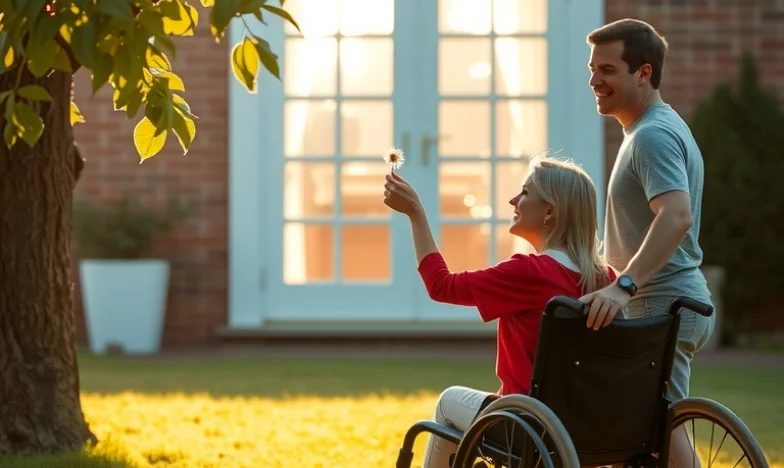
Outside, the air was sharp with the promise of rain. Jamie pushed my chair over the grass, careful not to tip me. He picked a daisy and tucked it behind my ear. “You look like a princess now,” he said, and I blushed.
We watched the clouds drift by, making up stories about the shapes they made. For the first time in months, I forgot about the ache in my legs, the endless hospital visits, the way people whispered when they thought I couldn’t hear. I was just Emily, and Jamie was my friend.
As the sun dipped behind the rooftops, Jamie stood up. “I should go. Mum’ll be waiting.”
My father cleared his throat. “Jamie, where do you live?”
Jamie pointed to the block of flats across the road. “Number twelve. Top floor.”
My father’s jaw tightened. “You came here alone?”
Jamie shrugged. “Mum’s working. She said I could play outside.”
My mother knelt beside me. “Did you have a nice time, darling?”
I nodded, my eyes shining. “The best.”
After Jamie left, the house felt emptier than before. My father paced the living room, muttering about security and strangers. My mother tried to reassure him, but I could see the worry in her eyes.
That night, as she tucked me into bed, I asked, “Mummy, why didn’t anyone else come?”
She hesitated. “Sometimes people are afraid of what they don’t understand, love. But that doesn’t mean there’s anything wrong with you.”
I thought about Jamie, about the way he’d smiled at me like I was just another kid. “Can Jamie come again?”
She kissed my forehead. “We’ll see.”
The next day at school, the girls whispered behind their hands. “Did you see Emily’s party? No one went.”
I held my head high. “I had a friend there. His name’s Jamie.”
They rolled their eyes. “He’s not from our school.”
But I didn’t care. Jamie was real. He saw me.
Over the weeks, Jamie came over after school. Sometimes my father grumbled, but my mother always welcomed him with biscuits and tea. Jamie taught me how to play chess, and I helped him with his reading. We built a den in the garden, using old sheets and pegs.
One afternoon, Jamie arrived with a black eye. My mother gasped. “What happened?”
Jamie shrugged. “Some lads at the estate. They said I was a posh girl’s pet.”
I clenched my fists. “You’re not. You’re my friend.”
Jamie grinned, but I saw the hurt in his eyes. “Doesn’t matter. They’re just jealous.”
My father overheard. That night, he sat me down. “Emily, I know you like Jamie, but he’s… different. His family’s not like ours.”
I glared at him. “He’s kind. He makes me happy. Isn’t that what matters?”
He sighed, rubbing his temples. “The world isn’t always kind to people who are different.”
I stared at the ceiling, wishing I could run away. “Then maybe the world needs to change.”
The next day, Jamie didn’t come. I waited by the window, watching the rain streak down the glass. My mother tried to distract me with stories, but I couldn’t focus.
Days passed. I grew quiet, withdrawn. My father noticed. “Emily, what’s wrong?”
I burst into tears. “I miss Jamie. I want my friend back.”
He looked stricken. “I’m sorry, love. I just wanted to protect you.”
I shook my head. “You’re not protecting me. You’re making me lonely.”
That evening, my father crossed the road to the flats. He knocked on Jamie’s door. Jamie’s mother answered, wary. “What do you want?”
He cleared his throat. “I’d like Jamie to come over. Emily misses him.”
She studied him, then nodded. “He’s a good boy. He just wants a friend.”
Jamie returned the next day, grinning from ear to ear. We hugged, and I felt whole again.
From then on, Jamie was part of our family. My father softened, inviting Jamie and his mother for Sunday roast. My mother taught Jamie how to bake scones. We laughed, we argued, we grew together.
At school, the girls still whispered, but I didn’t care. I had Jamie. He taught me that friendship isn’t about where you come from, but who you are.
Years later, as I wheeled across the stage to collect my university degree, Jamie cheered the loudest. My father wept, my mother beamed, and I knew that everything had changed because one boy had dared to ask, “Can I join you?”
Sometimes I wonder: how many lives could change if we just opened the door to someone different? Would you have let Jamie in?