The Girl from the Rubbish Lorry

“Oi, rubbish girl! You stink of bins!”
The words hit me before I’d even stepped through the school gates. It was always the same: a chorus of laughter, a few crumpled crisp packets lobbed my way, and the ever-present, burning shame that flushed my cheeks. I kept my head down, clutching my battered backpack, and tried to block out the jeers. Twelve years. Twelve years of this. I sometimes wondered if the teachers even noticed, or if they just thought I was quiet by nature.
My name is Ellie Turner, and my mum, Sandra, is a refuse collector for Manchester City Council. Every morning, before the sun even thought about rising, she’d pull on her hi-vis jacket, lace up her steel-toed boots, and head out to the depot. I’d hear her humming in the kitchen, making my packed lunch—always with a note tucked inside, always with a smile, even when her hands were raw from the cold. She’d come home smelling of diesel and sweat, but to me, she always smelled like home.
But to everyone else, she was just ‘the bin lady’. And I was ‘the rubbish girl’.
I remember the first time it really stung. Year 2, Mrs. Collins’ class. We were meant to draw what our parents did for work. I drew Mum in her orange jacket, picking up bags of rubbish. When I showed it to the class, the sniggers started. “Why can’t your mum work in an office like normal people?” someone said. I didn’t have an answer. That night, I asked Mum why she did what she did. She just smiled and said, “Someone’s got to do it, love. And I do it for you.”
The years rolled on, and the taunts grew sharper. Secondary school was the worst. The girls in my form would wrinkle their noses when I walked past. I’d find banana peels stuffed in my locker, notes calling me ‘Ellie the Stink’. I tried to scrub the smell of the depot off my clothes, but it lingered, just like the shame. I stopped inviting friends round. Not that I had many. Our flat was small, cluttered with second-hand furniture and the constant hum of the estate outside. Mum did her best to make it cosy, but I could see the tiredness in her eyes, the way she winced when she bent down to pick up my dropped pencil.
One evening, I came home to find Mum sitting at the table, her head in her hands. “They’re cutting my hours,” she said, voice trembling. “I don’t know how we’ll manage.” I wanted to scream, to rage at the world for making her life so hard. Instead, I hugged her tight and promised I’d work harder at school, that I’d get us out of this mess. She just stroked my hair and whispered, “You’re my clever girl. Don’t let them get to you.”
But it was hard not to let them. The teachers, though kind enough, never expected much from me. “You’re doing your best, Ellie,” they’d say, as if my best could never be good enough. I started spending lunchtimes in the library, hiding among the stacks, losing myself in stories of people who escaped, who made something of themselves. I dreamed of university, of a life where no one would know or care about my mum’s job.
But dreams felt fragile. Especially when reality kept barging in. Like the time I overheard Mrs. Jenkins, the head of year, talking to another teacher in the corridor. “Poor girl. With a background like that, it’s no wonder she struggles.” I wanted to march up to her and scream, “I’m not struggling! I’m surviving!” But I just kept walking, head down, as always.
The only person who never pitied me was Mum. She was proud, fiercely so. When I got my first A in English, she stuck the paper on the fridge and told everyone at the depot. “That’s my Ellie,” she’d beam. “She’s going places.” I wanted to believe her. I really did.
But the world has a way of reminding you where you belong. At prom, I wore a dress from the charity shop. The other girls wore designer. I spent the night in the toilets, listening to them laugh about my ‘bin bag dress’. I told Mum I’d had a great time. She didn’t believe me, but she didn’t push. She just made me a cup of tea and let me cry in her arms.
Then came the final year. The pressure was suffocating. I studied until my eyes ached, desperate to prove everyone wrong. But the whispers never stopped. “She’ll never make it. Not with a mum like that.”
The day of graduation arrived, and I almost didn’t go. I stood in front of the mirror, hands shaking, staring at the cheap black gown. Mum came in, her face shining with pride. “You did it, love. I always knew you would.” She pressed a kiss to my forehead, and for a moment, I felt brave.
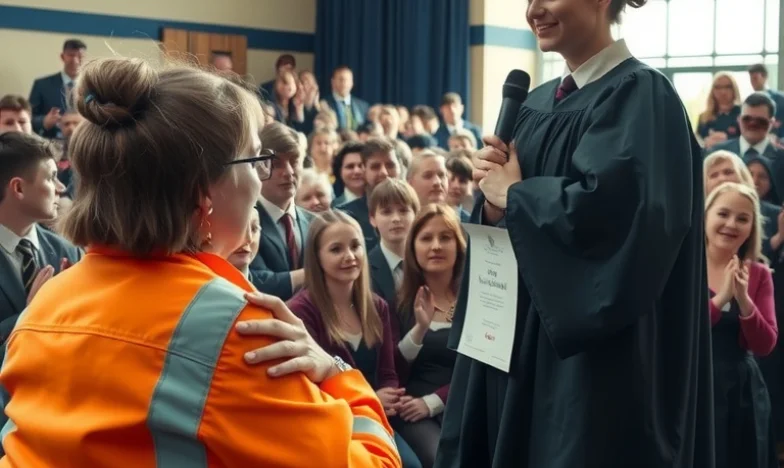
The hall was packed. Parents in smart suits, girls in heels, boys with slicked-back hair. I spotted Mum at the back, still in her work clothes, her hair pulled back in a messy bun. She looked out of place, but she didn’t care. She waved, grinning, and I felt a lump rise in my throat.
When my name was called, I walked up to the stage, heart pounding. The headteacher handed me my certificate, smiling politely. Then, to my horror, he handed me the microphone. “Would you like to say a few words, Ellie?”
I froze. The room was silent, hundreds of eyes on me. I could hear the girls in the front row whispering, see the smirks on their faces. I thought of all the years, all the pain, all the times I’d wanted to disappear. And then I saw Mum, standing tall, her eyes shining with tears.
I took a deep breath. My voice shook, but I spoke anyway.
“For twelve years, you called me ‘the rubbish girl’. But my mum taught me that no job is rubbish if it’s done with love. She picked up your bins so I could pick up my dreams. Thank you, Mum.”
For a moment, there was silence. Then someone started clapping. Then another. And another. Soon, the whole hall was on its feet, applauding, some wiping away tears. I looked at Mum, and she was crying, but she was smiling too. For the first time in my life, I felt seen. Not as ‘the rubbish girl’, but as Ellie Turner, daughter of Sandra, the bravest woman I know.
Afterwards, people came up to me, apologising, congratulating, telling me how brave I was. The girls who’d mocked me hugged me, tears in their eyes. Even Mrs. Jenkins pulled me aside and said, “You’ve taught us all a lesson today, Ellie.”
That night, Mum and I sat on the sofa, eating chips out of the paper, laughing and crying in equal measure. She squeezed my hand and said, “You made me proud today, love.”
I looked at her, really looked at her, and realised I’d never been ashamed of her. Only of how the world treated us. But maybe, just maybe, things could change.
So, I ask you—what would you have done, standing in my shoes? Would you have spoken up, or stayed silent? And when the world tries to put you in a box, will you let it—or will you break free?