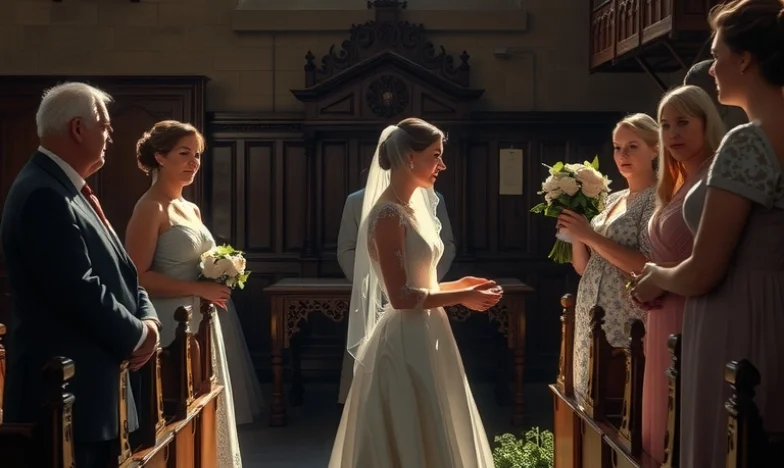
The Day the Church Bells Fell Silent: Kinga’s Story

“Where is he, Mum?” My voice trembled, echoing off the cold stone walls of St Mary’s, the scent of lilies and anticipation thick in the air. My mother, pale and tight-lipped, squeezed my hand so hard it hurt. “He’s just running late, love. Don’t fret.” But I could see the truth in her eyes, the way she avoided my gaze, the way my father paced outside, muttering curses under his breath. The vicar checked his watch for the third time, and my bridesmaids—my sister Ellie and my best friend Priya—hovered awkwardly, their pastel dresses suddenly too bright for the gloom settling over us.
I’d always been the quiet one, the dreamer. Growing up in a small village near Bath, I’d spent my childhood weaving daisy chains and sketching wedding dresses in the margins of my schoolbooks. My parents, both teachers, raised me to believe in hard work and happy endings. I met Tom at university in Bristol—he was charming, clever, and made me laugh in a way no one else could. We’d planned every detail of our wedding together: the wildflower centrepieces, the Victoria sponge cake, the playlist for the first dance. I’d imagined this day a thousand times, but never like this—never with my heart pounding in my chest, my hands shaking, and my future evaporating with every tick of the clock.
The guests began to murmur, shifting in their pews. Auntie Jean whispered something to Uncle Dave, who shook his head and glanced at me with pity. My little cousin Molly, dressed as a flower girl, tugged at my skirt. “Why isn’t Tom here yet?” she asked, her blue eyes wide. I knelt down, forcing a smile. “He’ll be here soon, sweetheart.” But even as I said it, I knew it was a lie.
My phone buzzed in my clutch. A message from Tom’s best man, Jamie: “No sign of him. Tried his flat, no answer. Sorry, Kinga.” My breath caught. I looked at my father, who strode over, jaw clenched. “We can’t keep everyone waiting, Kinga. What do you want to do?”
What did I want to do? I wanted to scream, to run, to wake up and find it was all a nightmare. Instead, I stood frozen, the weight of a hundred eyes pressing down on me. My mother wrapped her arms around me, her voice breaking. “It’s not your fault, darling. Whatever happens, we’ll get through it.”
The vicar approached, gentle and apologetic. “Perhaps we should give it another fifteen minutes?” I nodded, numb. Fifteen minutes passed. Then thirty. The church bells tolled the hour, and still, no sign of Tom. My father made the announcement, his voice steady but his hands shaking: “I’m afraid the wedding won’t be going ahead today. Thank you all for coming.”
The guests filed out, some offering hugs, others avoiding my gaze. Ellie and Priya stayed by my side, their faces etched with shock and sympathy. I sat in the empty church, the silence deafening, my bouquet wilting in my lap. “Why?” I whispered. “Why would he do this?”
The days that followed blurred together. My mother fielded phone calls from relatives, neighbours, and well-meaning friends. My father retreated into his garden, pruning roses with a vengeance. Ellie moved back home for a while, sleeping in my bed and holding me when the tears came. Priya brought over takeaway curries and bottles of wine, trying to make me laugh. But nothing could fill the void Tom had left.
I replayed every moment of our relationship, searching for clues. Had I missed something? Was I not enough? The shame was suffocating. I couldn’t face the village shop, couldn’t bear the whispers and sideways glances. My wedding dress hung in my wardrobe, a ghost of the life I’d imagined.
A week later, Tom finally called. His voice was hollow, apologetic. “I’m sorry, Kinga. I just… I couldn’t do it. I panicked. I’m so sorry.”
“Why didn’t you tell me?” I choked out, anger flaring through the grief. “Why leave me standing there like a fool?”
“I thought I could go through with it. I didn’t want to hurt you. I just… I’m not ready. I’m so sorry.”
Sorry. The word echoed in my mind, meaningless. I hung up, shaking with rage and heartbreak. My parents tried to comfort me, but their own disappointment was palpable. My father, usually so stoic, broke down one evening over dinner. “You deserved better, love. You always have.”
The village rallied around me in their own way. Mrs. Patel from the corner shop slipped extra biscuits into my bag. Old Mr. Harris offered to walk my dog when I couldn’t face leaving the house. But the pity was almost worse than the pain. I wanted to disappear, to start over somewhere no one knew my story.
One evening, Ellie found me sitting on the swings in the park, staring at the sunset. “You know, you’re allowed to be angry,” she said, her voice gentle. “You’re allowed to grieve. But you’re also allowed to move on.”
“I don’t know how,” I admitted. “Everything I planned, everything I dreamed of… it’s gone.”
She squeezed my hand. “Maybe it’s time to dream new dreams.”
It wasn’t easy. The months crawled by. I started volunteering at the local library, losing myself in books and the quiet comfort of routine. I joined a pottery class, my hands shaping clay into something new, something whole. Slowly, I began to reclaim pieces of myself.
Tom sent a letter, months later. He’d moved to London, started a new job, was seeing someone else. He wished me happiness. I didn’t reply. Instead, I took my wedding dress to a charity shop in Bath, watching as the assistant hung it in the window. “Someone will have a beautiful day in this,” she said, smiling. I hoped she was right.
My parents grew closer, united by the storm we’d weathered. My father apologised for his anger, my mother for her tears. We learned to laugh again, to find joy in small things—a walk along the river, a cup of tea in the garden, a new book shared between us.
Sometimes, late at night, I still wonder what might have been. But I also wonder what might still be. Life didn’t turn out the way I planned, but maybe that’s not the end of my story. Maybe it’s just the beginning.
So I ask you—have you ever had to let go of a dream you cherished? And if so, how did you find the courage to start again?