A Flicker in the Autumn: My Mother’s Last Wish

“Don’t let my soul grieve in the next world. Promise me, Alice.”
Her hand, so thin and cold, trembled in mine as the November wind rattled the windowpanes. I nodded, tears blurring my vision, but she was already slipping away, her breath as faint as the last flicker of a candle. My mother, Margaret Evans, was gone before the church bells struck eight, leaving behind a battered terraced house in Sheffield, a battered family, and a battered will.
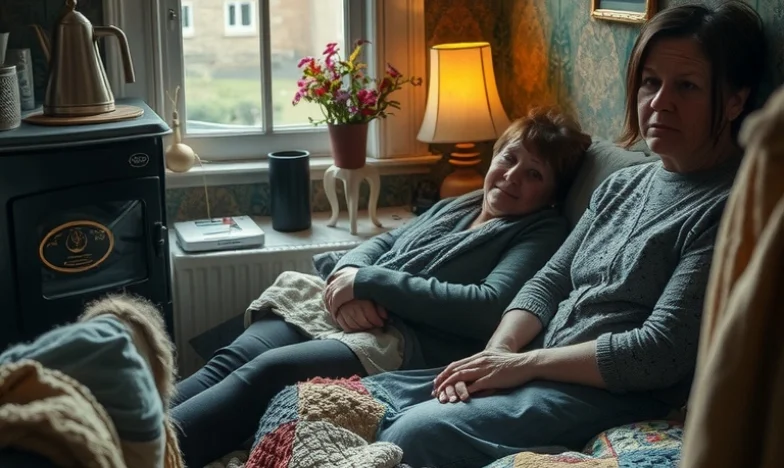
I was the one who found her, curled up like a child beneath the patchwork quilt she’d sewn the year Dad left. My brother Tom arrived half an hour later, red-eyed and silent, his wife hovering in the hallway with a face like thunder. My younger sister, Emily, came last, her hair wild, mascara streaked, clutching a Tesco bag of clothes and a bottle of cheap wine. We gathered in the cramped living room, the air thick with grief and old resentments.
“She’s gone,” I whispered, but no one replied. The clock ticked. The kettle boiled. Outside, the city carried on, indifferent.
It was Tom who broke the silence. “We need to call the solicitor. Mum said there’s a will.”
Emily snorted. “Probably not much to fight over, is there?”
I flinched. “She wanted us to stay together. She said—”
“She always said things,” Tom interrupted, voice brittle. “Doesn’t mean it’s possible.”
The funeral was a blur of black coats, weak tea, and neighbours whispering behind gloved hands. I watched as the vicar spoke of peace and rest, but all I felt was a gnawing emptiness. Mum had worked herself to the bone cleaning offices, scrimping and saving, never once taking a holiday. She left us with little more than a few hundred pounds, a house in need of repairs, and a letter, written in her careful, looping script:
“The money is not much, but I want my children to live with rectitude and harmony. Do not let my soul be saddened in the next world.”
I read it aloud in the kitchen, my voice shaking. Tom stared at the floor. Emily rolled her eyes, but I saw her wipe away a tear.
The solicitor came on a rainy Tuesday, his briefcase bulging with papers. “Your mother’s estate is modest,” he said, “but the house is to be divided equally among you.”
Tom’s jaw tightened. “I can’t afford to buy you out. I’ve got the kids, the mortgage—”
Emily cut in. “I need the money. I’m behind on rent. I can’t live here, not with all these memories.”
I tried to keep my voice steady. “Maybe we could rent it out? Split the income?”
Tom shook his head. “I’m not being a landlord. Too much hassle.”
Emily slammed her mug down. “So what, we just sell it? Chuck everything out? Like Mum never existed?”
Arguments flared, old wounds reopened. Tom accused Emily of never helping, Emily accused Tom of being Mum’s favourite, and I tried to mediate, my heart pounding. The house felt colder, emptier, as if Mum’s spirit had fled in despair.
Days turned into weeks. I stayed on, sorting through Mum’s things: her wedding dress, yellowed with age; a box of ration books from her childhood; a faded photograph of the three of us at Scarborough, before Dad left. Each item was a memory, a weight, a question I couldn’t answer.
One night, I found Emily in the garden, smoking in the drizzle. “I can’t do this, Alice,” she whispered. “I can’t pretend we’re a happy family. We never were.”
I sat beside her, the damp seeping through my jeans. “Mum wanted us to try.”
She laughed, bitter. “Mum wanted a lot of things. She wanted Dad to come back. She wanted Tom to stop drinking. She wanted me to finish uni. None of it happened.”
I reached for her hand, but she pulled away. “You’re the good one, Alice. You always do what you’re told. But I can’t. I’m tired.”
I watched her disappear into the night, her shoulders hunched against the cold. I wondered if I was really the good one, or just the one too scared to let go.
The next morning, Tom called. “We need to decide. The estate agent says the market’s good. If we sell now, we’ll get a decent price.”
I hesitated. “What about Emily?”
“She’ll take whatever she can get. She always does.”
I wanted to scream. Instead, I agreed to meet him at the house.
We walked through the empty rooms, the walls echoing with our footsteps. Tom paused in the kitchen, staring at the faded wallpaper. “Mum used to make us beans on toast after school. Remember?”
I nodded. “She never complained. Even when Dad left.”
Tom’s face crumpled. “I should’ve done more. I should’ve helped her.”
I touched his arm. “We all could’ve done more.”
He looked at me, eyes red. “Do you think she forgave us?”
I didn’t know how to answer.
The sale went through in January. We split the money, each of us poorer in spirit than before. Emily moved to Manchester, Tom buried himself in work, and I rented a flat on the outskirts of town, the letter tucked in my bedside drawer.
Sometimes, I dream of Mum, her voice soft and sad. “Live with rectitude and harmony.” But harmony is a fragile thing, easily broken. We are scattered now, three lost souls adrift in a city that never stops.
I visit her grave on Sundays, bringing daffodils in spring, chrysanthemums in autumn. I tell her about my week, about Tom’s new job, about Emily’s latest move. I tell her I’m trying, but some days it feels impossible.
As I stand beneath the grey Yorkshire sky, I wonder: Can a family ever truly heal after so much loss? Or are we all just flickers in the autumn, fading quietly into the night?