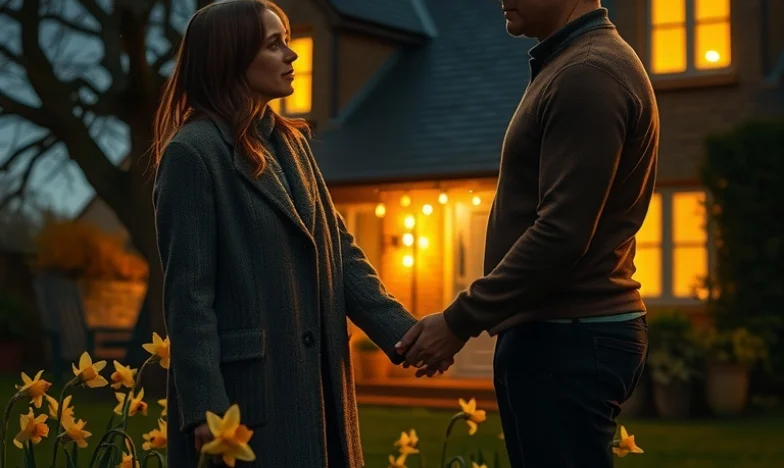
Between Two Worlds: When My Husband Became a Child in Someone Else’s Garden

“You never listen, do you, Tom?” My voice echoed off the peeling wallpaper of our cramped kitchen, the kettle’s shrill whistle slicing through the tension. Tom’s back was to me, shoulders hunched, hands gripping the edge of the sink as if he might fall if he let go. Rain battered the window, blurring the view of the estate’s grey blocks. “I’m not asking for much, Anna. Just a bit of space. A garden. Somewhere the kids could run about, if we ever had any.”
I slammed my mug down, tea sloshing over the rim. “And what about my job? My parents? My life here? You want to drag me off to some village where the only shop closes at four and the bus comes once a week?”
He turned, eyes tired, jaw clenched. “I’m suffocating here. I can’t breathe in this bloody city.”
That was always his refrain. I’d grown up in Hackney, the city’s noise and chaos a lullaby. Tom, from a sleepy village in Yorkshire, had come to London for university and never quite settled. He’d talk about his childhood like it was a lost paradise: climbing apple trees, fishing in the beck, bonfire nights that lasted till dawn. I’d listen, half-envious, half-exasperated. But I loved him. I thought love would be enough.
It wasn’t. Not after that visit to my parents’ place last Christmas. The flat was packed, the air thick with the smell of roast lamb and my mum’s perfume. My dad, ever the joker, ribbed Tom about his accent, his city shoes, the way he held his fork. Tom laughed along, but I saw the way his smile faltered, the way he retreated into himself. Later, as we lay in my childhood bedroom, he whispered, “I don’t belong here, Anna. I never have.”
I brushed his hair back, trying to soothe him. “You belong with me.”
He kissed my forehead, but I felt the distance growing between us, like a hairline crack in glass.
The arguments grew sharper after that. Tom started spending weekends trawling property sites, sending me links to cottages in Kent, Devon, even as far as Cumbria. I’d delete them without replying. My friends at work noticed the tension. “You alright, love?” asked Priya, as we queued for coffee. “You look knackered.”
I shrugged. “Just Tom. He wants to move to the middle of nowhere. I can’t.”
She squeezed my arm. “You’ve got to meet him halfway, Anna. Or you’ll lose him.”
I wanted to scream. Why was it always me who had to bend? Why couldn’t he see what he was asking me to give up?
One night, after another row, Tom stormed out. I sat on the sofa, staring at the silent telly, my phone heavy in my lap. Hours passed. When he finally returned, his eyes were red, his voice hoarse. “I went to the park. Just needed air.”
I reached for him, but he flinched. “I can’t do this anymore, Anna. I feel like a stranger in my own life.”
We tried counselling. The therapist, a soft-spoken woman with kind eyes, asked us to list what we wanted. Tom’s list was simple: space, quiet, a garden, a dog. Mine was messier: my job, my friends, my parents, the city’s heartbeat. The therapist nodded, scribbling notes. “You’re both holding onto different dreams. Is there any overlap?”
We stared at each other, silent.
Spring came, and with it, an invitation to Tom’s parents’ anniversary in Yorkshire. I dreaded it, but Tom was insistent. “Just a weekend. Please.”
The train ride north was tense. Fields blurred past, green and endless. Tom relaxed as we left the city behind, his shoulders loosening, his eyes brightening. His parents’ house was warm, the garden wild with daffodils. His mum hugged me tight, pressing a scone into my hand. “You look thin, love. City life not feeding you?”
That night, after too much wine, Tom took my hand and led me outside. The sky was thick with stars, the air sharp and clean. “This is what I want, Anna. Peace. Space to breathe.”
I shivered, not from cold. “And what about me? My life?”
He squeezed my hand. “I don’t know. But I can’t keep pretending I’m happy in London.”
We returned home, the silence between us heavier than ever. I threw myself into work, staying late, avoiding home. Tom started gardening on the estate’s tiny patch of grass, coaxing life from the stubborn soil. Our neighbours laughed, but Tom didn’t care. “It’s something,” he said, dirt under his nails, eyes distant.
One evening, I came home to find him sitting on the step, head in his hands. “I got a job offer. In Cornwall. It’s good money. A proper house, with a garden.”
My heart thudded. “And you want me to just pack up and go?”
He looked up, tears in his eyes. “I want you to want it too.”
I sat beside him, the city’s hum all around us. “I can’t, Tom. My parents are getting older. My mum’s health isn’t great. I can’t leave them.”
He nodded, wiping his face. “I know. But I can’t stay.”
The days blurred. We moved through the flat like ghosts, polite but distant. My mum called, her voice thin. “Are you alright, darling? You sound far away.”
“I’m fine, Mum. Just tired.”
One night, Tom packed a bag. “I need to go. Just for a bit. To clear my head.”
I watched him go, the door clicking shut like a final word. I sat in the dark, the city’s lights flickering outside. I thought about all the things I loved: the smell of rain on concrete, the rush of the Tube, my parents’ laughter, the way the city never slept. I thought about Tom, about the boy who’d once danced with me in the rain, who’d made me believe in forever.
Weeks passed. Tom called sometimes, his voice softer, sadder. “I miss you, Anna. But I feel alive here.”
I visited him once, in his new cottage. The garden was wild, the air thick with birdsong. Tom looked happy, but older, lines etched deep around his eyes. We walked by the sea, silent. At the station, he hugged me tight. “I’ll always love you, Anna. But I can’t come back.”
I returned to London, the city swallowing me whole. My parents grew frailer, my job busier. I missed Tom, missed the life we’d almost had. But I couldn’t leave. Not yet.
Sometimes, late at night, I wonder: was love supposed to be enough? Or were we always meant to live in different worlds, two hearts beating out of sync? Would you have chosen differently?