Unexpected Flatmates and Garden Luck: A Story of Second Chances

“You can’t just bring strangers into my house, Sophie!” My voice echoed off the kitchen tiles, brittle and sharp, as I gripped the mug so tightly I thought it might shatter. Rain battered the window, and the kettle hissed behind me, but all I could see was my daughter’s pleading face, her eyes wide and desperate.
“Mum, please. She’s got nowhere else to go. It’s just for a few weeks, until she finds her feet.” Sophie’s voice trembled, and I could see the exhaustion in her posture, the way she twisted her scarf in her hands.
I wanted to say no. I wanted to scream that I’d barely managed to keep myself together since David died, that the silence of our house was the only thing holding me up. But Sophie’s eyes—so like her father’s—held me in place. I nodded, the word ‘yes’ catching in my throat like a fishbone.
That’s how I met Leanne and her two children, Jamie and Millie. They arrived on a Tuesday, dragging battered suitcases and a carrier bag full of groceries. Leanne was younger than me, but her eyes were old, shadowed with worry. The children clung to her, silent and wary, as if the world might swallow them whole. I showed them the spare room, the bathroom, the kitchen. I tried to smile, but my lips felt stiff, as if I’d forgotten how.
The first week was chaos. Jamie left muddy footprints on the hall carpet. Millie cried at night, her sobs muffled by the thin walls. Leanne apologised constantly, her voice tight with embarrassment. I found myself resenting their presence—their noise, their mess, the way they filled the house with life I hadn’t asked for. I missed the quiet, the order, the way David used to hum as he made tea. I missed him so much it hurt to breathe.
One evening, as I scrubbed at a stubborn stain on the kitchen table, Leanne hovered in the doorway. “I’m sorry, Mary. I know this isn’t easy. I just… I didn’t have anywhere else to go.”
I looked up, meeting her gaze. For a moment, I saw past the awkwardness, the tension. I saw a woman who’d lost almost everything, just like me. “It’s all right,” I said, though it wasn’t. “We’ll manage.”
Days blurred into weeks. The children settled, their laughter echoing through the house. Leanne found a part-time job at the Co-op, and I started to notice the small ways she tried to help—washing up, folding laundry, bringing me a cup of tea when she thought I looked tired. Still, the house felt crowded, my grief pressed in by their presence.
One Saturday, I escaped to the garden. It had been David’s pride and joy—a riot of roses, runner beans, and the old apple tree that shaded the patio. Since he died, I’d let it go wild, weeds choking the beds, the shed door hanging off its hinges. I knelt in the damp earth, pulling at nettles, my hands stinging. The air was sharp with the scent of cut grass and rain.
I didn’t hear Leanne approach until she spoke. “It’s beautiful, even like this.”
I snorted. “It’s a mess.”
She crouched beside me, her jeans already muddy. “Maybe. But it’s got good bones. My gran had a garden like this. She used to say you can always start again, no matter how bad things get.”
I looked at her, surprised. There was something in her voice—a wistfulness, a longing. “Did you garden with her?”
She nodded. “Every summer. It was the only place I felt safe.”
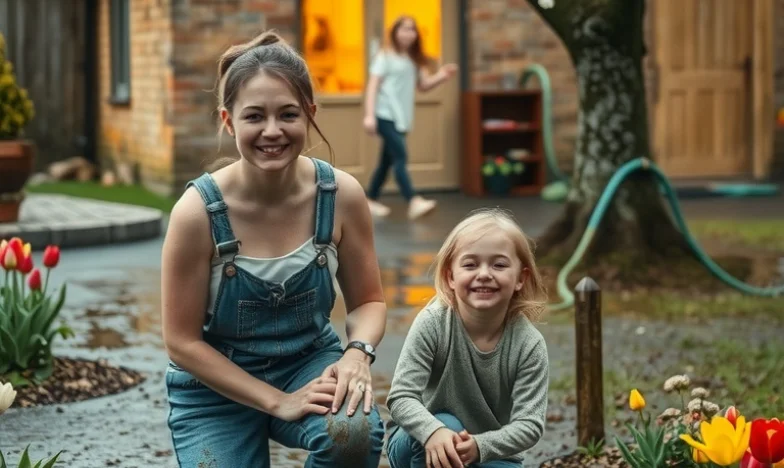
We worked in silence for a while, pulling weeds, turning soil. The children joined us, Jamie chasing worms, Millie collecting petals in a jam jar. For the first time in months, I felt something shift inside me—a flicker of hope, a memory of happiness.
That evening, we sat around the kitchen table, muddy and tired, eating jacket potatoes and laughing at Jamie’s stories. The house felt different—warmer, somehow. I caught Leanne’s eye, and she smiled, a real smile, the kind that reaches the eyes.
But not everything was easy. My sister, Ruth, called one Sunday, her voice sharp as ever. “You’re letting strangers live in your house? Mary, have you lost your mind?”
I bristled. “They’re not strangers. Not anymore.”
She tutted. “You’re too soft. People take advantage.”
I wanted to argue, but I remembered the way Leanne had cried quietly in the garden, the way Millie clung to my hand when she was scared. “Sometimes people just need a bit of kindness, Ruth.”
Ruth sniffed, unconvinced. “Don’t come running to me when it all goes wrong.”
I hung up, my hands shaking. Doubt crept in, cold and insistent. Was I making a mistake? Was I letting my loneliness cloud my judgement?
The next week, Leanne came home late, her face pale. “I lost my job,” she whispered, her voice breaking. “They said they can’t keep me on.”
I made tea, the old ritual soothing my nerves. “We’ll manage,” I said, though I wasn’t sure how. “We always do.”
Money grew tight. I started selling old books and clothes online, Leanne took cleaning jobs wherever she could find them. The children noticed the tension, their laughter fading. I worried about the bills, about the future, about whether I’d made everything worse.
One afternoon, as I pruned the roses, Leanne joined me, her hands trembling. “I’m sorry, Mary. I never wanted to be a burden.”
I put down my secateurs, turning to face her. “You’re not a burden. You’re family now.”
She burst into tears, and I held her, awkwardly at first, then tighter. For the first time since David died, I felt needed. I felt alive.
Spring came, and with it, new growth. The garden flourished under our care—tulips, daffodils, the apple tree heavy with blossom. We planted vegetables, the children helping to water and weed. The house filled with the scent of earth and flowers, laughter and hope.
One evening, as we sat in the garden, Leanne turned to me. “I don’t know what I’d have done without you, Mary.”
I smiled, tears prickling my eyes. “You saved me, too.”
Sophie visited, bringing news of her own—she was pregnant, her face glowing with excitement. “You’ll be a grandmother again, Mum!”
I hugged her, my heart full. For the first time in years, I felt whole.
But life isn’t a fairy tale. There were still arguments—about chores, about money, about boundaries. Ruth continued to criticise, neighbours gossiped, and some days the grief returned, sharp and sudden. But we faced it together, our little patchwork family.
One rainy afternoon, as I watched the children play in the garden, Leanne sat beside me, her hand warm in mine. “Do you ever think about starting over?” she asked.
I looked at the garden, at the tangled beauty we’d created from chaos. “Every day,” I said. “And every day, I’m glad I did.”
Now, as I sit here, the scent of roses drifting through the open window, I wonder—how many lives could change if we opened our doors, just a little? How many hearts could heal, if we dared to let someone in?