The Mysterious Painting

“Don’t touch anything when we get there, Ewa. Do you hear me?” My father’s voice was low, almost a growl, as he stared straight ahead, hands gripping the steering wheel so tightly his knuckles turned white. I nodded, swallowing hard, my eyes fixed on the back of his thick neck, the skin taut and unfamiliar. The car smelt of wet wool and old tobacco, and the world outside was a blur of grey and green as we sped through the sodden lanes of Kent.
I pressed my forehead to the cold glass, watching the raindrops race each other down the window. My birthday was in December, but today, in the middle of July, I felt the same nervous excitement I always did before something important. Only, I didn’t know what was coming. My father hadn’t spoken much since Mum left two months ago, and I’d learnt to read his moods by the way he drove: fast and silent meant trouble.
We pulled up outside Gran’s cottage, the garden wild with foxgloves and nettles. My father killed the engine and turned to me, his face shadowed and stern. “Remember what I said.”
Inside, the cottage was dim and musty, the air thick with the scent of lavender and old books. Gran was waiting in her armchair, a tartan blanket over her knees, her sharp blue eyes flicking between me and my father. “You’re early,” she said, her voice clipped. “Tea’s not even brewed.”
My father ignored her, striding straight to the parlour. I hovered in the hallway, unsure if I should follow. Gran patted the seat beside her. “Come here, love. Let the menfolk sort themselves out.”
I sat, my legs swinging above the floor. Gran’s hand was warm and dry on mine. “You look peaky, Ewa. Are you eating?”
I shrugged. “Dad cooks sometimes. Mostly beans on toast.”
She tutted, shaking her head. “He’s never been much good in the kitchen. Not like your mum.”
A crash sounded from the parlour, followed by my father’s muffled curse. Gran’s grip tightened. “He’s after that painting again, isn’t he?”
I frowned. “What painting?”
She hesitated, then leaned in, her voice barely above a whisper. “The one your mother brought back from Poland. The one she hid before she left.”
My stomach twisted. I remembered the night Mum came home late, her coat soaked through, clutching a brown paper parcel. She’d kissed me on the forehead and told me not to tell Dad. “It’s a secret, darling. Just for us.”
Now, the secret felt heavy, dangerous.
My father stormed back in, his face flushed. “Where is it, Mum?”
Gran’s eyes flashed. “I told you, I don’t know. Maybe you should ask your wife.”
He glared at her, then at me. “Ewa, did your mother say anything to you? About a painting?”
I shook my head, heart pounding. “No.”
He stared at me for a long moment, as if trying to see through my skin. Then he turned on his heel and stomped upstairs.
Gran let out a shaky breath. “He’s obsessed, your father. Thinks that painting’s worth a fortune. But it’s not about money, is it?”
I looked at her, confused. “What do you mean?”
She squeezed my hand. “Your mother was trying to protect you. That painting… it’s part of your story, Ewa. Part of who you are.”
I didn’t understand, but I was too scared to ask more. Instead, I slipped away while Gran made tea, creeping up the narrow staircase. My father’s voice echoed from the attic, angry and desperate. I pressed myself against the wall, listening.
“…she lied to me, Mum lied, everyone bloody lies!”
I tiptoed past, into the spare room where Mum used to sleep when she and Dad fought. The room was cold, the curtains drawn. I remembered the night she left, her suitcase packed, tears streaming down her face. “I’m sorry, Ewa. I have to go. I’ll come back for you, I promise.”
But she never did.
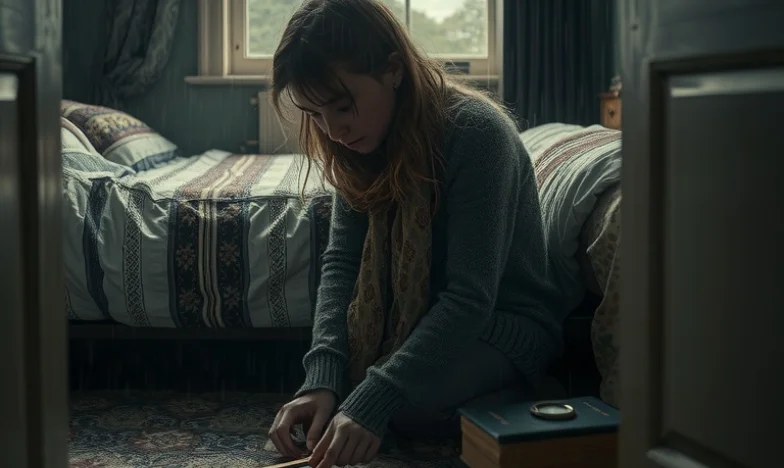
I knelt by the bed, running my fingers along the floorboards. Something caught—a loose board. My heart leapt. I prised it up, hands shaking. Beneath, wrapped in a faded scarf, was the painting.
It was small, no bigger than a schoolbook. The image was strange: a girl standing in a field of sunflowers, her face turned away, the sky swirling with storm clouds. There was something haunting about it, something that made my skin prickle.
I heard footsteps on the landing. Panicking, I shoved the painting under my jumper and hurried downstairs. Gran was in the kitchen, pouring tea. She looked up, her eyes narrowing. “You found it, didn’t you?”
I nodded, unable to speak.
She beckoned me over, her voice urgent. “Listen to me, Ewa. That painting belonged to your great-grandmother. She painted it during the war, before she came to England. It’s not just a picture—it’s a memory. Your mother wanted you to have it, to remember where you come from.”
Tears stung my eyes. “Why didn’t she tell Dad?”
Gran sighed. “Because he wouldn’t understand. He thinks everything’s about money or pride. But some things… some things are just for us.”
The front door slammed. My father’s boots thudded across the hall. “Ewa! Where are you?”
Gran pressed the painting into my hands. “Go. Hide it. Don’t let him take it.”
I ran, heart racing, out the back door and into the rain-soaked garden. The grass slapped against my legs, cold and wet. I ducked behind the old shed, clutching the painting to my chest.
My father’s voice rang out, furious. “Ewa! Come back here!”
I crouched, trembling, as he stormed through the garden, searching. I could see his boots through the cracks in the shed wall, mud splattered up the sides. He kicked at the door, making me jump. “If you’re in there, come out now!”
I held my breath, praying he wouldn’t find me. After what felt like hours, he gave up, stomping back to the house.
I stayed hidden until the rain stopped, the sky clearing to a pale evening blue. When I finally crept back inside, Gran was waiting, her arms open. She held me tight, whispering, “You did the right thing, love.”
That night, I lay in bed, the painting hidden beneath my pillow. I traced the girl’s outline with my finger, wondering who she was, what she’d seen. I thought about Mum, about the secrets she carried, about the family I barely knew.
In the weeks that followed, my father grew colder, more distant. He stopped asking about the painting, stopped talking to me altogether. Gran tried to fill the silence with stories—about Poland, about the war, about the women in our family who’d survived so much.
I started painting, too. At first, just copying the sunflowers, the swirling sky. But soon, I painted my own memories: Mum’s smile, Gran’s hands, the rain on the car window. Each brushstroke felt like a piece of myself, a way to hold on to the things I was afraid to lose.
Years later, after Gran died and my father moved away, I found the painting again, tucked in the back of a drawer. I hung it in my flat in London, above my desk. Sometimes, when the city felt too loud, too lonely, I’d sit and stare at it, remembering that summer, the secrets, the fear—and the love that somehow survived it all.
I still wonder, sometimes, what would have happened if I’d given the painting to my father. Would he have understood? Or would it have just been another thing to fight over, another piece of our family lost to anger and pride?
Do we ever really know the people we love—or the stories that make us who we are?