A Grandmother’s Shadow: Can My Family Survive Her Unfair Tradition?

“Why does Grandma always give Jamie the biggest slice of cake?” my daughter, Sophie, whispered, her eyes wide and brimming with confusion. The question hung in the air, heavy as the silence that followed. We were seated around the Harrisons’ oak dining table, the Sunday roast barely touched, the air thick with the scent of gravy and unspoken grievances. My husband, Tom, shot me a warning glance, the kind that said, “Not now, not here.” But Sophie’s words echoed in my mind, louder than the clatter of cutlery or the forced laughter from the other end of the table.
It had been like this for years, ever since Jamie, Tom’s sister’s son, was born. My mother-in-law, Margaret, doted on him as if he were the only grandchild in the world. Every birthday, every Christmas, every ordinary Sunday lunch, Jamie was the star. He got the first present, the biggest slice, the warmest hug. Sophie, my sweet, clever girl, was always second. Or third. Or forgotten altogether.
I remember the first time I noticed. Sophie was five, clutching a crayon drawing she’d made for Margaret. She’d spent all morning on it, her tongue poking out in concentration, determined to get the colours just right. When she handed it over, Margaret barely glanced at it before turning to Jamie, who was showing off a plastic dinosaur. “Aren’t you clever, Jamie! Look at that, everyone!” she’d exclaimed, holding his toy aloft. Sophie’s drawing slipped to the floor, unnoticed.
At first, I told myself it was nothing. That I was imagining things. That Margaret was just old-fashioned, or distracted, or tired. But as the years went by, the pattern became impossible to ignore. Jamie was always the favourite. And Sophie, my darling girl, started to shrink into herself, her confidence eroding with every slight.
I tried to talk to Tom about it. “She’s your mum,” I said one night, after Sophie had gone to bed in tears because Jamie had been given a new bike while she got a pair of socks. “You have to see what she’s doing.”
Tom sighed, rubbing his temples. “She doesn’t mean anything by it, love. Jamie’s had a tough time at school, you know that. Mum just wants to make him feel special.”
“And what about Sophie? Doesn’t she deserve to feel special too?”
He looked away, the silence between us growing colder. “It’s just how Mum is. She’ll never change.”
But I couldn’t accept that. Not when I saw the way Sophie’s eyes dimmed every time we visited. Not when she started making excuses to stay home, claiming she had homework or a headache. Not when she asked me, in a voice so small it broke my heart, “Mummy, do you think Grandma loves me?”
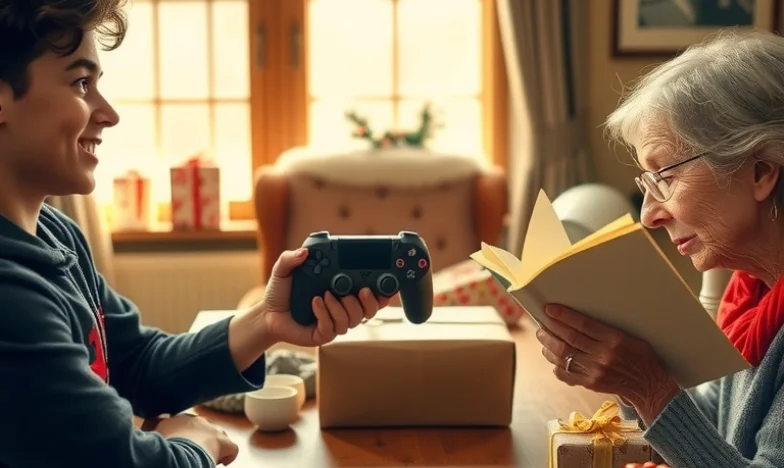
The final straw came last Christmas. Margaret had insisted on hosting, as always. The house was decked out in tinsel and fairy lights, the smell of mulled wine and mince pies filling the air. Presents were piled high under the tree. When it was time to open them, Margaret handed Jamie a huge box wrapped in shiny paper. “For my special boy,” she said, beaming. Jamie tore it open to reveal the latest games console. Sophie’s present was a book – second-hand, the price sticker still on the back.
Sophie’s face crumpled. She tried to hide it, but I saw the tears welling up. I wanted to scream, to snatch the console from Jamie’s hands and demand to know why my daughter was always left out. Instead, I took Sophie’s hand and led her outside, the cold December air biting at our cheeks.
“I’m sorry, darling,” I whispered, pulling her into a hug. “It’s not fair.”
She nodded, silent tears streaming down her face. “I just want Grandma to like me.”
That night, after everyone had gone to bed, I confronted Margaret in the kitchen. She was washing up, humming a Christmas carol. I took a deep breath, my hands shaking.
“Margaret, can we talk?”
She looked up, surprised. “Of course, dear. What’s on your mind?”
“It’s about Sophie. She feels… left out. Hurt. I know you love Jamie, but Sophie’s your granddaughter too. She needs to feel loved, just as much as he does.”
Margaret’s expression hardened. “I treat them both the same.”
“With respect, you don’t. Jamie always gets more – more attention, more gifts, more affection. Sophie notices. She’s not stupid.”
Margaret bristled, her lips pressed into a thin line. “Jamie’s had a difficult time. His father left, and he needs extra support. Sophie has you and Tom. She’s fine.”
“She’s not fine,” I said, my voice trembling. “She’s hurting. And I can’t keep watching her suffer.”
Margaret turned away, scrubbing at a plate as if she could erase the conversation. “You’re overreacting. Children are resilient.”
I left the kitchen, feeling more alone than ever. Tom was no help – he refused to take sides, insisting that I was making a fuss over nothing. My sister-in-law, Claire, was too grateful for Margaret’s support to see the damage being done. And so, I was left to pick up the pieces, to comfort Sophie, to try and shield her from the worst of it.
The months passed, each family gathering a fresh ordeal. Sophie grew quieter, her laughter rarer. She stopped bringing drawings to Margaret’s house, stopped trying to win her approval. I watched her retreat into herself, and I hated myself for not being able to protect her.
One afternoon, after another tense Sunday lunch, I found Sophie in her room, curled up on her bed. She looked up as I entered, her eyes red.
“Why doesn’t Grandma like me?” she asked, her voice barely above a whisper.
I sat beside her, stroking her hair. “It’s not about you, sweetheart. Sometimes grown-ups get things wrong. Sometimes they don’t see how their actions hurt others.”
“But why does she always pick Jamie?”
I had no answer. All I could do was hold her and promise that I loved her, that she was special to me, even if her grandmother couldn’t see it.
I started to avoid family gatherings, making excuses, putting Sophie’s wellbeing first. Tom was furious. “You’re tearing the family apart,” he accused. “Mum’s just old-fashioned. She doesn’t mean any harm.”
“I’m protecting our daughter,” I shot back. “If you can’t see what this is doing to her, then maybe you’re part of the problem.”
The arguments grew more frequent, the distance between us widening. I felt trapped – torn between loyalty to my husband and my duty to my child. I knew I couldn’t go on like this, but I didn’t know how to fix it.
One day, Sophie came home from school with a note from her teacher. She’d been withdrawn, struggling to concentrate, her grades slipping. The teacher suggested she might benefit from counselling. That was the moment I realised how deep the wounds ran.
I made an appointment with a family therapist, desperate for help. Tom was reluctant, but he came. In the safety of the therapist’s office, I poured out everything – the favouritism, the hurt, the way Sophie was fading before my eyes. Tom listened, really listened, for the first time.
“I didn’t realise,” he said quietly. “I thought… I thought she was fine.”
“She’s not,” I replied, tears streaming down my face. “And if we don’t do something, we’ll lose her.”
The therapist helped us find ways to support Sophie, to rebuild her confidence. We set boundaries with Margaret, limiting visits, insisting on fairness. It wasn’t easy – Margaret was furious, accusing me of turning Tom against her, of breaking up the family. But for the first time, I stood my ground.
Slowly, things began to change. Sophie started to smile again, to laugh, to believe in herself. Tom became more involved, more protective. Our marriage, battered but not broken, began to heal.
Margaret never truly understood. She clung to her old ways, her old grievances. But I no longer cared. My loyalty was to my daughter, to my family. I refused to let the past dictate our future.
Sometimes, late at night, I wonder if I did the right thing. If I could have handled it differently. If families like ours can ever truly break free from the shadows of old traditions. But then I see Sophie’s smile, hear her laughter, and I know I made the only choice I could.
Do we owe loyalty to tradition, even when it hurts those we love? Or is it braver to break the cycle, to fight for a better future? I wonder what you would have done, in my place.