The Wealthy Widower Who Swore Never to Love Again, Until a Waitress Cared for His Child as Her Own

‘Lottie, darling, please—just one more spoonful for Daddy?’ My voice trembled, betraying the exhaustion I tried so hard to hide. The soup cooled in the bowl, untouched, as my four-year-old daughter stared at me with those wide, blue eyes—so like her mother’s. I could feel the other diners’ eyes on us, their pity as thick as the gravy on their Sunday roasts. I hated it. I hated being the centre of attention, the object of whispered sympathy in this sleepy Cotswolds village. But most of all, I hated that I couldn’t even get my own child to eat.
That’s when she appeared—Megan, the waitress. She was new at The Swallow, the only hotel in town worth a visit, and I’d noticed her before: always smiling, always quick with a kind word, even when the regulars grumbled about their tea being too weak or their chips too soggy. Today, she knelt beside our table, her brown hair escaping its bun, her eyes soft as she addressed Lottie, not me. ‘Hello, sweetheart. That soup looks delicious. May I have a taste?’
Lottie blinked, surprised. Megan took a tiny spoonful, made an exaggerated ‘Mmm!’ and grinned. ‘You’re so lucky! I wish I had soup like this when I was little.’
To my astonishment, Lottie giggled—a sound I hadn’t heard in weeks—and opened her mouth. Megan fed her a spoonful, then another, chatting all the while about her own childhood, her silly cat, the ducks on the village pond. I sat there, useless, watching as my daughter ate for the first time since Helen’s funeral.
Afterwards, Megan stood and smiled at me. ‘She just needs a bit of company, that’s all. Don’t we all?’
I wanted to thank her, but the words stuck in my throat. Instead, I nodded, feeling something shift inside me—a crack in the wall I’d built around my heart.
The weeks blurred together after that. I returned to The Swallow every Sunday, Lottie in tow, and every time Megan was there, she made a point of sitting with us, telling stories, coaxing Lottie to eat. The other staff noticed, of course. I heard the whispers: ‘That’s Willem van Dijk, the Dutchman with the big house on the hill. Lost his wife, poor soul. The waitress seems to have taken a shine to him.’
I tried to ignore it. I’d sworn, after Helen died, that I’d never let anyone in again. Love was too dangerous, too painful. My world had shrunk to Lottie and work—endless meetings in London, the long commute back to the empty house, the silence that pressed in on me like a physical weight. But Megan’s kindness was impossible to ignore. She never pried, never asked about Helen, never made me feel like a charity case. She just… cared.
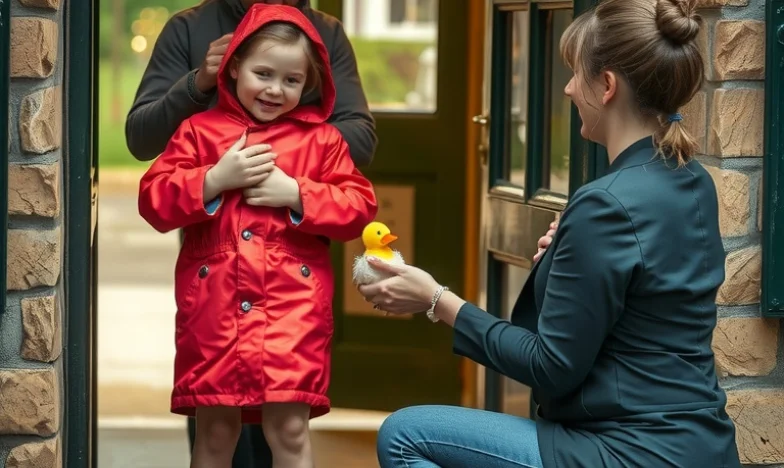
One rainy afternoon, as I struggled to wrestle Lottie into her raincoat, Megan appeared at the door, umbrella in hand. ‘Let me help,’ she said, her tone gentle but firm. She knelt, zipped up Lottie’s coat, and handed her a tiny yellow duck. ‘For luck,’ she whispered.
‘You don’t have to do this,’ I said, my voice harsher than I intended.
She looked up at me, unflinching. ‘Maybe I want to.’
I didn’t know what to say to that. I watched as she led Lottie outside, splashing in puddles, laughing. For a moment, I envied my own child—her ability to accept love without question, to find joy in the smallest things.
That night, after Lottie was asleep, I sat in the kitchen, staring at the empty chair across from me. Helen’s chair. I remembered her laughter, the way she used to tease me about my terrible English, the way she’d sing to Lottie in Dutch. The ache in my chest was almost unbearable.
I poured myself a whisky, the good stuff I’d been saving for a special occasion. What was I doing? Was I betraying Helen by letting someone else into our lives? Or was I betraying Lottie by shutting the world out?
The next Sunday, Megan wasn’t at The Swallow. Lottie was inconsolable, refusing to eat, her small fists pounding the table. I felt helpless, angry. I cornered the manager, a gruff man named Mr. Hargreaves. ‘Where’s Megan?’
He shrugged. ‘Family trouble, I think. Her mum’s not well. She’ll be back next week.’
I left a generous tip and drove home in silence, Lottie sniffling in the back seat. That night, I found myself pacing the kitchen, phone in hand, Megan’s number on the screen. I hesitated, then put the phone down. Who was I to intrude on her life?
But when she returned the following week, I couldn’t hide my relief. She looked tired, her smile a little forced, but she still knelt beside Lottie, still made her laugh. After our meal, I caught her in the corridor. ‘If you ever need anything…’
She shook her head. ‘I’m fine. Really. But thank you.’
We stood there, awkward, the air thick with things unsaid. Finally, she spoke. ‘You’re not the only one who’s lost someone, Willem.’
I stared at her, startled. She looked away. ‘My dad died last year. Cancer. I know what it’s like, feeling like you’re drowning. But you’re not alone. Not really.’
I wanted to reach out, to touch her hand, but I didn’t. Instead, I nodded, swallowing the lump in my throat.
After that, something changed between us. We talked more—about Lottie, about the village, about the small, everyday things that make up a life. Megan told me about her mother, who was struggling with dementia, about the endless doctor’s appointments, the fear of losing her one piece at a time. I listened, grateful for the distraction from my own pain.
One evening, as I walked Lottie home from nursery, I saw Megan sitting on the bench by the pond, her head in her hands. I hesitated, then sat beside her. ‘Bad day?’
She nodded, wiping her eyes. ‘Mum wandered off again. The police found her at the bus station, trying to get to London. She thought Dad was waiting for her.’
I didn’t know what to say, so I just sat with her, the silence comfortable. After a while, she looked at me, her eyes red. ‘How do you do it? How do you keep going?’
I shrugged. ‘For Lottie. She needs me. And maybe… maybe I need her, too.’
Megan smiled, a real smile this time. ‘You’re a good dad, Willem. Don’t let anyone tell you otherwise.’
The weeks turned into months. Megan became a fixture in our lives—Sunday lunches at The Swallow, walks by the river, trips to the playground. The villagers noticed, of course. Some were supportive, others less so. Mrs. Cartwright, the vicar’s wife, cornered me after church one morning. ‘It’s lovely, what you’re doing for that girl, but you must think of Lottie. She’s been through so much already.’
I bit back a retort. Did she think I didn’t know that? Did she think I hadn’t lain awake every night, worrying about my daughter’s future?
One evening, as I tucked Lottie into bed, she looked up at me, her voice small. ‘Daddy, is Megan going to be my new mummy?’
The question hit me like a punch. I didn’t know how to answer. I kissed her forehead and whispered, ‘Megan is our friend. She cares about us very much.’
But the question lingered, echoing in my mind. Was I ready to let someone else into our family? Was it fair to Megan? To Lottie? To Helen’s memory?
A few weeks later, Megan invited us to her mother’s birthday tea. It was a modest affair—just a Victoria sponge, a pot of tea, and a handful of neighbours. Lottie sat on Megan’s lap, feeding her cake, giggling as Megan’s mother told stories about her own childhood in Yorkshire. For the first time in a long while, I felt… at home.
Afterwards, as we walked back to the car, Megan slipped her hand into mine. ‘Thank you for coming. It meant a lot to Mum. And to me.’
I squeezed her hand, my heart pounding. ‘Thank you for everything you’ve done for us. For Lottie.’
She stopped, turning to face me. ‘Willem, I care about you. About both of you. But I can’t be Helen. I won’t try to be. I just want to be here, if you’ll let me.’
I looked at her, really looked at her—the kindness in her eyes, the strength in her voice. For the first time since Helen died, I allowed myself to hope.
We stood there, in the fading light, the village quiet around us. I thought of all the things I’d lost, and all the things I might still find. Was it possible to love again, without betraying the past? Could I open my heart, not just for my sake, but for Lottie’s?
Now, as I watch Megan and Lottie together—laughing, playing, living—I realise that love isn’t about replacing what’s gone. It’s about building something new, together. Maybe that’s what Helen would have wanted for us.
Do we ever truly move on, or do we simply learn to carry our losses with us, making room for new joys? I wonder—what would you do, if you were in my place?