Mum, Why Did You Come Into Our Flat? – A Story of Trust, Family, and Betrayal

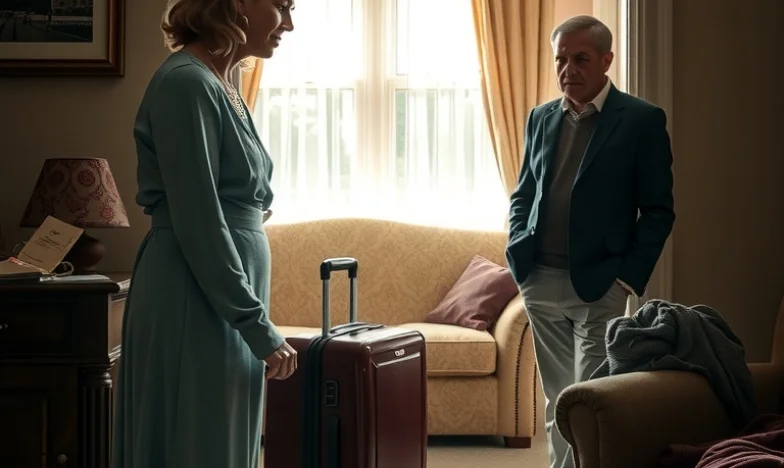
‘Mum, why did you come into our flat?’ The words tumbled out of my mouth before I could even think, my voice trembling as I stood in the hallway, suitcase still in hand, staring at her. She was sitting on the edge of our sofa, her hands clasped tightly in her lap, eyes darting between me and the half-empty mug of tea on the coffee table. The air was thick with the scent of her perfume—Chanel No. 5, always too strong for my liking—and something else, something sour, like disappointment.
I’d only been gone a week. Just a week in Cornwall with Tom, hoping the sea air and the quiet would help us patch things up. We’d argued so much lately—about money, about his job, about my mother, always about my mother. But as soon as I saw her sitting there, I knew that whatever peace I’d found on the cliffs of St Ives had evaporated the moment I crossed the threshold.
‘Darling, I was just… I needed to check on things,’ she said, her voice brittle, as if she’d rehearsed the line a hundred times. Tom hovered behind me, his jaw clenched, eyes fixed on the floor. He hated confrontation, but I could feel his anger radiating off him in waves.
‘You needed to check on things? What things, Mum? Our things?’ I tried to keep my voice steady, but it cracked on the last word. I glanced around the living room, suddenly noticing the small changes—the stack of post on the sideboard had been opened, the photo of Tom and me at Brighton Pier was slightly askew, and the throw on the armchair was folded the way only my mother ever folded it.
She looked at me, her eyes wide and pleading. ‘I just wanted to make sure everything was alright. You know how worried I get.’
Tom finally spoke, his voice low and cold. ‘We asked you not to come in when we’re away. We gave you a key for emergencies, not for… this.’
Mum’s lips tightened. ‘I am your mother, Emily. I have a right to be concerned. You never answer your phone, and I thought—well, I thought something might have happened.’
I felt the old anger rising, the one I’d tried so hard to bury. ‘So you just let yourself in? Went through our things? Opened our post?’
She stood up, suddenly defensive. ‘I didn’t go through your things. I just… I just wanted to tidy up a bit. You know how you leave things lying around.’
Tom scoffed, and I shot him a warning glance. This was my battle, not his. But I could see the hurt in his eyes, the way he looked at me as if to say, ‘I told you so.’
I turned back to Mum. ‘You can’t keep doing this. I’m not a child anymore. This is my home. Our home.’
She looked at me, her face crumpling. For a moment, I almost felt sorry for her. Almost. ‘I just wanted to help, Emily. After your father left, I promised myself I’d always be there for you. I can’t help it. I worry.’
‘But you don’t trust me,’ I said quietly. ‘You never have.’
The silence that followed was heavy, filled with all the things we’d never said. I could feel Tom’s hand on my shoulder, steadying me, but I shrugged it off. This was between me and her.
‘Mum, you have to leave,’ I said finally. ‘I need some space. We need some space.’
She looked at me, her eyes shining with unshed tears. ‘If that’s what you want.’
I nodded, unable to speak. She gathered her things—her handbag, her scarf, the Tupperware of shepherd’s pie she’d brought ‘just in case’—and walked to the door. She paused, her hand on the handle. ‘I only ever wanted what’s best for you, Emily. You’ll understand when you have children of your own.’
The door closed behind her with a soft click, but it felt like a slam. I sank onto the sofa, burying my face in my hands. Tom sat beside me, silent, his arm around my shoulders.
‘She’ll never change, will she?’ I whispered.
He shook his head. ‘Probably not. But you can.’
We sat there for a long time, the flat suddenly feeling both emptier and heavier than before. I thought about all the times my mother had crossed boundaries—reading my diary as a teenager, turning up unannounced at university, calling my boss when I didn’t answer my phone. I’d always forgiven her, always told myself she meant well. But now, as I looked around at the small intrusions—the opened post, the rearranged cushions—I realised how much I’d let her get away with.
That night, I lay awake, staring at the ceiling. Tom was asleep beside me, his breathing slow and even. I replayed the scene over and over in my mind, wondering if I’d been too harsh, or not harsh enough. Was it really so wrong for a mother to worry? But then I remembered the feeling of violation, the sense that my life was never truly my own.
The next morning, I found a note slipped under the door. My mother’s handwriting, neat and precise:
‘Emily,
I’m sorry if I upset you. I only wanted to help. Please call me when you’re ready.
Love, Mum.’
I stared at the note, my heart aching. I wanted to forgive her, to go back to the way things were. But I knew I couldn’t. Not this time.
Days passed. I ignored her calls, her texts, the emails with subject lines like ‘Just checking in’ and ‘Are you alright?’ Tom tried to distract me—dinners out, long walks on Hampstead Heath, tickets to the theatre—but I couldn’t shake the feeling of loss. Not just the loss of trust, but the loss of the mother I thought I had.
One evening, as we sat in the kitchen eating takeaway curry, Tom put down his fork and looked at me. ‘You need to talk to her, Em. This isn’t going away.’
I nodded, knowing he was right. The next day, I called her. She answered on the first ring.
‘Emily! Oh, thank God. I’ve been so worried.’
‘Mum, we need to talk. Properly. No more excuses, no more pretending.’
She was quiet for a moment. ‘Alright. Come round for tea?’
I hesitated, then agreed. The familiar walk to her flat in Highgate felt different this time. I noticed the cracks in the pavement, the faded paint on the front door, the way the curtains twitched as I approached. She opened the door before I could knock, pulling me into a tight hug.
We sat in her kitchen, the same kitchen where she’d made me beans on toast as a child, where she’d bandaged my scraped knees and listened to my teenage heartbreaks. Now, the air was thick with tension.
‘I know I overstepped,’ she said, her voice small. ‘I just… I get so lonely, Emily. Since your father left, you’re all I have.’
I looked at her, really looked at her, and saw the lines on her face, the way her hands trembled as she poured the tea. For the first time, I realised how scared she must be—scared of being alone, of losing me.
‘Mum, I love you. But you have to let me live my own life. You can’t keep crossing boundaries. It’s not fair to me, or to Tom.’
She nodded, tears slipping down her cheeks. ‘I’ll try. I promise.’
We sat in silence, sipping our tea. It wasn’t a perfect ending, but it was a start. I knew it would take time to rebuild the trust, to find a new way of being mother and daughter. But for the first time, I felt hopeful.
As I walked home that evening, the sky streaked with pink and gold, I wondered: can we ever truly forgive the ones who hurt us most? And if family isn’t safety, what is it, really?