Seventeen Years Later: The Knock at My Door

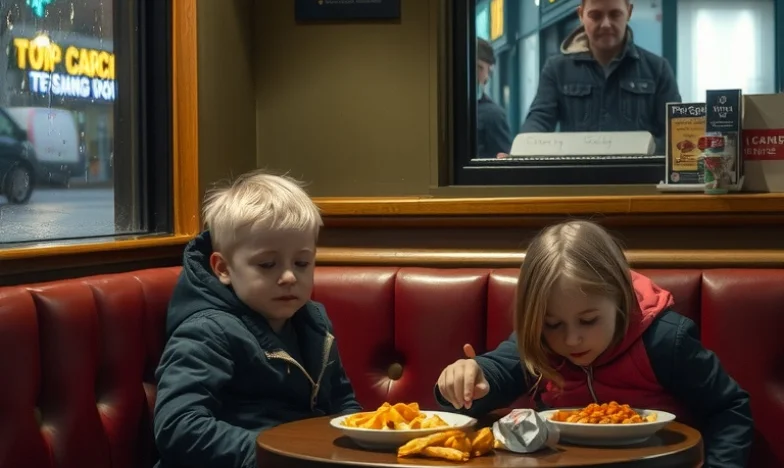
The rain hammered against the cracked windowpane as I scrubbed the last mug behind the counter, my fingers numb from the cold water. It was nearly midnight, and the greasy spoon café on Oldham Road was empty except for the two children huddled in the corner booth, their faces pale and eyes wide with hunger. I glanced at the clock, then at my boss, Mrs. Jenkins, who was counting the till with her usual scowl.
“Oi, Sarah, don’t you dare give them anything for free,” she hissed, not bothering to lower her voice. “We’re not a bleeding charity.”
I bit my tongue, but my heart twisted. The boy, maybe ten, clutched his sister’s hand. She couldn’t have been more than seven, her hair matted and shoes falling apart. I remembered what it was like to be hungry, to feel invisible. My own mum had worked three jobs to keep us fed after Dad left, and sometimes even that wasn’t enough.
When Mrs. Jenkins disappeared into the back, I slid a plate of chips and beans across to the children. “Eat quick,” I whispered, “and don’t tell anyone.”
The boy’s eyes filled with tears. “Thank you, miss,” he said, voice trembling. “We haven’t eaten since yesterday.”
I watched them wolf down the food, my chest aching. I wanted to do more, but I was barely scraping by myself. When they finished, I pressed a fiver into the boy’s hand. “Get yourselves somewhere warm tonight, yeah?”
They nodded, and before I could ask their names, they slipped out into the rain, swallowed by the night. I never saw them again.
Seventeen years passed. Life didn’t get easier. I lost the café job when it closed down, bounced from cleaning offices to stacking shelves at Tesco, always just one step ahead of the landlord’s threats. My mum died of cancer, and my brother drifted away, blaming me for not doing more. I never married, never had kids. The council house on the edge of Moston was all I had left, its paint peeling and garden choked with weeds. Some nights, I’d sit by the window, watching the rain, wondering if those children ever made it out alive.
It was a Tuesday when everything changed. I was scrubbing the kitchen floor, radio blaring, when I heard the engine outside. Not the usual battered Ford or screeching motorbike, but a low, purring growl. I peered through the lace curtain and nearly dropped the mop. A black Mercedes-Benz, gleaming even in the drizzle, had pulled up outside my gate. The driver’s door opened, and a tall man in a tailored suit stepped out, his hair slicked back, face sharp and handsome. He looked out of place on our street, where most folks wore tracksuits and kept their heads down.
I froze as he strode up the path, his shoes crunching on the gravel. My heart thudded. Was he lost? Or worse, was he from the council, here to evict me? I wiped my hands on my apron and opened the door a crack.
“Can I help you?” I managed, voice shaking.
He smiled, and something about his eyes tugged at my memory. “Sarah Evans?”
“Yes?”
He hesitated, then reached into his pocket and pulled out a battered five-pound note, folded and creased. “You gave this to me seventeen years ago. At the café on Oldham Road. You saved my sister and me.”
My breath caught. I stared at him, searching his face. The boy from the café. Older now, but the same haunted eyes.
“Oh my God,” I whispered. “Is it really you?”
He nodded. “My name’s Daniel. My sister, Emily, she’s waiting in the car. We’ve been looking for you for years.”
I stepped back, letting him in. My knees trembled as I led him to the living room, cluttered with old magazines and threadbare cushions. Emily joined us, her hair now glossy and her coat expensive, but her smile shy and grateful.
“We wanted to thank you,” Daniel said, his voice thick. “That night, you were the only one who cared. You gave us hope. We ended up in care, but your kindness stuck with us. I worked hard, got a scholarship, started my own business. Emily’s a nurse now.”
Tears pricked my eyes. “I just did what anyone would do.”
He shook his head. “No, most people turned away. You didn’t.”
We talked for hours, sharing stories of hardship and survival. They told me about the foster homes, the loneliness, the moments when they almost gave up. I told them about my mum, my struggles, the emptiness that had settled in my chest. For the first time in years, I felt seen.
As dusk fell, Daniel stood and handed me an envelope. “We want to help you, Sarah. You gave us a second chance. Let us do the same for you.”
Inside was a cheque for more money than I’d ever seen. Enough to fix the house, pay off debts, maybe even start fresh. I stared at it, hands shaking.
“I can’t accept this,” I whispered. “You don’t owe me anything.”
Emily squeezed my hand. “You gave us everything when we had nothing. Please, let us do this.”
I broke down, sobbing into my hands. All the years of struggle, the loneliness, the feeling that nothing I did mattered—it all poured out. Daniel and Emily hugged me, and for the first time in decades, I felt like I belonged.
After they left, I sat by the window, watching the rain. The Mercedes disappeared into the night, but the warmth in my chest remained. I thought of all the choices I’d made, the small kindnesses that seemed to vanish into the void. Maybe, just maybe, they mattered after all.
I wonder, if you had the chance to change someone’s life with a single act, would you do it? Or would you walk away, thinking it made no difference? Sometimes, the smallest kindness can echo through the years, returning when you least expect it.