Alone with My Newborn: A British Mother’s Battle for Support and Self-Worth

The taxi door slammed behind me, jolting my son awake in his car seat. Rain lashed the pavement outside our block of flats in Croydon, and I stood there, clutching the carrier, my stitches aching, my heart pounding. The driver, a kindly older man, offered to help with my bags, but I shook my head, blinking back tears. I wanted to do this myself. I needed to prove I could.
Inside, the hallway was cold and silent. I fumbled for my keys, the baby’s whimpers growing louder. My hands shook as I unlocked the door, expecting—hoping—for some sign of welcome. A balloon, a card, even just the faint smell of dinner. Instead, the flat was eerily quiet, the only sound the hum of the fridge and the distant rumble of traffic. There was no cot in the corner, no changing table, not even a pile of tiny clothes. Just the same cluttered living room, the same pile of unopened post, and the same sense of emptiness that had haunted me for months.
I set the car seat down and called out, “Michał? Are you home?”
No answer. I checked my phone. A text from him, sent an hour ago: “Stuck at work. Big meeting. Will be late. Sorry.”
I stared at the message, my throat tightening. I’d told him I was coming home today. I’d begged him to help get things ready, to at least assemble the cot we’d ordered weeks ago. But work always came first for Michał. He was a software engineer, and his job at the tech start-up seemed to swallow him whole. I’d tried to understand, to be patient, but now, standing in the middle of our flat with a newborn and nowhere to put him, I felt something inside me snap.
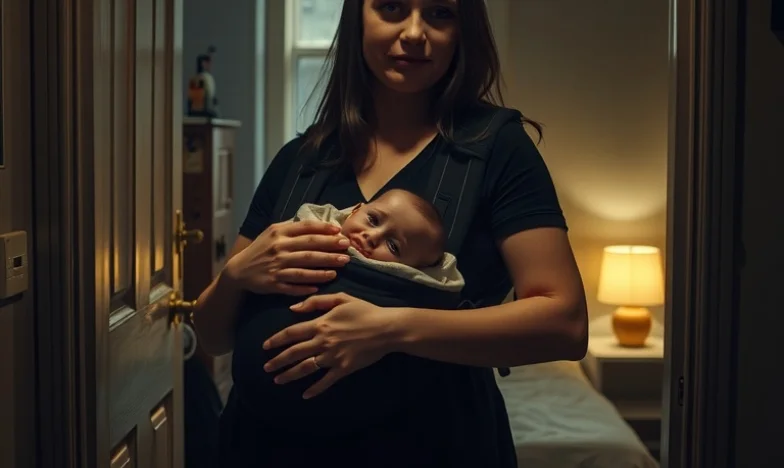
I carried my son—Daniel, just three days old—into the bedroom. The bed was unmade, the sheets crumpled and stained. I laid him gently on the duvet, surrounding him with pillows so he wouldn’t roll. He looked up at me with wide, trusting eyes, and I felt a wave of guilt crash over me. He deserved better than this. We both did.
I sat on the edge of the bed and sobbed, silent and shaking, so I wouldn’t wake him. My mum had offered to come down from Manchester, but I’d told her not to. I’d wanted to prove to myself—and to Michał—that I could handle this. But now, with every ache in my body and every cry from my son, I realised how wrong I’d been.
The hours crawled by. I changed Daniel on a towel on the floor, using the last of the nappies from my hospital bag. I fed him, cradling him in my arms, singing lullabies I barely remembered from my own childhood. I watched the sky darken outside, the rain never letting up. I texted Michał again: “We need nappies. And formula. Please come home.”
No reply.
By the time he finally walked through the door, it was nearly midnight. He looked exhausted, his hair rumpled, his shirt stained with coffee. He barely glanced at me before dropping his bag and heading straight for his laptop.
“Michał,” I said, my voice trembling. “Can you help me, please? I haven’t slept, I’m out of nappies, and Daniel needs a proper place to sleep.”
He sighed, not looking up from the screen. “I’ve got a deadline, Kasia. Can’t it wait until tomorrow?”
I stared at him, disbelief and anger warring inside me. “No, it can’t. He’s your son too. I can’t do this on my own.”
He finally looked at me, his eyes tired and distant. “You’re overreacting. Loads of women manage. My mum raised me and my sister without any help.”
I wanted to scream. Instead, I whispered, “I’m not your mum. And I’m not coping.”
He shrugged, turning back to his laptop. “You’ll be fine. Just… try to get some sleep.”
That night, I lay awake, listening to Daniel’s soft breathing and Michał’s furious typing. I felt invisible, like a ghost haunting my own life. I thought about calling my mum, about begging her to come. But pride kept me silent. I didn’t want her to know how badly I was failing.
The days blurred together. Michał was always at work, or working from home, headphones clamped over his ears. He barely spoke to me, except to ask what was for dinner or if I’d seen his charger. I tried to keep the flat tidy, to keep Daniel quiet, to pretend everything was fine. But inside, I was falling apart.
One afternoon, as I struggled to fit Daniel into a too-small sleepsuit, the doorbell rang. It was my neighbour, Mrs. Jenkins, a retired nurse with a sharp tongue and a kind heart. She took one look at me—unwashed hair, tear-stained cheeks, Daniel screaming in my arms—and marched straight in.
“Good heavens, love, you look done in. Where’s your husband?”
“At work,” I mumbled, embarrassed.
She tutted, scooping Daniel up with practised hands. “Men. Useless, the lot of them. Sit down, I’ll make you a cuppa.”
I burst into tears. She didn’t flinch, just handed me a tissue and set about boiling the kettle. Over tea and biscuits, I told her everything—the empty flat, the sleepless nights, the loneliness that felt like it was crushing me.
“You need help, love,” she said firmly. “You can’t do this alone. Have you spoken to your health visitor?”
I shook my head. I hadn’t wanted to admit how bad things were. But Mrs. Jenkins insisted, and the next day, she sat with me while I called the GP. The health visitor came that afternoon, gentle and reassuring, and for the first time, I felt like someone saw me.
But Michał was furious when he found out. “Why did you have to involve strangers?” he snapped. “You’re making us look bad.”
“I needed help,” I said quietly. “I can’t do this on my own.”
He glared at me, his jaw clenched. “You’re just being dramatic. You always make everything about you.”
I stared at him, the man I’d once loved so fiercely, and wondered when he’d become a stranger. I thought about leaving, about packing a bag and taking Daniel to my mum’s. But I was scared—scared of failing, scared of being judged, scared of what would happen to us.
The weeks passed. I went through the motions—feeding, changing, rocking Daniel to sleep. I joined a local mums’ group, desperate for connection, but I felt like an outsider. The other mums seemed so confident, so put-together. I envied them, their easy laughter, their supportive partners. I wondered what was wrong with me, why I couldn’t just be happy.
One night, after another argument with Michał—this time about money, about how I wasn’t contributing—I snapped. “I gave up my job for this family,” I shouted. “I’m doing my best, but I need you. I need you to care.”
He looked at me, his eyes cold. “Maybe you should have thought about that before you got pregnant.”
I felt something inside me break. I packed a bag, bundled Daniel into his pram, and walked out into the night. The rain had stopped, but the air was cold and sharp. I walked for hours, pushing Daniel through the empty streets, tears streaming down my face. I ended up at Mrs. Jenkins’ door, shaking and exhausted.
She took us in without question, tucking me into her spare bed, rocking Daniel to sleep. In the morning, she made me breakfast and called my mum. Within hours, my mum was on a train from Manchester, her voice trembling with worry and love.
When she arrived, she hugged me tight, whispering, “You’re not alone, Kasia. You never were.”
With her help, and Mrs. Jenkins’ support, I started to rebuild. I found a counsellor, started talking about the pain and anger I’d bottled up for so long. I filed for separation from Michał, terrified but determined. I found a part-time job at the local library, something just for me. Slowly, I started to feel like myself again.
Daniel thrived, his laughter filling the flat we now shared with my mum. I still had bad days—days when the loneliness crept in, when I missed the life I’d imagined. But I knew I wasn’t alone anymore. I’d found my voice, and I’d fought for my son and myself.
Sometimes, late at night, I lie awake and wonder: Why is it so hard to ask for help? Why do we expect mothers to be superheroes, to carry the weight of the world alone? Maybe if we talked about it more, if we were honest about the struggle, things might change. Or maybe, for now, it’s enough to know that I survived—and that I’m not alone after all.