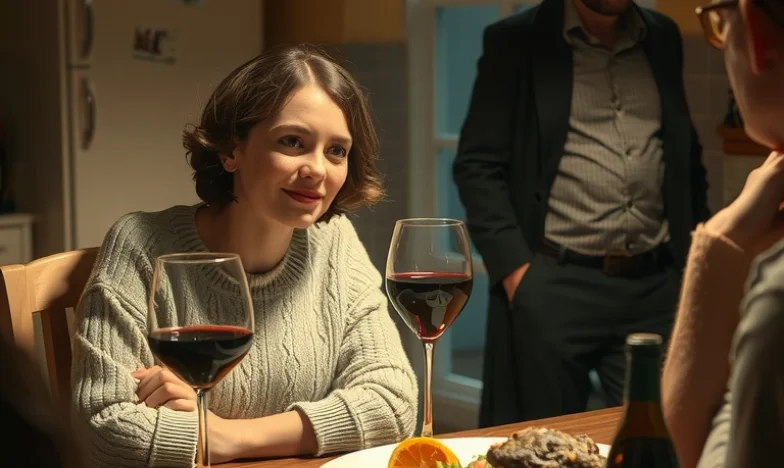
The Silence Between Us: A British Wife’s Secret

“You’re late again, Tom.” My voice was steady, but my hands trembled as I set his dinner on the table. The clock on the wall ticked past midnight, and the roast lamb had long gone cold. He didn’t meet my eyes, just shrugged off his coat and muttered something about a client meeting running over. I watched him, searching for the man I’d married, but all I saw was a stranger with guilt in his eyes and perfume on his collar.
That was the first time I knew. The first time I saw the lipstick on his shirt, a shade I’d never wear, and the way he flinched when I touched him. I wanted to scream, to throw the plate at the wall, to demand the truth. But instead, I smiled, poured him a glass of wine, and asked about his day. That’s what a good wife does, isn’t it? Keeps the peace. Keeps the family together.
We lived in a semi-detached in Guildford, the kind with a neat garden and a white picket fence. To the neighbours, we were the perfect couple: Tom, the successful estate agent, and me, Sarah, the ever-supportive wife, always at the school gates with a smile for the other mums. Our children, Emily and Ben, were bright, polite, and never wanted for anything. But inside, I was hollow. Every time Tom’s phone buzzed late at night, every time he came home smelling of someone else’s perfume, I felt another piece of me crumble away.
I tried to convince myself it was just a phase. That he’d come back to me, that our love would be enough. But the years dragged on, and the affairs continued. Sometimes I’d catch a glimpse of a text message, a name I didn’t recognise. Once, I found an earring under the passenger seat of his car. I held it in my palm, cold and sharp, and wondered if she was prettier than me, younger, more exciting. I never confronted him. Instead, I buried the earring in the back of my jewellery box, a silent monument to my pain.
My mother always said, “Don’t air your dirty laundry in public.” So I kept my silence. I smiled at dinner parties, laughed at Tom’s jokes, and made small talk with his colleagues’ wives. I became an expert at pretending. But at night, when the house was quiet and Tom was out “working late,” I’d lie awake, staring at the ceiling, wondering how much more I could take.
One evening, as I tucked Emily into bed, she looked up at me with those big blue eyes and asked, “Mummy, why are you sad?” I froze. Had I let my mask slip? I kissed her forehead and told her I was just tired, but her question haunted me. I realised then that my silence wasn’t just protecting Tom—it was suffocating me, and maybe even hurting our children.
But what could I do? Divorce wasn’t an option, not for me. My parents had stayed together through thick and thin, and I was determined to do the same. Besides, what would people say? The whispers, the pitying looks, the judgement. I couldn’t bear it. So I stayed. I cooked his meals, washed his clothes, and smiled for the neighbours. I became invisible, a ghost in my own home.
The years blurred together. Emily went off to university, Ben started sixth form, and Tom’s hair turned grey at the temples. His affairs became less frequent, or maybe he just got better at hiding them. Sometimes I’d catch him looking at me across the breakfast table, as if he wanted to say something, but the words never came. We were two actors, playing our parts in a play that had long since lost its meaning.
Then, one autumn morning, Tom collapsed in the kitchen. The ambulance came, sirens wailing, and I watched as they loaded him into the back, his face pale and drawn. The doctors said it was cancer, advanced and aggressive. Suddenly, our world shrank to hospital rooms and test results, whispered conversations in sterile corridors. I became his carer, holding his hand through the pain, spoon-feeding him soup when he was too weak to eat.
He looked so small in that hospital bed, tubes snaking from his arms, eyes sunken and afraid. One night, as the rain lashed against the window, he turned to me and whispered, “Sarah, I’m sorry.”
I wanted to scream, to tell him how much he’d hurt me, how his betrayals had hollowed me out. But instead, I stroked his hair and said, “Shh, it’s all right.” Because that’s what I’d always done—put his needs before my own, swallowed my pain for the sake of the family.
But as the days passed and the end drew near, something inside me shifted. I realised I’d spent twelve years living a lie, sacrificing my happiness for a man who’d never truly loved me. I thought about all the times I’d bitten my tongue, all the nights I’d cried myself to sleep, all the dreams I’d buried for the sake of appearances.
On his final night, as the machines beeped softly and the nurses tiptoed past, I leaned in close and whispered in his ear. My voice was steady, but my heart was pounding. “I know, Tom. I’ve always known. Every late night, every lie, every woman. I saw it all, and I said nothing. But you know what? The real punishment isn’t what you did to me—it’s what you did to yourself. You lost the chance to be truly loved, to be truly known. And now, it’s too late.”
His eyes widened, a flicker of fear passing across his face. He tried to speak, but the words caught in his throat. I kissed his forehead, wiped away a tear, and walked out of the room, leaving him alone with his regrets.
After the funeral, the house felt emptier than ever. The neighbours brought casseroles and sympathy cards, but I couldn’t bring myself to care. Emily and Ben tried to comfort me, but they didn’t know the truth. Maybe one day I’ll tell them. Maybe not.
Sometimes I sit in the garden, watching the roses bloom, and wonder if I did the right thing. Was my silence an act of strength, or just cowardice? Did I protect my family, or did I just let myself disappear? I’ll never know for sure. But I do know this: I survived. I endured. And now, for the first time in years, I’m free to be myself.
Tell me, if you were in my place, would you have spoken up? Or is silence sometimes the loudest scream of all?