A Gift of Time: The Day I Found My Mother Again

‘You can’t just throw money at everything, Karl,’ my sister’s voice echoed in my head as I stepped out of the Bentley, the drizzle pattering on my Savile Row suit. I’d heard it a thousand times, but today, as I stood outside Rosewood Care Home in the grey heart of Manchester, it felt like a challenge. I was here to make a donation, yes, but also to prove—to myself, to my family—that I was more than just a cheque book with a pulse.
The receptionist, a young woman with tired eyes and a badge that read ‘Chloe’, greeted me with a polite smile. ‘Mr. Bennett? We’re so grateful for your generosity. Would you like a tour?’
‘Of course,’ I replied, forcing a smile. My mind was elsewhere, as it always was when I visited places like this. I’d made my fortune in property, buying up old buildings and turning them into luxury flats. But this—this was different. This was about giving back, or so I told myself.
As Chloe led me through the corridors, the smell of disinfectant and boiled vegetables mingled in the air. Residents shuffled past, some in wheelchairs, others clutching walkers. I nodded, smiled, tried to look engaged. But inside, I was restless. I’d always been restless, ever since Mum disappeared.
It was thirty years ago, but the memory was as sharp as the day it happened. I was twelve, my sister Emily ten. Mum had left for the shops and never returned. Dad said she’d run off, couldn’t handle the pressure. But I never believed him. I’d spent years searching, hiring private investigators, scouring records. Nothing. She’d vanished, leaving a hole in my life that no amount of money could fill.
‘This is our lounge area,’ Chloe was saying. ‘Some of the residents are having tea. Would you like to meet them?’
I nodded, barely listening. My phone buzzed in my pocket—another deal, another crisis. I silenced it. For once, I wanted to be present.
The lounge was warm, filled with the low hum of conversation and the clink of china. An old woman with silver hair and a tartan blanket over her knees caught my eye. She was staring at me, her gaze unwavering. Something about her seemed familiar, but I couldn’t place it.
‘That’s Mrs. Harris,’ Chloe whispered. ‘She’s been with us a few years. Doesn’t talk much.’
I smiled politely, but the woman’s eyes followed me as I moved around the room. I felt a chill, as if she could see right through me.
After the tour, Chloe led me to the manager’s office to sign the donation forms. As I scribbled my name, I heard raised voices from the corridor.
‘You can’t take my things! I told you, they’re mine!’
It was Mrs. Harris. Chloe excused herself and hurried out. I followed, curiosity piqued.
In the corridor, Mrs. Harris was clutching a battered handbag, her knuckles white. A care assistant was trying to calm her.
‘It’s all right, love, we’re just tidying up—’
‘No! You don’t understand!’
I stepped forward. ‘Is everything all right?’
Mrs. Harris looked up at me, her eyes wild. ‘They want to take my things. But I need them. They’re all I have left.’
Something in her voice tugged at me. I knelt beside her. ‘No one’s going to take anything from you, I promise.’
She stared at me, her gaze softening. ‘You sound just like him. Like my Karl.’
The world seemed to tilt. ‘What did you say?’
She blinked, confusion clouding her features. ‘My son. Karl. He was a good boy. Always looking after his sister.’
My heart hammered in my chest. ‘Mrs. Harris… what was your son’s full name?’
She hesitated, then whispered, ‘Karl Bennett. Like you.’
The room spun. I felt Chloe’s hand on my shoulder. ‘Mr. Bennett, are you all right?’
I couldn’t speak. I stared at the woman—at my mother. Thirty years older, frailer, but unmistakable. The curve of her jaw, the dimple in her chin. Tears pricked my eyes.
‘Mum?’ I whispered.
She looked at me, really looked, and for a moment, I saw recognition flicker. ‘Karl?’
I nodded, choking back a sob. ‘It’s me, Mum. It’s really me.’
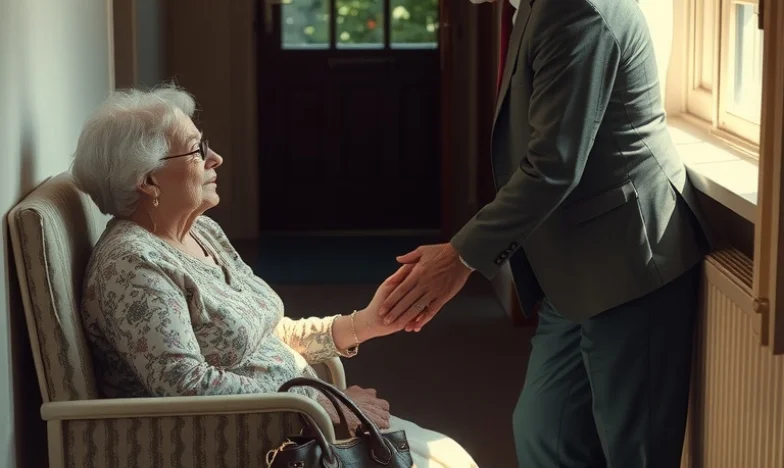
She reached out, her hand trembling. I took it, holding on as if I’d never let go again.
The care assistant stepped back, her eyes wide. Chloe looked from me to Mrs. Harris, realisation dawning.
‘We need to talk,’ I said, my voice shaking.
We sat together in her small room, the afternoon light slanting through the window. I tried to piece together the missing years, but Mum’s memory was patchy. She’d suffered a breakdown, she said, after Dad’s death. She’d wandered, lost, until someone found her and brought her here. She’d taken her mother’s maiden name—Harris—because she couldn’t remember her own.
‘Why didn’t you come back?’ I asked, my voice raw.
She shook her head, tears streaming down her face. ‘I wanted to. But I was so confused. Everything was a blur. I’m so sorry, Karl. I never meant to leave you.’
I held her hand, feeling the years slip away. ‘It’s all right, Mum. You’re here now. That’s all that matters.’
But it wasn’t all right. Not really. I’d built my life on the foundation of her absence—driven, ambitious, desperate to prove myself. I’d married, divorced, thrown myself into work. Emily had drifted away, unable to cope with the family’s silence. Now, with Mum back, everything felt uncertain.
I called Emily that night. ‘You need to come. It’s Mum. She’s alive.’
There was a long silence. ‘Don’t joke, Karl. That’s not funny.’
‘I’m not joking. She’s here. At Rosewood. Please, Em. She needs us.’
Emily arrived the next day, her face pale, eyes red-rimmed. When she saw Mum, she broke down, sobbing in her arms. The three of us sat together, talking, crying, trying to bridge the gap of thirty lost years.
But the reunion wasn’t easy. Old wounds reopened. Emily blamed me for not searching harder. I blamed myself for not protecting her. Mum blamed herself for everything.
One evening, as I sat with Mum, she took my hand. ‘You’ve done well for yourself, Karl. But you look so tired. Are you happy?’
I hesitated. ‘I don’t know. I thought I was. But now… I’m not sure.’
She smiled sadly. ‘Money can’t fix everything, love. Sometimes, all we need is each other.’
Her words haunted me. I’d spent my life chasing success, thinking it would fill the void she left. But sitting with her, I realised how empty it all felt.
I started visiting Rosewood every day, bringing flowers, books, little treats. I got to know the other residents, listened to their stories. I funded new activities, better meals, a garden for them to enjoy. For the first time, I felt like I was making a real difference.
Emily and I began to heal, slowly. We talked about Dad, about our childhood, about the pain we’d both carried. Mum’s health was fragile, but her spirit was strong. She told us stories, sang old songs, held our hands as if afraid we’d disappear again.
One afternoon, as we sat in the garden, Mum looked at me, her eyes clear. ‘Promise me you’ll look after your sister. And yourself. Don’t let the past steal your future.’
I nodded, tears in my eyes. ‘I promise, Mum.’
When she passed away a few months later, it was peaceful. Emily and I were by her side, holding her hands. We buried her in the old churchyard, beneath a yew tree, her favourite spot as a girl.
After the funeral, Emily and I stood together, the rain falling softly. ‘Do you think she knew how much we loved her?’ Emily asked.
I looked at the grave, at the flowers we’d laid. ‘I hope so. I think she did.’
Now, as I walk through the corridors of Rosewood, I see echoes of my mother everywhere. In the laughter of the residents, in the kindness of the staff, in the quiet moments of connection. I still have my business, my wealth. But I know now that the real riches in life are the people we love, the time we share, the forgiveness we find.
Sometimes I wonder—if I hadn’t come here that day, would I ever have found her? Would I have found myself? Or would I still be chasing shadows, trying to buy back what was lost?
What would you do, if you were given a second chance to put things right? Would you take it, no matter how much it hurt?