A Puddle, a Forklift, and a Slice of Cheesecake: The Night Everything Changed

“Did you ever think, Kasia, that life could change in a blink?” Gran’s voice was soft, her hands curled around her chipped mug, steam rising between us. The kitchen was warm, the air thick with the scent of baked cheesecake and the faint tang of lemon. Rain battered the window, a steady, relentless drumming that made the world outside seem impossibly far away. I smiled, tucking my knees beneath me on the old wooden chair. “You’re being dramatic, Gran. It’s just another Tuesday.”
She gave me that look – the one that said she’d seen more Tuesdays than I could count, and each one had its own story. “You’ll see, love. Sometimes, it’s the smallest thing. A puddle, a knock at the door, a word you can’t take back.”
I laughed, but before I could reply, a sharp screech cut through the rain. We both froze. The sound was wrong – metal on tarmac, a guttural grind that made my skin prickle. Gran’s eyes widened. “What on earth…?”
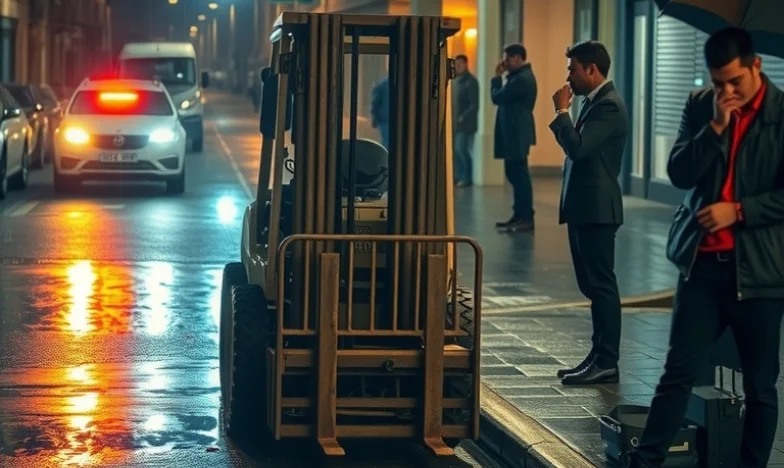
I was already on my feet, cheesecake forgotten. I darted to the window, peering through the condensation. The street outside was slick with rain, the orange glow of the streetlamp reflecting in a wide, shimmering puddle. And there, right in the middle of it, was a forklift – a bloody forklift – its forks skewed at an odd angle, the driver’s cab empty. Our neighbour, Mr. Patel, stood on the pavement, hands on his head, shouting into his mobile. A crowd was gathering, umbrellas bobbing like mushrooms in the downpour.
“Stay here, Gran,” I said, grabbing my coat. She didn’t argue, just watched me with that same, knowing look. I dashed outside, the cold rain soaking through my trainers in seconds. My heart thudded as I pushed through the crowd. The forklift had skidded, its wheels half-submerged in the puddle, and it had smashed into the side of Mrs. McCarthy’s old Fiesta. She was out there too, her face pale, clutching her shopping bag to her chest.
“What happened?” I asked, but no one seemed to know. Mr. Patel was still shouting, his voice rising above the rain. “It just slid! I swear, I was parked, and then it moved – like it had a mind of its own!”
The police arrived, blue lights flashing, and soon the street was cordoned off. I shivered, watching as they questioned everyone, their notebooks getting soggy in the rain. Mrs. McCarthy was crying now, and someone had draped a blanket over her shoulders. The forklift driver, a young lad from the warehouse up the road, was sitting on the kerb, head in his hands. I recognised him – Jamie, who used to play football with my brother.
I went back inside, dripping water onto the kitchen tiles. Gran was waiting, her face tight with worry. “Is everyone alright?”
“Mostly. Just shaken. Mrs. McCarthy’s car is wrecked, though. And Jamie – he looks like he’s about to be sick.”
Gran sighed, pushing a plate of cheesecake towards me. “Eat, love. There’s nothing you can do now.”
But I couldn’t eat. My mind was racing. What if Jamie lost his job? What if Mrs. McCarthy couldn’t get to her doctor’s appointments now? The accident was small, in the grand scheme of things, but it felt like a stone dropped in a pond – the ripples spreading out, touching everyone.
That night, as the rain eased and the street emptied, I sat with Gran in the kitchen. She told me stories – about the war, about rationing, about the time she’d nearly missed her own wedding because of a broken-down bus. “Life’s full of accidents, Kasia. Some big, some small. It’s how you pick up the pieces that matters.”
I nodded, but I wasn’t sure I believed her. The next morning, the street was eerily quiet. The forklift was gone, but the gouges in the tarmac remained, and Mrs. McCarthy’s Fiesta was a crumpled mess. I saw Jamie, shoulders hunched, talking to his boss outside the warehouse. I wanted to go to him, to say something – but what could I say?
Days passed. The accident became the talk of the street. Some blamed Jamie, others blamed the council for not fixing the potholes. Mrs. McCarthy’s daughter started a petition for better road maintenance. Gran baked a cake and took it round to Jamie’s mum. “He’s a good lad,” she said, when she came back. “Just unlucky.”
But the real change came quietly. Jamie lost his job. The warehouse said it was ‘health and safety’, but everyone knew it was about the insurance. He started hanging around the park, smoking with the older lads. Mrs. McCarthy, who’d always been fiercely independent, now relied on lifts from neighbours. The street felt different – tense, uncertain, as if we were all waiting for the next accident.
One evening, I found Jamie sitting on the swings, staring at the ground. I hesitated, then sat beside him. “It wasn’t your fault, you know.”
He shrugged, not meeting my eyes. “Doesn’t matter. They needed someone to blame.”
We sat in silence, the air thick with things unsaid. Finally, he spoke. “I just wanted to help. Mum’s been struggling since Dad left. The job was all I had.”
I wanted to tell him it would get better, but the words felt hollow. Instead, I listened. Sometimes, that’s all you can do.
Back at home, Gran was waiting. She poured me a cup of tea, her hands steady despite the tremor in her fingers. “You can’t fix everything, love. But you can be kind. That’s enough.”
Weeks turned into months. The street slowly healed. Jamie found work at a garage, Mrs. McCarthy got a mobility scooter, and the council finally filled in the potholes. Life went on, but I never forgot that night – the rain, the screech of metal, the way everything changed in an instant.
Now, as I sit in this kitchen, the same old table between us, I wonder: do we ever really see the turning points coming? Or do we only recognise them in the rear-view mirror, when the rain has stopped and the world is quiet again?
What would you have done, if you’d been there that night? Would you have rushed out, or stayed safe inside? Do we ever really know what we’re capable of, until fate gives us no choice at all?